
- A new Energy Department report warns that, in a time of rising demand for electricity, the U.S. can’t keep retiring natural gas and coal plants and replacing them with wind and solar without dire consequences.
- Sen. McCormick’s energy summit attracts a star-studded cast of government and industry officials and $90 billion in energy investment for Pennsylvania.
- Resource adequacy is on the agenda at meetings in Boston, where state utility regulators will be meeting with FERC officials.
- President Trump makes another nomination to fill out the Federal Energy Regulatory Commission.
- Can North Carolina provide the power to support massive corporate investments in AI and other high technology? The state schedules a technical conference to meet the challenge.
- Spurred by the White House and Supreme Court, FERC moves to streamline the process to get energy infrastructure up and running.
- A new Executive Order seeks to block subsidies that encourage non-dispatchable energy sources to displace natural gas and coal.
‘The Status Quo Is Unsustainable,’ Says a New Energy Dept. Report, Arguing That the U.S. Can’t Keep Shuttering Gas and Coal Plants
On July 7, the U.S. Department of Energy released a report that evaluated the state of grid reliability. The results were alarming: “Blackouts could increase by 100 times in 2030 if the U.S. continues to shutter reliable power sources and fails to add additional firm capacity.”
DOE’s methodology found that the “average Loss of Load Hours [LOLH) could jump from 8.1 annually to 817.7 under some scenarios.” In a year of extreme weather, the LOLH could rise from a previous average of 50 hours to 1,316.
The report said bluntly that “the status quo is unsustainable…. If current retirement schedules and incremental additions remain unchanged, most regions will face unacceptable reliability risks within five years, and the Nation’s electrical power grid will be unable to meet expected demand for AI, data centers, manufacturing and industrialization while keeping the cost of living low for all Americans.
The U.S. cannot maintain the current trend of “more generation retirements and less dependable replacement generation,” said the report. Such a policy “is neither consistent with winning the AI race and ensuring affordable energy for all Americans, nor with continued grid reliability.”
The July 7 report, titled “Strengthening Grid Reliability and Security,” pointed to a double-barreled supply problem: first, 104 gigawatts (GW) of fossil-fuel plant retirements are scheduled by 2030. Second, the 209 GW of new generation over the next five years will come almost entirely from wind and solar, which are non-dispatchable sources.
In March, the U.S., for the first time in history, generated less than half of its electricity from fossil fuels. Below is a forecast by the U.S. Energy Information Administration (EIA) of additions to U.S. electricity-generating capacity this year. Wind and solar outstrip natural gas by about 10 to 1.
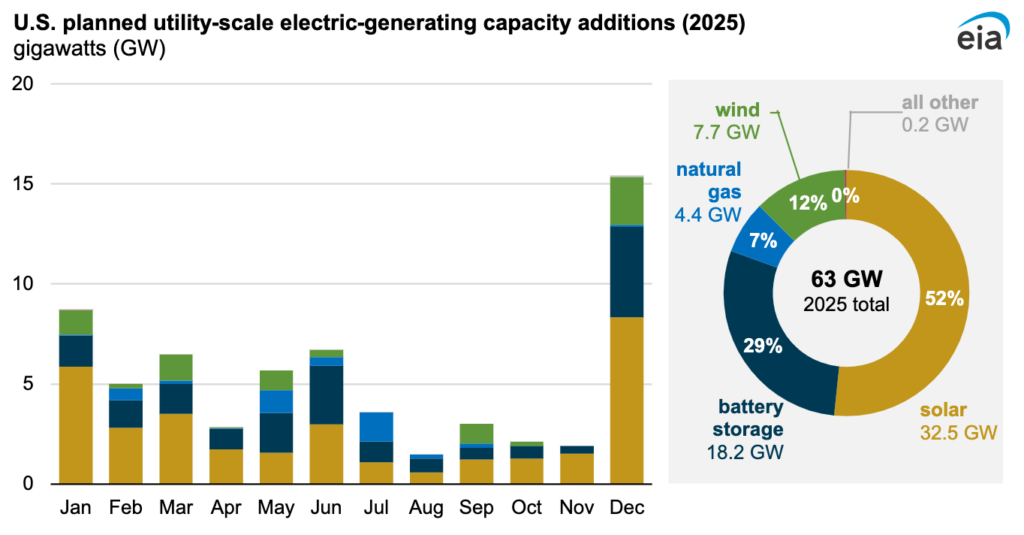
Losing the generation provided by natural gas and coal plants without dispatchable replacements, said the report, “could lead to significant outages when weather conditions do not accommodate wind and solar generation. In the ‘plant closures’ scenario of this analysis, annual loss of load hours (LOLH) increased by a factor of a hundred.”
Said Energy Secretary Chris Wright:
This report affirms what we already know: The United States cannot afford to continue down the unstable and dangerous path of energy subtraction previous leaders pursued, forcing the closure of baseload power sources like coal and natural gas. In the coming years, America’s reindustrialization and the AI race will require a significantly larger supply of around-the-clock, reliable, and uninterrupted power. President Trump’s administration is committed to advancing a strategy of energy addition, and supporting all forms of energy that are affordable, reliable, and secure.
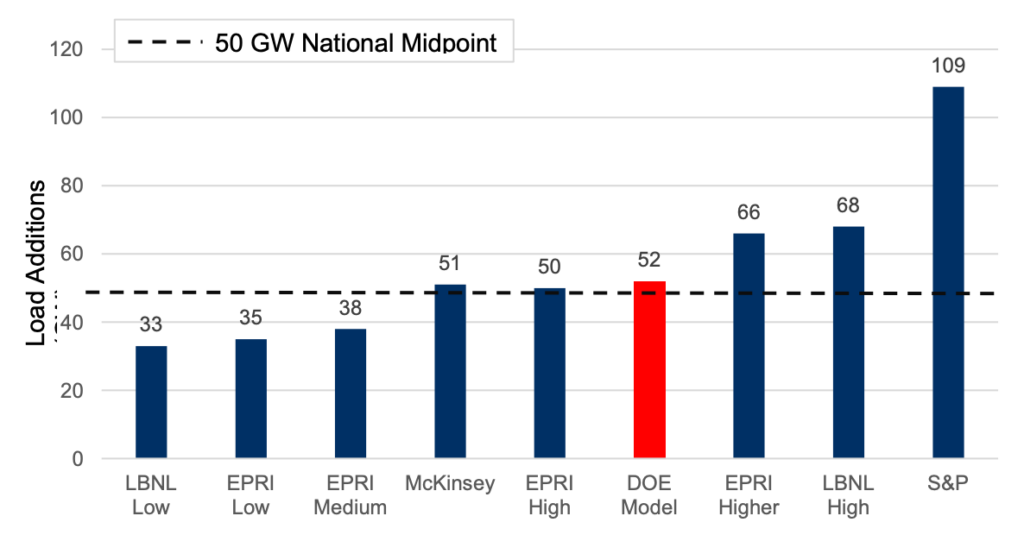
A Fact Sheet summarizing the report said that “load growth is accelerating at a rate not seen in decades.” The report “estimated that 100 GW of new peak-hour supply is needed by 2030, with about half of that attributable to data centers.” Those data centers themselves “can be built in 18 months, but it takes more than three times as long to add new generation required to service those data centers to the grid.” As a result of rising demand, even if there are no plant retirements, the outage risk in several regions will rise 30-fold.
Below are estimates from different sources of the additional load in megawatts needed to meet data center growth between 2024 and 2030.
The Fact Sheet cited a March 25 hearing before the House Energy and Commerce Subcommittee on Energy, where top grid officials “testified that the U.S. power system is under mounting strain—and without urgent reform, their ability to maintain reliable electric service will fail.”
At that hearing, Rep. Bob Latta (R-Ohio), the subcommittee chair, set the tone by stating that “too many electric-generating facilities have been retired in recent years while new and emerging technologies are increasing the need. It is critical that we meet the growing demand for power, the need to secure it, and address the reliability challenges confronting our electric industry.”
Issue No. 47 of this newsletter reported on that hearing as well as on the June 5 technical conference on resource adequacy sponsored by the Federal Energy Regulatory Commission (NERC), also cited in the DOE report. At that conference, leaders of the North American Electric Reliability Council (NERC) “testified that mounting resource adequacy challenges are elevating the outage risk profile across a broad swath of North America, leaving few areas untouched.”
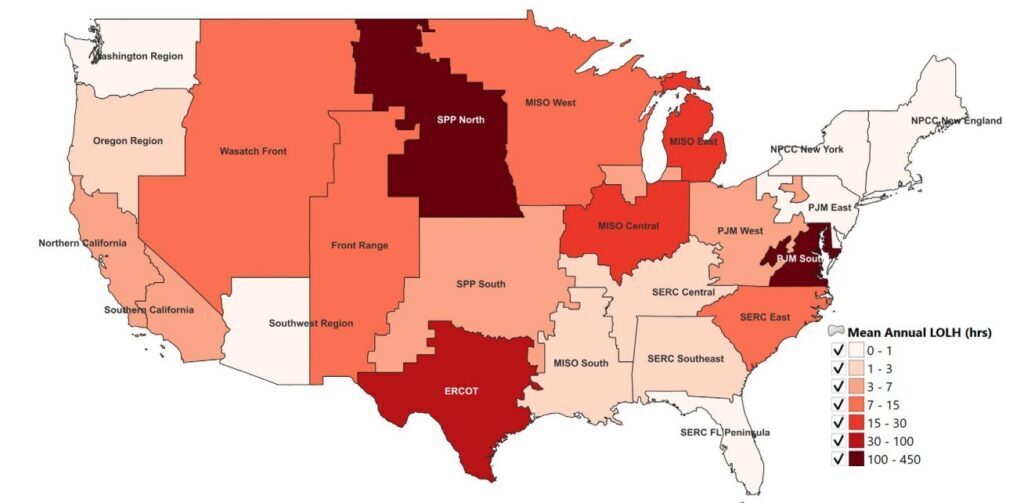
The DOE study predicts that nearly all sections of the country will be significantly affected by insufficient capacity to prevent a loss of load during peak hours. Hardest hit will be Texas, North Carolina (see below), South Carolina, much of the upper Midwest and Plains states, and parts of Virginia and Maryland. (Least affected are New England, New York, eastern Pennsylvania, Florida, and Washington state). The map below shows the extent of loss of load hours (LOLH) across the country, assuming plant closures happen as scheduled.
The findings were similar to those of NERC in its Summer Reliability Assessment, which found much of the U.S. at “elevated risk” for power shortages and outages between June and September. As the Washington Post reported on May 14:
The seasonal electricity forecast warns that regional power grids extending from the Upper Midwest south through Texas may lack the power needed to meet all customer needs in the event of prolonged periods of high temperatures.
The July 7 DOE report included a uniform methodology to identify regions at risk of power outages and guide federal reliability interventions. But, reported Utility Dive, “clean energy advocates say the methodology appears to exaggerate the risks, and undercount the contributions of wind, solar and battery storage resources.”
Caitlin Marquis, managing director at Advanced Energy United, a trade association whose members include Microsoft and NRG Energy, was quoted as saying, “If the analysis is overly pessimistic about advanced energy technologies and the future of the grid, consumers will end up paying too much for resources we no longer need.”
The DOE report came in response to President Trump’s Executive Order of April 8, which instructed the Secretary of Energy to find regions at risk of power outages and shortfalls and establish “a protocol to identify which generation resources within a region are critical to system reliability.”
An earlier Executive Order, issued on Jan. 20, said:
We need a reliable, diversified, and affordable supply of energy to drive our Nation’s manufacturing, transportation, agriculture, and defense industries, and to sustain the basics of modern life and military preparedness.
The order blamed the crisis on “the harmful and shortsighted policies of the previous administration” and said that “our Nation’s inadequate energy supply and infrastructure causes and makes worse the high energy prices that devastate Americans, particularly those living on low- and fixed-incomes.”
In that same vein, and with respect to the retirement of coal plants, America’s Power president and CEO Michelle Bloodworth wrote in a statement:
This report from the Department of Energy is further proof that the premature retirement of coal plants is putting the reliability of the U.S. electricity grid at risk. The Department of Energy’s report concludes that the aggressive regulatory agenda pursued under previous administrations would leave millions of American homes and businesses more vulnerable to blackouts because baseload power sources like coal are being replaced by less reliable sources like wind and solar. These renewables are not capable of meeting the constant 24/7 electricity demands required for AI, data centers, and other advanced technologies…This aggressive retirement of coal plants is happening too quickly and will leave America without dependable replacement power. This will damage the American economy, harm our national security, and undermine our ability to compete with nations like China.
Sen. McCormick’s Pennsylvania Energy Summit Draws a Star-Studded Cast and Billions in Pledges of Energy Investment
Sen. David McCormick (R-PA) convened a July 15 summit that brought some of the nation’s top policymakers together at Carnegie Mellon University in Pittsburgh to discuss Pennsylvania’s emergence as a hub for Artificial Intelligence and energy technology.
Among the attendees: President Donald Trump, Pennsylvania Democratic Gov. Josh Shapiro, Energy Secretary Chris Wright, Commerce Secretary Howard Lutnick, Interior Secretary Doug Burgum, Treasury Secretary Scott Bessent, and White House Artificial Intelligence czar David Sacks. Also present: CEOs from Google, Meta, Amazon Web Services, Microsoft and Open AI, as well as oil and gas CEOs and Blackstone’s Jonathan Gray, BlackRock’s Larry Fink, and Softbank’s Masayoshi Son.
Sen. McCormick’s office issued a Fact Sheet stating:
At this first-of-its-kind summit, companies announced over $90 billion of investments in data centers, energy and power infrastructure, and workforce and AI training projects. These commitments will create tens of thousands of construction jobs and thousands of permanent jobs, signaling Pennsylvania’s readiness to power the AI and energy revolution, further strengthening America’s resilience and independence.
Among the announcements was a $25 billion investment by Blackstone, in a joint venture with the utility PPL to build data center and energy infrastructure in Northeast Pennsylvania, a project expected to create 3,000 new permanent jobs and catalyze an additional $60 billion in private capital. Also announced: $400 million from TC Energy to modernize its gas pipeline network in the state, $3.2 billion from Frontier Group to transform a coal power plant into a natural gas power station, and a $3 billion deal from Google and Brookfield to re-power two hydroelectric facilities, generating 670 MW of power.
In addition, Constellation Energy said it will create 3,000 jobs per year through a $2.4 billion investment to upgrade the Limerick, Pa., nuclear power plant, which will add 340 MW in power capacity. CoreWeave announced a $6 billion investment to develop a data center in Lancaster that will require 300 MW of power. And Energy Capital Partners will invest $5 billion in a plan to develop a data center in York. Energy Capital Partners plans to develop 51 community solar projects designed to power 24,000 homes.
The summit focused heavily on natural gas (Pennsylvania is the number-two producing state after Texas) and coal (number three after Wyoming and West Virginia), as well as nuclear energy. Trump and Commerce Secretary Howard Lutnick emphasized the need to embrace “clean, beautiful coal,” as well as natural gas and nuclear.
Trump said he is speeding up permitting (see above) and making it easier for data centers to connect to the grid, Axios reported. “The President’s remarks again promoted building new generating facilities that directly supply data centers instead of feeding power grids, calling it a faster approach.”
Meanwhile, Brendan Bechtel, CEO of the engineering and construction giant Bechtel, urged bipartisan legislative reform to streamline energy projects and make permitting laws more efficient (see above).
An irony also hung over the Pennsylvania gathering. As we reported in Issue No. 48 of this newsletter, the Trump Administration’s Federal Trade Commission and Department of Justice in May filed a “statement of interest” backing a lawsuit seeking to force large asset management firms to divest their holdings in the coal industry. And, as evidenced by the first section of this very newsletter, the coal industry can hardly afford to lose any of the necessary capital that’s been invested into the sector.
The administration has taken the side of several states, led by Texas Attorney General Ken Paxton, in alleging “that BlackRock, State Street, and Vanguard engaged in an anticompetitive conspiracy to drive down coal production as part of an industry-wide ‘Net Zero’ initiative to further anti-coal Environmental, Social, and Governance (ESG) goals,” according to a May 22 FTC press release, which continued:
BlackRock, State Street, and Vanguard allegedly exercised their influence as shareholders in competing coal companies to push them to reduce industrywide coal output. The multistate lawsuit alleges that these actions…increased coal prices and forced American consumers to pay more for energy as part of an unlawful left-wing ideological scheme.
The “anti-woke lawsuit may unintentionally threaten Trump’s coal revival agenda,” said the headline on a June 18 Fox News opinion piece by Pinar Cebi Wilber, chief economist of the American Council for Capital Formation.
Wrote Wilber: “By forcing Vanguard, BlackRock, and State Street to fully divest from their holdings, the coal industry would lose nearly $18 billion ($17.9B) in capital – severely undermining President Trump’s goal to revive the American coal industry.”
The irony is that, given the DOE report and other dire warnings, this action against coal could make powering data centers, especially in a state like Pennsylvania, a good deal harder. If the status quo is unsustainable, as the DOE report illustrates, then more capital is needed across the board, and especially for the coal industry—not billions less.
State Utility Regulators and FERC Officials Meet in Boston With Resource Adequacy and RTO Governance Issues on the Agenda
The National Association of Regulatory Utility Commissioners (NARUC), representing state utility regulators, is holding its Summer Policy Summit July 27-30 in Boston. Featured speakers include Environmental Protection Agency Administrator Lee Zeldin; James Danly, deputy secretary of Energy; Peter Lake, senior director of power at the White House National Energy Dominance Council; and the four sitting members of FERC.
The conference opens with a session on “Resilience in Practice,” which is described this way:
Growing demand for and dependence on electricity, coupled with increases in the frequency and severity of extreme weather events, is challenging the reliability of the grid. And while grid resilience is a newer concern, reliability and resilience are interconnected. Resilience investments often enhance reliability, as the same system hardening or modernization efforts that improve recovery capabilities also reduce the frequency of interruptions.
That theme will also resonate when, on July 27 in Boston, FERC convenes its third joint NARUC-FERC Federal and State Current Issues Collaborative Meeting between federal and state officials on current threats to the grid.
“The overarching topic” for the collaborative session, said FERC, will be the “the States’ Role in Regional Transmission Organization (RTO) Governance, including on resource adequacy issues.”
NARUC has been an advocate for federal funding of advanced transmission technologies as a means of getting more out of the current grid. In a resolution in November, NARUC’s board stated:
The federal government, states, and industry can work together to accelerate the use of these new innovative technologies to affordably expand the transmission capacity needed to maintain reliability and meet growing electricity demand.
The NARUC board said at the time there are potential ratepayer benefits from the “holistic deployment” of advanced transmission technologies, reported Utility Dive.
Trump Nominates Another FERC Commissioner to Fill out the Board
As the FERC meeting approached, President Trump announced another nominee as a FERC commissioner: David LaCerte, now an official of the U.S. Office of Personnel Management. If confirmed, LaCerte will fill the seat of Willie Phillips, a Democrat who once headed the commission and resigned earlier this year.
The term for the seat Phillips held expires on June 30, 2026. The LaCerte nomination was received July 16 by the Senate Committee on Environment and Natural Resources.
LaCerte, a New Orleans lawyer, served as the Trump administration’s acting managing director at the U.S. Chemical Safety and Hazard Investigation Board during first term. He is a veteran of the Marine Corps infantry with decorations that include two Bronze Stars and the Afghanistan Campaign Medal.
As we reported in Issue No. 49 of this newsletter, President Trump announced June 2 that he was nominating Laura Swett to replace Republican Mark Christie as chairman of FERC.
Swett is an attorney at the law firm Vinson & Elkins, where her profile says her “principal areas of practice are federal and state energy and regulatory litigation,” representing pipelines and electric power companies before FERC.
No date has been set for hearings for Swett and LaCerte. If they are confirmed, Republicans will have a 3-2 majority on the commission, which is now split, 2-2.
As a Data Center Hub, North Carolina Announces a Technical Conference to Meet Rising Demands for Electricity
Individual states are feeling the pinch as demand for electricity increases. One of them is North Carolina, among the states pinpointed by the Department of Energy’s report on energy shortfalls coming in 2030 (see above).
To address “growing reliability concerns related to large electric load integration,” the North Carolina Utilities Commission recently announced a technical conference on October 14. In its order, the commission pointed to NERC’s analyses last fall of more than two dozen voltage-sensitive load-loss events related to data centers and cryptocurrency mines in the Mid-Atlantic and Texas.
North Carolina ranks eighth among the states in electricity consumption, and utility rates for households, businesses and industry are well below U.S. averages. With its wealth of universities and technology companies, the state is becoming an increasingly important market for the growth of data centers.
Hitachi Energy, a Japanese data center support company, has its North American headquarters on North Carolina State University’s campus, and Microsoft, Meta and Google have all announced projects in and around Raleigh and Charlotte. In addition, Amazon said last month that it would invest $10 billion in the state “to expand cloud computing infrastructure and advance AI innovation.”

The commission, whose May Large Electric Load Report explained that there is “rapid and unprecedented large customer load growth” occurring in North Carolina due to economic development, asked utilities to provide updates on negotiations with data centers and other customers that require significant electricity. The state needs information on back-up generation, co-location with energy-producing facilities and “measures that will need to be implemented to ensure grid reliability and fair cost to customers.”
Duke Energy last month updated its periodic large electric load forecast to 5.9 GW by 2035, an increase of nearly 2 GW from 12 months earlier.
Utility Dive reported on July 7:
While the total number of potential large load customers in advanced development stayed roughly the same from 2024, Duke’s May forecast shows a nearly 50% jump in expected future wholesale loads due to an increase in average project capacity…. Of 35 projects in advanced development, nine projects totaling 540 MW have executed energy service agreements and 22 projects totaling 4,669 MW have executed letters of intent to interconnect.
North Carolina utilities have to find ways to satisfy new technology customers and keep rates down for households at the same time they are trying to meet legislative mandates, passed in 2021, for 70% carbon-neutral electricity by 2030 and 100% by 2050.
The state legislature recently passed a bill that would have eliminated the 70% interim target, but Gov. Josh Stein, a Democrat, vetoed it on July 2, saying that the legislation “walks back our state’s commitment to reduce carbon emissions, sending the wrong signal to businesses that want to be a part of our clean energy economy.”
Stein also said, “As our state continues to grow, we need to diversify our energy portfolio so that we are not overly reliant on natural gas and its volatile fuel markets.” In fact, natural gas prices have moved in the right direction for consumers and businesses, falling by more than half since the summer of 2022.
According to the U.S. Energy Information Administration, “North Carolina ranks among the bottom one-third of states with the lowest gas use per capita, even though natural gas use for electricity generation in the state has more than doubled in the past decade.” The state uses more natural gas than any other energy resource.
Responding to Presidential Orders and a Court Decision, FERC Moves to Streamline Permitting for Energy Infrastructure
On June 30, FERC unanimously voted to adopt a new, 18-page staff guidance manual on how to implement the National Environmental Policy Act (NEPA) following President Trump’s Executive Order titled “Unleashing American Energy,” issued on the first day of his second term.
As part of Section 5 of the order, “Unleashing Energy Dominance Through Efficient Permitting,” Trump called on the Council on Environmental Quality (CEQ) to “expedite and simplify the permitting process” by rescinding certain NEPA regulations.
The new manual says its purpose is to set “forth the procedures and practices Commission staff will follow to fulfill its requirements under NEPA. It further explains Commission staff’s interpretation of key concepts in NEPA that are used in preparing environmental documents.”
The Trump policy received a big boost on May 29 when the U.S. Supreme Court reversed an appellate ruling and decided that NEPA should be read as providing guidelines, not hard-and-fast rules. “Simply stated, NEPA is a procedural cross-check, not a substantive roadblock,” Associate Justice Brett Kavanaugh wrote in the court’s opinion in a case involving a crude-carrying railroad in the Uinta Basin of Utah. “The goal of the law is to inform agency decision-making, not to paralyze it.”
A year earlier, reported Hart Energy, “the U.S. Court of Appeals, D.C. Circuit ordered energy projects from Texas to New Jersey to stop, ruling that the projects had violated” NEPA permitting standards. But the Supreme Court ruled, 8-0, that the lower court had overstepped. Said Hart Energy:
NEPA requires companies to create an environmental impact statement (EIS) for major projects. The reports include the potential results of the project on air, water quality and other issues, and often run over 1,000 pages. The report from the seven Utah counties that proposed a new crude transport railway out of the Uinta Basin totaled more than 3,600 pages.
The Trump order and the court ruling enabled FERC to implement revisions to the environmental review process at a fast pace. “We will continue to ensure our environmental reviews are legally durable, so projects stand up in court and get built,” said FERC Chairman Mark Christie. “Thanks to the leadership of President Trump, our new staff guidance on NEPA will inform all interested parties on our process and should be a useful tool in making the permitting process more efficient and transparent.”
The current permitting regime is a big reason it takes so long to build new energy infrastructure and modernize the grid to meet the rising demand for electric power. Reforming the system has long been an elusive goal in Washington. Proposals have stalled, endangering national energy security and making the grid less reliable.
The Energy Permitting Reform Act of 2024, a bill sponsored by Sen. Joe Manchin (I-WV), then the chairman of the Energy and Natural Resources Committee, and Sen. John Barrasso (R-WY), who was ranking member, never came to a vote on the floor. It would have streamlined the process and brought projects online quicker. Among the reforms: making it harder to file lawsuits to stop infrastructure construction and making it easier to get permits to build interstate transmission lines.
In further actions to streamline construction, FERC on June 18 voted unanimously to waive the operations of FERC Order 871 and seek its ultimate repeal “to avoid delaying natural gas infrastructure projects that FERC has found are needed.” FERC also unanimously voted to raise the threshold above which natural gas facility owners have to seek a FERC permit to add or improve their facilities.
The Trump Administration is also trying to bring about reform through new rules that will speed environmental analyses so projects can meet the two-year statutory deadline for completing impact statements. Further reforms will cut down on FERC’s internal workload, reduce backlogs and accelerate review times. The idea is to boost interagency coordination to unleash American energy.
Ending Subsidies for Renewables That Displace ‘Reliable, Dispatchable Domestic Energy Sources’
Three days after the July Fourth signing of the reconciliation bill (the One Big Beautiful Bill, or BBB), President Trump issued an Executive Order titled, “Ending Market Distorting Subsidies For Unreliable, Foreign Controlled Energy Sources.”
The order’s goals were to: “(a) rapidly eliminate the market distortions and costs imposed on taxpayers by so-called ‘green’ energy subsidies; (b) build upon and strengthen the repeal of, and modifications to, wind, solar, and other ‘green’ energy tax credits in the One Big Beautiful Bill Act; and c) end taxpayer support for unaffordable and unreliable ‘green’ energy sources and supply chains built in, and controlled by, foreign adversaries.” According to the order:
The proliferation of these projects displaces affordable, reliable, dispatchable domestic energy sources, compromises our electric grid, and denigrates the beauty of our Nation’s natural landscape. Moreover, reliance on so-called “green” subsidies threatens national security by making the United States dependent on supply chains controlled by foreign adversaries.
The order required the Treasury Secretary by mid-August to “strictly enforce the termination of the clean electricity production and investment tax credits under sections 45Y and 48E of the Internal Revenue Code for wind and solar facilities.” The BBB accelerated the phaseout – or termination — of credits for certain renewable energy projects that were enacted in the Inflation Reduction Act passed during the Biden Administration.
The bill also introduced “complex foreign entity of concern (FEOC) rules that make projects owned or controlled by, or that receive ‘material assistance/from, a prohibited foreign entity (PFE) ineligible for certain tax credits,” according to an analysis by the law firm Sidley Austin.
An amendment to the BBB being considered by the Senate also took aim at wind and solar with taxes ranging from 30% to 50%, but the taxes were eliminated in the final version after opposition from Republican Sens. Chuck Grassley and Joni Ernst, both of Iowa, a state that generates 60% of its electricity from wind. In a press release announcing his success in killing the amendment, Grassley stated that he “successfully got the wind energy industry off the ground by instituting America’s first-ever federal wind energy tax credit in 1993, earning him recognition as the ‘father’ of wind energy production.”
President Trump’s order also required the Secretary of the Interior to “conduct a review of regulations, guidance, policies, and …to determine whether any provide preferential treatment to wind and solar facilities in comparison to dispatchable energy sources.”
The U.S. is rapidly adding capacity from wind and solar, which in 2024 accounted for 27% of electricity generation, up from 21% the year before. In Texas over the last four years, more than 90% of additional capacity came from renewable sources, according to the Federal Reserve Bank of Dallas.
The Trump Administration, however, worries that wind and solar cannot be dispatched immediately to meet peak-power demands (see above). In addition, solar output can be reduced by weather events and natural deterioration, according to a 2024 National Renewable Energy Laboratory report on weather and solar system performance.
There is concern as well that poor integration of solar and wind into the grid can trigger dangerous blackouts. As we reported in Issue No. 48 of this newsletter, a major blackout on the Iberian Peninsula on April 28 caused Spain to lose nearly 60% of its power supply in seconds.
In a headline, E&E News called the blackout “a warning sign for [the] U.S. grid,” which is straining under the weight of increased demand for electricity. Spain’s grid is heavily based on wind and solar. E&E’s Peter Behr wrote:
While the U.S. system is fundamentally different, grids that serve Texas, California, Florida, Iowa and Great Plains states also manage relatively high levels of renewable penetration. Still, the shift from traditional power generators to solar, wind and batteries has made it harder — but not impossible — for high-voltage grids to absorb sudden disruptions.
The U.S. has not had an event of the Iberian scale in recent years, but California’s energy policies have thrust the issue of wind and solar reliability and cost to the forefront. According to the EIA, California this year will generate an estimated 4 million megawatts (MW) of electric power from natural gas, 3 million MW from hydro, and 8 million MW from other renewables, mainly wind and solar.
California electricity rates have surged dramatically in recent years, from about a third higher than the national average in 2015 to over 80% higher in 2024, according to the Public Policy Institute of California. The state has aggressively pursued greenhouse gas (GHG) reduction policies and offered robust cost‑reduction subsidies for rooftop solar customers, according to California’s Legislative Analyst Office.
Along with high utility prices, California has had a long history of rolling blackouts, and rising energy demand in coming years creates a precarious situation for the state’s policy makers as they try to navigate the energy limitations they have imposed to get to a goal of carbon neutrality by 2045. And to make matters worse, the state will fall 21.1 percent short of the electricity required to meet the state’s 100 percent electric vehicle mandates
The Department of Energy’s July resource adequacy report (see above) assessed that, if scheduled plant closures occur, California will face “substantial shortfalls, particularly during summer evening hours when solar output declines. Average LOLH [loss of load hours] reached 7 hours per year, and the worst-case year showed load shed events affecting up to 31% of demand. The NUSE [normalized unserved energy, a measure of the extent of outages] exceeded reliability thresholds, signaling the system’s vulnerability to high load and low renewable output periods.”
Like the BBB itself, President Trump’s Executive Order is an attempt to prioritize fossil fuels as more reliable than wind and solar at a time when natural gas and coal plants are being retired and states like California and Texas are turning more toward renewables.