
- Voters in New York want to ease the way for natural gas pipelines, and, with affordability and reliability ranking high in a survey, Gov. Hochul seems to be responding.
- At FERC’s big technical conference on resource adequacy, industry experts worry that energy capacity is not adequate for the challenges ahead.
- As the risk of power outages is pushed to “new highs,” policies in many states prioritize solar and wind. But these sources are intermittent, dependent on the weather.
- The middle of the nation faces special dangers from rising demand for electricity and constrained supply.
- EPA proposes to end greenhouse gas emissions standards for the power industry and to revive coal plants by cutting pollution-reduction requirements.
- In a surprise, Laura Swett, a Washington lawyer, is nominated to replace Mark Christie as FERC chair.
New Yorkers Want to Balance Renewables With Natural Gas, and ‘Left-for-Dead’ Pipelines May Be Revived
Even in the blue state of New York, voters oppose the policy of blocking new natural gas pipelines from Pennsylvania to support the regional grid and make electricity more reliable and less expensive.
That was one of the results of a poll released June 9 by a group called Natural Allies for a Clean Energy Future. In the poll, 59% of those surveyed answered in the negative and just 25% in the positive when they were asked:
Six New England states plus New York are facing skyrocketing power bills and reliability risks without new natural gas supplies from Pennsylvania, but they can’t be built across upstate because New York leaders in Albany won’t approve their construction. Do you support or oppose New York’s policy to stop new natural gas supplies that put reliability at risk here in New York as well as in New England?
In addition, 82% of respondents said their utility bills were too high. The most important concerns of New Yorkers when it comes to energy are affordability (82%), reliability (65%), and climate change (42%).
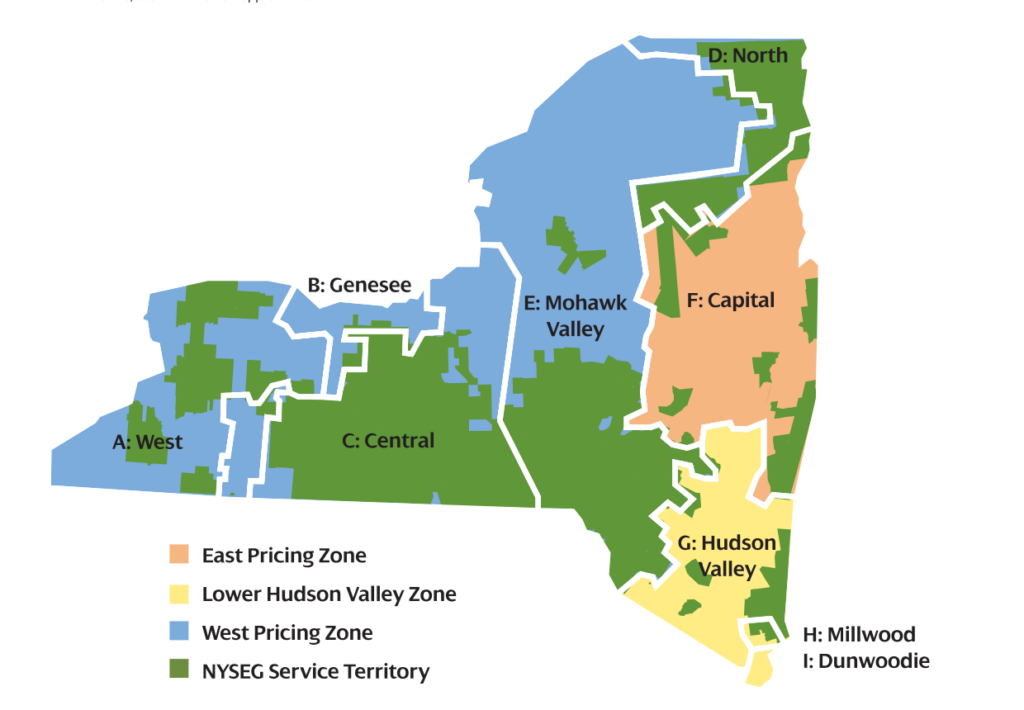
“As energy bills increase across the Northeast in an already uncertain economic environment, it is no surprise that residents care first and foremost about affordable and reliable energy,” said former Philadelphia Mayor Michael Nutter, co-chair of the Leadership Council of the Natural Allies group. (Like Nutter, the three other co-chairs are also Democrats.) Nutter added:
Coming out of the 2024 election, Democrats need to find their way back to common sense policies that put affordability and kitchen table issues first…. Advancing balanced energy policies, that include both renewables and natural gas, is a political winner and key to tackling our energy affordability and climate challenges together.”
In announcing the results, Natural Allies pointed out that New York “Gov. Kathy Hochul has worked in a bipartisan fashion to…restart New York’s offshore wind construction while reconsidering new natural gas infrastructure to support regional reliability and affordability. The survey finds this is a winning issue in New York.”
Polling tested six different policy positions and found that the most popular was “balancing more renewables with more natural gas.” It was backed by 66% of New York voters, including 74% of state Democrats.
As a result of Hochul’s shifted position, “developers of two left-for-dead natural-gas pipeline projects in New York are preparing to file permitting paperwork with federal energy regulators to move forward with the projects, according to people familiar with the matter,” reported the Wall Street Journal on May 28.
In 2020, the New York Department of Environmental Conservation denied permits for the gas pipelines. This April, the new Trump Administration, which is unfriendly to offshore wind, blocked Equinor’s Empire Wind project, 15 to 20 miles off Long Island. The next month, the U.S. Secretary of the Interior, Doug Burgum announced that the administration would lift the stop-work order, saying on X (the former Twitter) that he was “encouraged” that Hochul had expressed her “willingness to move forward on critical pipeline capacity.”
There was, naturally, speculation that Hochul had “agreed to approve natural gas pipelines in exchange for the offshore wind project,” according to the news outlet City & State New York. The Governor “denied that she made any such deal.”
Even if Hochul now decided to support gas pipelines, the outlet reported, “she wouldn’t necessarily be able to wave a magic wand and change the existing climate laws – but a state agency taking a hands-off approach would have a nullifying effect, according to some experts.”
The Governor has not yet confirmed her support for the pipelines, but she must be aware that such backing is politically wise. According to the poll, only 25% of New Yorkers support restricting natural gas from energy-rich western Pennsylvania.
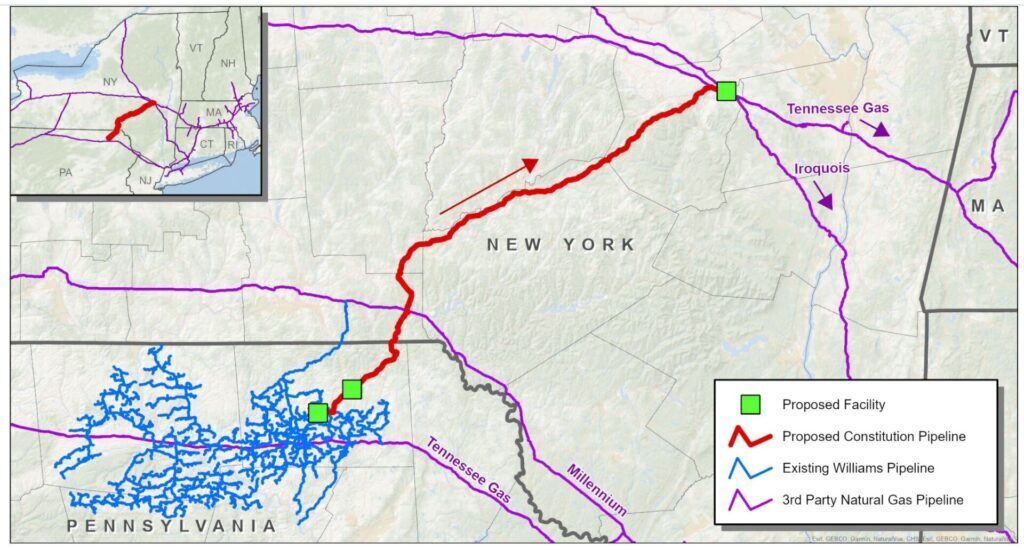
The Journal’s news story presented a chart showing that residential retail natural gas prices have risen since 2020 by about 50% in New England – which, like New York, is a beneficiary of the stalled 121-mile Constitution Pipeline. As the map shows how, it connects with other pipelines going east and taps into the rich Marcellus Shale in Pennsylvania. Those gas prices were the same as the U.S. average in 2021 at $15 per 1,000 cubic feet. Prices in New York are now about $22, compared with a U.S. average that has stayed around $15.
A Hochul policy that threatens to have a seriously depressive effect on energy development is the state’s Climate Change Superfund Act, which she signed Dec. 26. As our Issue No. 45 noted, the act requires energy companies to pay into a fund, eventually reaching $75 billion in order to “bear a proportionate share of the cost of infrastructure investments and other expenses necessary for comprehensive adaptation to the impacts of climate change in New York state.”
New York and Vermont, which passed the first such laws, were sued last month by the U.S. Justice Department and separately by two dozen state attorneys general, led by West Virginia. The DOJ argued that the laws are “a brazen attempt to grab power from the federal government” and force others to pay for the states’ infrastructure spending. The states say a superfund requirement would “fine America’s coal, oil and natural gas suppliers into oblivion.”
If the laws survive the challenges, the cost of energy production will rise, say critics, making electricity less reliable and affordable.
Meanwhile, the HEAT Act is advancing in the New York legislature. The initials stand for Home Energy Affordable Transition. The bill, according to its sponsors, “aligns utility regulation with state climate justice and emission reduction targets.” Specifically, it would curb the expansion of natural gas (ending its use for some customers) and cap utility bills. FingerLakes1.com reported on May 30, that “lawmakers may finally pass New York’s long-stalled HEAT Act…after amending the bill to exclude Western New York — where opposition has slowed progress for years.”
The HEAT Act appears to run counter to the wishes of voters in the entire state. The Natural Allies poll found that natural gas had the highest net positive score of all energy sources, with 63% of respondents saying they have positive feelings and just 14% have negative ones for a net of plus-49%, slightly ahead of solar at plus-46%. By contrast, fuel oil had a net of minus-3% and coal, minus-30%.
An overwhelming majority of New York voters (71%) oppose banning natural gas. They believe consumers should be able to choose the energy source that works best for them.
The support for natural gas is evident in its rising position as the favored fuel source for generating electricity. Gas powers 43% of utility-scale electricity in the U.S., according to the U.S. Energy Information Administration, which reports that the proportion for New York is even higher, at 46% (wind is 4%, solar 5% and hydropower, where New York leads the nation, is 22%, thanks mainly to Niagara Falls).
As the state with the third-largest economy (after California and Texas), New York requires reliable, affordable electricity. It is critical politically as well. In 2024, New York’s swing to the Republican candidate for president was the largest in the nation at 11.5 percentage points. It is hardly a surprise that Gov. Hochul is following popular opinion and beginning to shift her support to policies that will bring New York more natural gas.
FERC’s Big Technical Conference Focuses on ‘Resource Adequacy’: How Do We Build Energy Capacity and Get It Where It’s Needed?
On June 4 and 5, the Federal Energy Regulatory Commission (FERC) hosted a high-level technical conference that focused on the challenge of “resource adequacy,” including the roles of capacity markets in the Regional Transmission Organization (RTO) and Independent System Operator (ISO) regions.
FERC set the stage for the first panel this way:
In recent years, resource retirements, load growth, and the changing resource mix have contributed to resource adequacy challenges across the nation…. According to NERC’s 2024 Long-Term Reliability Assessment, five of the six Commission jurisdictional RTO/ISO regions are at either high or elevated risk of experiencing electricity supply shortfalls.
High risk regions are expected to fall below established resource adequacy criteria in the next five years, while elevated risk regions meet resource adequacy criteria but are likely to experience shortfalls in extreme weather conditions.
Added FERC: The trends that “continue to challenge regions’ abilities to achieve resource adequacy include increasing amounts of large commercial and industrial loads (e.g. data centers); electrification of energy end uses in transportation and building heating/cooling; retirement of baseload generation resources; and slower than anticipated interconnection of new resources.”
The Commission wanted to know the plans of RTOs and ISOs “to address resource adequacy challenges within their RTOs/ISOs in the future as demand grows.”
Utility Dive reported that at the conference, Jim Robb, CEO of North American Reliability Corporation (NERC), which oversees the adequacy of the grid, pointed out that his non-profit has been conducting seasonal and longer-term resource adequacy assessments for decades, but for most of the reliability watchdog’s history “these were some of the dullest reports we ever created.”
That changed in 2018, when NERC’s long-term resource assessment showed a material expectation of unserved energy. In August of 2020, California experienced a significant disruptive event because of a lack of power. “Since then, our analyses have shown a growing risk of unserved energy across the continent,” Robb said. “There are a number of interrelated factors that account for that degradation and risk.”
Leading the list: “disorderly generator retirements.” Also, while several ISO and RTO areas appear to be resource-adequate “through the narrow lens of capacity,” future energy shortfalls “are looming because the resource mix is not supported with the right levels of dispatchable generation with secure fuel to balance supply and demand fluctuations.”
The need for a proper diversity of generation resources was a major theme at the conference. Said Carrie Zalewski, vice president of transmission and electricity markets at American Clean Power:
As we all know, the sun doesn’t always shine, the wind doesn’t always blow, gas pipelines freeze, and there needs to be refueling for nuclear power, so all types of resources have different weaknesses. The good news is that these weaknesses come in different flavors at different times, so in using these weaknesses together in an area like MISO [Midcontinent Independent System Operator], we can really build the most superior grid.
Michelle Bloodworth of America’s Power, an association representing the coal industry, referred to the widespread, controversial blackout in Spain, Portugal and France that we cited in Issue No. 48 as well as to the outage in southeast Louisiana last month.
In the latter event, on the Sunday evening before Memorial Day, MISO directed Entergy, the utility for New Orleans and other parts of the state, “to periodically shut off power” for an estimated 100,000 customers in order to “maintain the reliability of the bulk electric system” – a process termed “load-shedding.”
“The fact that we load-shed because we didn’t have enough transmission and generation to me is very telling,” said Bloodworth. “The problem is only going to get worse, not better, as certainly we all should want to serve the demand centers and growth.”
Transmission and grid upgrades also were a central topic, along with the need to increase interregional transmission and cooperation.
Said Illinois Commerce Commission Chair Doug Scott, “Interregional transmission, I think, is really important… We thought it was important…to ask PJM [the largest RTO] and MISO to look between the seam and see if there are some things that could help in terms of easing some congestion.” Scott acknowledged the “great job” that the Southwest Power Pool, an RTO serving states from Texas to North Dakota, and MISO did working together on the JTIQ (Joint Targeted Interconnection Queue) projects to help alleviate congestion.
Robb, the NERC CEO, called for the design of the grid to be modernized to “reflect the contemporary realities of fuel supply limitations, common condition and common mode failures, and additional complications of load growth.” Renewable Energy World reported that “he emphasized the need for a better understanding of extreme weather risks, a more consistent approach to capacity accreditation, and a more accurate valuation of interregional transfer capability.”
FERC Commissioner Lindsay See took an upbeat approach. “Large load growth is a challenge,” she said, “but it’s an incredible opportunity for us as well. I’m also a firm believer that this is a very good problem for our country to have when it comes to economic development and our position as a country, and the ways that building out the grid in order to meet these needs can have real benefits for Americans.”
See said that a diverse grid is critical to support future load growth. She advocates an “all-of-the-above” strategy for generation interconnection and transmission to get power where it is needed.
Storms, AI Demand and Policy Failures Upend the Grid
E&E News on June 5 reported that “the risk of power outages” are being pushed to “new highs.”
These concerns were raised widely on the second day of FERC’s Technical Conference Regarding the Challenge of Resource Adequacy in RTO and ISO Regions.
Wrote E&E’s Peter Behr:
Grid rules developed during periods of relatively slow growth aren’t equipped for the demands of Silicon Valley’s investment in artificial intelligence, extreme weather shocks, and deep national and state political divisions over energy and climate policy, grid operators told [FERC] members.
Behr quoted Manu Asthana, CEO of the PJM Interconnection, grid operator for 67 million customers in all or parts of 13 Eastern states and the District of Columbia, as saying, “AI is going to change our world. In our forecast between 2024 and 2030, currently we have a 32-gigawatt increase in demand, of which 30 is from data centers.”
Asthana added, “We need to stabilize market rules and find that intersection between reliability and affordability that works both for consumers and suppliers, and that intersection is getting harder and harder to find.”
The investment bank Goldman Sachs forecasts global power demand from data centers will increase 50% by 2027 and by as much as 165% by the end of the decade.
State policies are prioritizing wind and solar, which are weather-dependent. That emphasis could be exacerbating the challenges of AI, said some grid operators. A McKinsey report in February said that as the share of renewable sources on the grid increases, “the lack of real-time network management at low voltages could lead to network instability, which may affect high reliability standards and cause voltage instabilities, frequency inconsistency, and harmonic distortion of the power system.”
The report said that, because solar and wind are intermittent sources, grids face an uphill battle to integrate, contend with network instability, and optimize capacity.
Lanny Nickell, the new CEO of SPP, which covers a north-south band of Midwest and Great Plains states, said that extreme weather threats and the increasing role of wind and solar power render outages 125 times more likely than eight years ago. “Peak demand over the next 10 years could be as much as 75% higher than today’s levels,” he said in a prepared statement to the FERC conference.
“There is a lack of trust that even very high prices” in grid markets “can move the needle” to get new non-renewable generation in service, said Susan Bruce, counsel to the Industrial Energy Consumers of America and other groups, in her statement to the conference. “New rules of the road are necessary.”
Part of the problem in developing those rules is that the state groupings that comprise RTOs and ISOs have leaders with different political viewpoints – as well as different levels of grid reliability. Some states are forced to lean on others, jeopardizing reliability overall.
The FERC chair, Mark Christie (below), pressed panelists for their opinions on whether states should be held accountable if their utilities aren’t building enough generation to meet reliability needs. “If you don’t build enough, maybe you need to pay a penalty. Clearly, there are states leaning on other states,” he said.
Christie is clearly implying that states must collaborate more to build up regional baseload power, using abundant and affordable energy such as natural gas. They also need to invest in grid upgrades to accommodate the intermittent nature of solar and wind and face up to the realities of a grid in drastic needs of strengthening.
The Grid Operator for the Middle of America is Facing ‘Significant Uncertainty’
MISO, the Midcontinent Independent System Operator, which we cited several times above, is expected to have adequate generating capacity this summer, but it faces “significant uncertainty” in overall resource adequacy projections, according to a survey by the grid operator and the Organization of MISO States (OMS), a group of state regulators.
Projections for the summer of 2026 “show a potential planning surplus of between 1.4 and 6.1 gigawatts (GW). “However, even in the most optimistic scenario, the region will still need at least 3.1 GW of additional uncommitted capacity to meet reserve margin targets,” said a June 10 Smart Energy International summary of the survey.
The MISO-OMS survey covered representatives of 97% of the region’s load and looked at adequacy over a five-year horizon.
The news from MISO comes as Energy Secretary Chris Wright issued an emergency order a few weeks earlier to minimize the risk of blackouts this summer and address critical grid security issues in the Midwest ahead of high electricity demand expected this summer.
The order directed MISO, in coordination with Consumers Energy, to ensure that the 1,560 MW J.H. Campbell coal-fired power plant in West Olive, Mich., “remains available for operation, minimizing any potential capacity shortfall that could lead to unnecessary power outages,” said a May 23 DoE press release. “The Campbell Plant was scheduled to shut down on May 31, which is 15 years before the end of its scheduled design life.”
Said Wright, “This administration will not sit back and allow dangerous energy subtraction policies threaten the resiliency of our grid and raise electricity prices on American families.”
As we reported in our Issue No. 48, NERC’s assessment of grid reliability this summer, issued last month, identified the MISO region as being at an elevated risk of operating reserve shortfalls during periods of demand.
Expected solar penetration in MISO is increasing sharply – with 54 GW of signed generation agreements scheduled to come online. Because of the intermittent nature of solar, reliability risks could rise.
The MISO-OMS survey indicates a 2.2% compound annual growth rate in demand over the next five years, primarily driven by commercial and industrial loads. Forecasts approach the high end of MISO’s long-term projections.
In Illinois, one of the states covered by MISO, experts warned late last year that “prices will spike this summer and rolling blackouts could become necessary in the coming years. That is, unless the state takes action to make sure enough electricity is available – in the right place and at the right times of day,” reported Capitol News Illinois.
The state is trying to jumpstart its transition to renewable energy. Meanwhile, Illinois has committed to phasing out coal generation by 2030 and natural gas generation 2045 as required by the Illinois Climate and Equitable Jobs Act of 2021. “In 1990, renewable energy accounted for only 0.23% of Illinois’ total in-state electricity generation. In 2023, that number has increased to 13.53%,” according to the state’s Clean Energy Dashboard. (These figures exclude nuclear).
Clogged queues, permitting delays, labor constraints and supply chain disruptions are holding up new generation. At the same time, regulatory pressures, economic headwinds and aging infrastructure are pushing current generation offline sooner than expected.
“Today we think we’re okay, but there’s work to do within the region to maintain requirements of where we need them to be,” said Todd Ramey, MISO’s senior vice president for Markets and Digital Strategy, during the FERC technical conference.
But the problem isn’t going away. As Capitol News Illinois concluded:
Several factors contribute to the concern over the grid’s future. A growing number of data centers in the U.S. and in Illinois are demanding massive amounts of energy. The state’s fossil fuel industry is – by design – in decline. And backlogs at regional grid operators have delayed renewable electricity generation from coming online.
EPA Proposes Repealing Greenhouse Gas Emissions Standards for the Power-Generation Sector
On June 11, the Environmental Protection Agency (EPA) Administrator, Lee Zeldin – along with a host of Republican members of Congress — proposed repealing all greenhouse gas (GHG) emissions standards for the power-generation sector under Section 111 of the Clean Air Act (CAA) said an EPA press release. The proposals were published in the Federal Register six days later.
Zeldin and the others also proposed repealing amendments to Mercury and Air Toxics Standards (MATS) “that directly result in coal-fired power plants having to shut down.”
The press release added: “These Biden-era regulations have imposed massive costs on coal-, oil-, and gas-fired power plants, raising the cost of living for American families, imperiling the reliability of our electric grid, and limiting American energy prosperity.”
The members of Congress who called for the changes were: Sen. Kevin Cramer (R-ND), House Energy and Commerce Chairman Brett Guthrie (R-KY), and Reps. Troy Balderson (R-OH), Carol Miller (R-WV), Dan Meuser (R-PA), Rob Bresnahan (R-PA), and Michael Rulli (R-OH. Said Zeldin:
Affordable, reliable electricity is key to the American dream and a natural byproduct of national energy dominance. According to many, the primary purpose of these Biden-Harris administration regulations was to destroy industries that didn’t align with their narrow-minded climate change zealotry. Together, these rules have been criticized as being designed to regulate coal, oil and gas out of existence.
Specifically, EPA wants to “repeal the 2015 emissions standards for new fossil fuel-fired power plants issued during the Obama-Biden Administration, and the 2024 rule for new and existing fossil fuel-fired power plants issued during the Biden-Harris Administration.”
In addition, EPA is proposing repeal of MATS amendments issued in May 2024. That rule, said the release, “has caused significant regulatory uncertainty, especially for coal plants in Florida, Illinois, Kentucky, Mississippi, Missouri, Montana, North Carolina, North Dakota, Pennsylvania, Texas, West Virginia, and Wyoming.”
Environmental groups immediately criticized the rollbacks. “Fossil fuel power plants are the single largest industrial source of climate-destabilizing carbon dioxide in the United States, said Vickie Patton, general counsel for the Environmental Defense Fund, quoted in the New York Times.
Patton called the proposed regulation “an abuse of the E.P.A.’s responsibility under the law” and added, “It flies in the face of common sense and puts millions of people in harms way to say the single largest industrial source of carbon dioxide in the United States is not significant.”
According to a fact sheet issued by EPA, “the proposal would save up to $19 billion in regulatory costs over about two decades beginning in 2026, or about $1.2 billion a year.”
But there are potential costs. The EPA estimates that the “repeal would result in nationwide changes of carbon dioxide (CO2), which is the regulated pollutant.” The fact sheet does not say what the changes will be. Nor does EPA “monetize these impacts…due to the uncertainties related to monetizing these impacts.” EPA also “estimates nationwide changes in emissions of nitrogen oxides (NOx), sulfur dioxide (SO2), and fine particulate matter (PM2.5) for the snapshot years” – again, without the fact sheet saying what the changes will be.
The fact sheet does assert that “GHG emissions from fossil fuel-fired power plants do not contribute significantly to dangerous air pollution.”
Responding positively to the proposals, Todd Snitchler, CEO of the Electric Power Supply Association (EPSA), wrote on LinkedIn:
The United States is on the cusp of an increased level of demand for electricity, driven in part by the development of artificial intelligence, a resurgence of domestic manufacturing, and electrification policies. To meet this challenge, federal, regional, and state energy policies should be focused on encouraging the continued operation of existing power plants and attracting investment in new generation.
National Mining Association (NMA) President and CEO Rich Nolan wrote that he applauds the Trump Administration’s “work to counter the Biden administration’s direct assault on coal power and address both the nation’s teetering grid reliability and electricity affordability…. Today’s announcement nullifies two of EPA’s most consequential air rules, removing deliberately unattainable standards and leveling the playing field for reliable power sources.”
Also congratulatory was Jay Timmons, president of the National Association of Manufacturers, who said the “decision to repeal the unworkable power plant rule…is a critical and welcome step toward rebalanced regulations and American energy dominance. This change will strengthen grid reliability and support manufacturing growth in the United States.”
Michelle Bloodworth (see above), the CEO of America’s Power, commended Zeldin and the EPA, saying that the “rules would have shut down the nation’s fleet of coal power plants despite warnings from experts and officials that more than half of the U.S. is at risk of electricity shortages…. This bold step will make our nation’s electricity system more reliable and electricity prices more affordable.”
According to the law firm Holland & Knight, “These first major rules of the second Trump Administration must navigate a post-Chevron legal landscape, requiring EPA to demonstrate its interpretations represent the ‘single best reading’ of the CAA.”
The firm is alluding to the Supreme Court decision a year ago in Loper Bright Enterprises v. Raimondo. That ruling, noted the law firm White & Case, overturned the 40-year-old practice of deferring to agencies’ reasonable interpretations of ambiguous federal laws. “In a 6-3 decision, Chief Justice Roberts wrote that the judiciary has the sole prerogative to ‘say what the law is.’”
Holland & Knight points out that EPA argues that the CAA allows the agency “to determine when emissions reach the threshold of significant contribution; specifically, the agency states that GHG emissions from fossil fuel-fired power plants do not contribute significantly because they represent only 3 percent of global emissions and no cost-effective control measures are reasonably available.”
EPA says it will hold “a virtual public hearing for the proposed action 15 days after publication of this proposal in the Federal Register,” which came on June 17. The agency will accept comments through Aug. 7. Comments, identified by Docket ID No. EPA-HQ-OAR-2025-0124, may be submitted by going to this link.
In a Surprise, Christie Is Out as FERC Chair; Lawyer Swett Is Nominated to Succeed Him
In a surprise move, President Trump announced June 2 that he was replacing Mark Christie as chairman of the Federal Energy Regulatory Commission (FERC).
“I learned this evening from a media inquiry that Pres. Trump has appointed Laura Swett to replace me when my term expires,” Christie said on social media. “I congratulate Laura and wish her the best.”
Swett is an attorney at the law firm Vinson & Elkins, where her profile says her “principal areas of practice are federal and state energy and regulatory litigation,” representing pipelines and electric power companies before FERC.
Previously, she served as senior legal and policy advisor at FERC and, before that, she “was a lawyer in the FERC Office of Enforcement, where she ran and supported investigations through all stages, from their genesis through federal court litigation.”
Swett will have to be confirmed by the Senate after hearings by the Energy and Natural Committee. Christie, meanwhile, plans to remain for a few weeks after June 30, when his term currently ends, to get some FERC orders out.
A former member of the Virginia State Corporation Commission, Christie was nominated as a FERC Commissioner by Trump in 2020 and acceded to the chair, replacing Willie Phillips, a Democratic appointee.
If Swett is confirmed, as expected, her term will run through June 2030. She will join David Rosner, a Democrat; Lindsay See, Republican (see above); and Judy Chang, Democrat. Phillips’s seat has still not been filled. If Christie leaves before Swett is confirmed, then See is likely to become interim chair.
Is there any particular significance in the White House replacing Christie with Swett? Politico Pro reported that “ClearView Energy Partners said Swett’s nomination and prior experience may suggest the Trump administration’s desire to highlight the commission’s role in permitting interstate gas pipelines and setting rates for interstate oil pipelines.”
Led by Christie, FERC in April upheld its November decision to block a co-location agreement between an Amazon Web Services data center and a nuclear power plant in Pennsylvania operated by Talen Energy. Christie, as we reported in Issue No. 45, cited concerns that the data center “could remove a significant amount of electricity from the grid operator’s market. It could also increase energy and capacity prices, according to the [PJM] market monitor.”
Swett may have a different viewpoint.
The media outlet Data Center Dynamics reported that because of the “current administration’s declaration of an energy emergency at the start of the year, as a means to approve new power stations for AI data centers, there is a possibility that FERC” – under new leadership – “could revisit this issue and support future collocation agreements.”