
- Electric bills are rising, but the cost of generating power is not the culprit, a new report shows.
- A massive power outage hits Spain, Portugal and France – with critical lessons for the U.S. grid.
- Data centers for Artificial Intelligence are driving the demand for electricity, creating a “collision course” with infrastructure limits. What’s the solution?
- NERC’s summer electric reliability report has bad news, especially for the center of the United States.
- A new study reveals the huge cost of California’s renewable energy mandates.
- Ken Paxton’s lawsuit claims that coal has suffered from a financial conspiracy rather than simple market forces with the rise of fracking.
Why Are Electric Bills Rising? The Answer Is Not the Cost of Generating Power
A new study has debunked the persistent narrative that today’s rising electric bills are the result of higher power-generation costs. Instead, researchers found that less than half the costs of the average electric bill come from generation and the rest from expenses attributed to distribution, transmission, state policies and taxes. Generation costs as a proportion of total bills have been steady for the past 10 years as the graphic below shows:
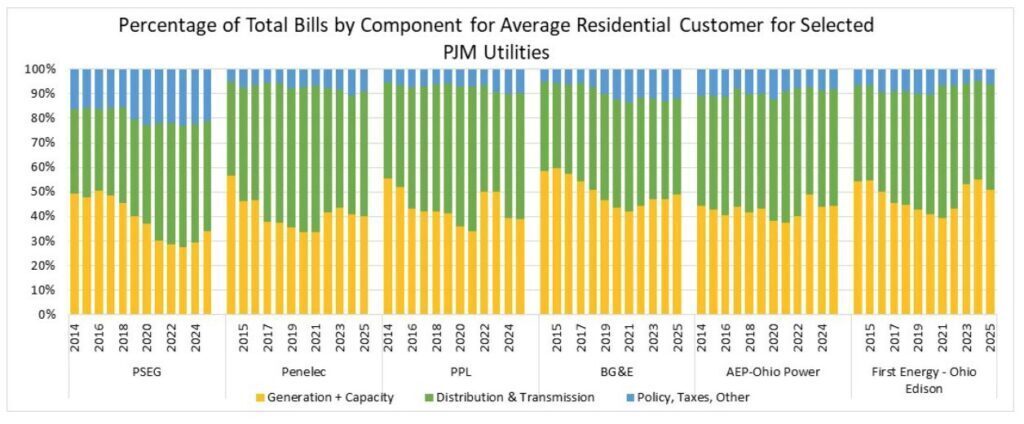
“In conclusion, in calendar year 2025, total generation costs as a percentage of the total bill and in inflation adjusted unit cost terms are consistent with historical averages for residential customers,” said the study, which was conducted by Energy Tariff Experts (ETE) and titled, “Power Generation Costs and Impacts on Electric Bills.”
ETE analyzed bills and costs over the past decade for utilities serving customers in Pennsylvania, Ohio, New Jersey, and Maryland, all part of the PJM Interconnection territory. In a May 14 summary, the Electric Power Supply Association (EPSA), the association of competitive power providers that commissioned the study, stated:
ETE’s study found that the generation component of residential customer bills accounted for only about 45% of the costs of the average electric bill across the utilities studied…. Even as policy choices and utility investments in transmission and distribution have continued to drive overall bill costs upward, the costs of generation and capacity have remained generally stable.
James Bride, ETE’s president, said that the data were clear: “Electric generation prices within competitive wholesale markets, though impacted by the same range of challenges as almost every industry, have trended lower in recent years and even with the reset of capacity prices in June 2025, remain lower than many years from the 2010s on an inflation-adjusted basis throughout PJM.”
In its analysis of data from Maryland, the study “found that the generation component of residential customer bills has fluctuated over the study period, averaging approximately 48% of the total bill. In 2025, the residential retail cost of generation as a percentage of customer bills has not increased materially and is consistent with historical averages. Transmission and public- policy-related charges have grown in the last decade and consume a greater share of the total residential bill.”
What is driving higher electric bills, then, is not the cost of generating power but actions taken by policymakers to intervene in a competitive market with measures noted by ETE such as New Jersey’s Societal Benefits Charge, a 3% surcharge on electric bills to support “consumer education,” “social programs” and other projects, according to the state Clean Energy Program.
There are other policy fees as well, including the Solar Pilot Recovery Charge and the Green Programs Recovery Charge. Lawmakers in New Jersey’s Assembly this month began considering ways to reduce electric bills by reconsidering these charges.
Competitive grid markets would help as well by delivering affordable electricity to homes and businesses without hitting bill payers with the cost of massive utility company investments.
Todd Snitchler, EPSA’s CEO said that “competitive markets continue to prove they are the ideal mechanism to not only keep electric power prices manageable, but also to meet rising demand and encourage system efficiency while shielding ratepayers from investment risk.”
He added that it was “clear that the rise in capacity costs is a consequence of application of state policies that have led to the premature retirement of critical baseload power and tightening supply at a time when it is needed most.”
The Massive Iberian Power Outage Is a Warning for the U.S. Electric Grid
On April 28, a swath of the Iberian Peninsula in Spain and Portugal was hit by a catastrophic power outage. “The outage grounded planes, halted public transport, caused panic buying and left the two countries scrambling to restore power to millions of homes and businesses,” reported CNBC. Power was out for over 10 hours in some areas, and even regions of southern France were affected.
One question raised after one of the worst outages in memory was whether these European nations were relying too much on renewable energy. In a headline, E&E News called the blackout “a warning sign for [the] U.S. grid,” which is straining under the weight of increased demand for electricity at the same time fossil-fuel plants are being retired and replaced with solar and wind power that is intermittent, that is, dependent on the vagaries of sunshine and breezes. Spain’s grid is heavily based on wind and solar. E&E’s Peter Behr wrote:
While the U.S. system is fundamentally different, grids that serve Texas, California, Florida, Iowa and Great Plains states also manage relatively high levels of renewable penetration. Still, the shift from traditional power generators to solar, wind and batteries has made it harder — but not impossible — for high-voltage grids to absorb sudden disruptions.
When the blackout hit, Spain was drawing 59% of its electricity from solar panels, nearly 12% from wind turbines, 11% from nuclear reactors and 11% from gas-fired turbines.
Bloomberg reported on May 19 that Spain began boosting generation from natural gas “in the wake of a nationwide blackout that raised concerns about the grid’s ability to cope with an abundance of renewable energy.”
Power from combined-cycle gas turbines, which Bloomberg called “a more steady generation technology than solar,” increased 37% in the two weeks after the outage, according to the grid operator Red Electrica.
Heavy reliance on wind and solar does not describe the entire problem in Spain. Such systems need to be equipped with voltage support and reactive power, such as implementing inverters, to assist in fixing blackouts.
A 2020 report by the U.S. Department of Energy’s National Renewable Energy Laboratory (NREL) pointed out that solar and wind power and battery storage that lack built-in inertia increase the risk of outages if no other defense is in place. As the E&E article stated:
Power from traditional generators is synchronized with the rising and falling cycles of alternating currents. Technology known as inverters convert direct current produced by solar and wind farms to the alternating current that delivers electricity to customers.
“The grid is the largest machine on the planet,” said Mario Garcia-Sanz, a program director at DOE’s Advanced Research Projects Agency-Energy. “As we reduce the number of synchronous generators and the associated inertia,” he said, “the normal grid contingencies can lead to more dramatic swings in frequency, which could result in large blackouts.”
In a 2021 report, the non-profit North American Electric Reliability Corporation (NERC) found that the industry was not sufficiently implementing technical recommendations or “following the guidance issues (such as phase lock loop, loss of synchronism, AC overvoltage, high-speed recording and retention, time to restart, and many other relevant topics).”
The NERC report focused on the “Odessa Disturbance,” an incident in Texas when instability in the surrounding grid caused solar plants with a total capacity of 1,112 megawatts (MW) to shut down unexpectedly. The blackout in Spain had echoes in the Odessa Disturbance. NERC researchers at the time stated:
The trends point to critical reliability challenges facing the industry: satisfying escalating energy growth, managing generator retirements, and accelerating resource and transmission development.
The NERC report warned that, as coal- and gas-fired generators are retired and energy demand surges, U.S. policy makers will have to find ways to upgrade the grid, unleashing power that is reliable, affordable and secure.
Today, natural gas is by far the top source of U.S. electric power at 41%. Wind accounts for 10% of electricity generation; hydro, 6%; solar, 4% according to the U.S. Energy Information Administration (EIA). Nuclear and coal represent nearly all the rest.
For the near future at any rate, renewable sources of energy will be inadequate to meet rising demand. Too much reliance on these sources can lead to the dire situation we saw in Spain, Portugal and France.
The Boom in Data Center Demand Collides with Infrastructure Limits: ‘I Have Never Seen a Moment Like This’
In a report ahead of BloombergNEF (BNEF) Summit, Schneider Electric showed how quickly artificial intelligence (AI) electricity needs are increasing. Among the findings:
- AI will drive up to 50% of U.S. electricity demand growth by 2030…outpacing other electrification drivers like transport and heating.
- Data center expansion is on a collision course with infrastructure limitations: Projected increases of 43–92 GW [gigawatts] in data center capacity by 2030 face major hurdles from outdated grid interconnection processes, permitting delays, and supply chain bottlenecks.
- Infrastructure deficits could impede AI development…. Energy scarcity will constrain innovation and global competitiveness.
- Unchecked demand growth risks triggering system-wide inefficiencies. In an “Abundance Without Boundaries” scenario, AI power demand could reach 500 TWh [terawatts] by 2030, which would overwhelm grid capacity, drive up consumer costs and encourage oversized, inefficient infrastructure.
- An unmanaged surge could result in a national or regional energy crisis…placing critical pressure on the grid and exposing seven regional operators, including MISO, PJM, and ERCOT, to reserve shortfalls by 2028.
The report, entitled “Powering Sustainable AI In the United States”, builds on recent findings from the International Energy Agency (IEA) and new data from Schneider, AlphaStruxure, and Data Center Frontier on the new realities of a growth in data center power.
A troubling survey by AlphaStruxure of 150 senior industry professionals on how the U.S. data center sector is adapting to the unfolding energy crunch found that it is taking longer and longer to secure more grid capacity – more than four years, according to 44% of respondents.
The survey also found that 92% of respondents see grid infrastructure as the most significant obstacle to data center progress. They said that deploying generation systems on-site at data centers was the best option to meet concerns about power availability. Also, they said the Mountain West has shown the fastest time to power.
“I’ve been in the power industry over 30 years, and I have never seen a moment like this,” said Juan Macias, CEO of AlphaStruxure. “The findings from this first-of-its-kind survey show the breadth and depth of the energy demand crisis…. Wait times are stretching to seven years, even a decade in some cases. This survey also shows how the industry is innovating in the face of grid constraints, including on-site power generation.”
In its own report last month, the IEA found that a diverse range of energy sources will have to be tapped to meet data centers’ rising electricity needs, with renewables and natural gas set to take the lead because they are cost-competitive and available in key markets.
But supplying enough power won’t be easy. “Global electricity demand from data centers is set to more than double over the next five years, consuming as much electricity by 2030 as the whole of Japan does today, said the IEA’s executive director, Fatih Birol.
Schneider Electric, a French multinational company that specializes in digital automation and energy management, estimated that the achievement of projected increases of 43 GW to 92 GW in data center capacity by 2030 faces major hurdles from outdated grid interconnection processes, permitting delays, and supply-chain bottlenecks. What’s needed are “streamlined permitting, modular construction and distributed energy for resilience and scale.”
Schneider’s April 28 report issued several stark warnings, including that “unregulated AI growth…could lead to oversized and inefficient infrastructure expansions, failing to meet the need for stable, affordable and accessible electricity.”
Power demand and geographic clustering will expose seven regional operators, including MISO (Midwest), PJM (primarily Mid-Atlantic), and ERCOT (Texas), to reserve shortfalls by 2028, said the report.
But Aamir Paul, Schneider Electric’s president of North America Operations, expressed some optimism. “The rapid and widespread adoption of AI coupled with the soaring demand for electricity are fundamentally reshaping America’s energy landscape,” he said.
“With concerted efforts and strategic investments, we can ensure that AI’s growth is supported by a robust, efficient, and resilient energy infrastructure, paving the way for greater sustainability.”
Managing and protecting the grid are key. The industry and regulators must act proactively and innovatively to pass permitting reform, address regional vulnerabilities, and prevent out-of-control data center development from harming reliability, affordability and security.
The AI products of these data centers, however, can “transform and optimise energy and mineral supply, electricity generation and transmission, and energy consumption,” said the IEA report. There are numerous objectives in play, including reducing costs, enhancing supply, extending asset lifetimes, reducing downtime and lowering emissions.”
The report also noted that “AI can help to balance electricity networks that are growing more complex, decentralised and digitalised.” But these gains won’t be realized unless data centers get the power they need for the AI revolution.
In Its Summer Reliability Report, NERC Projects That Much of the U.S Faces ‘Elevated Risk’ of Power Shortages and Outages
The North American Reliability Corporation (NERC) recently issued its Summer Reliability Assessment, once again finding much of the U.S. at “elevated risk” for power shortages and outages between June and September. As the Washington Post reported on May 14:
The seasonal electricity forecast warns that regional power grids extending from the Upper Midwest south through Texas may lack the power needed to meet all customer needs in the event of prolonged periods of high temperatures.
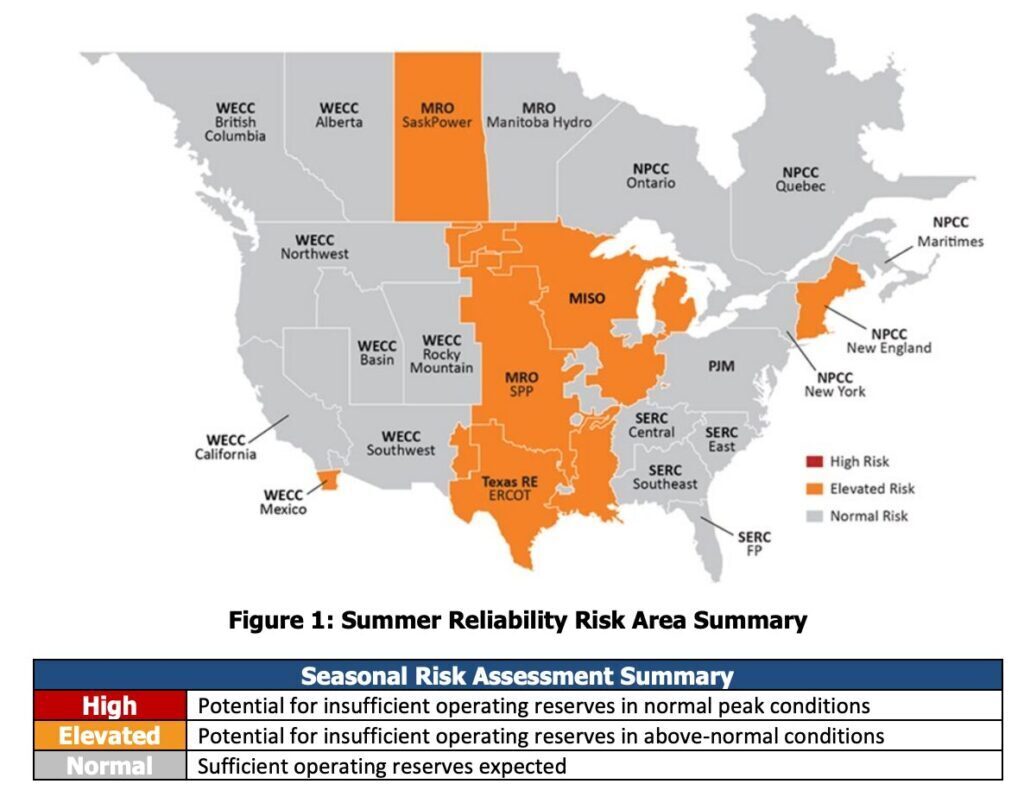
The report points out that “since last summer, the aggregate of peak electricity demand for NERC’s 23 assessment areas has risen by over 10 GW.” That is double the year-to-year increase that occurred between the summers of 2023 and 2024.
The reasons are well-known: a surge in demand from AI data centers and advanced manufacturing plants as well as scorching temperatures. At the same time, “over 7.4 GW of generator capacity…has retired or become inactive” – nearly all of it gas- or coal-fired. What is coming on-line is mainly solar generation, which is intermittent.
“Operators in many parts of the BPS [North American bulk power system] face challenges in meeting higher demand this summer with a resource mix that, in general, has less flexibility and more variability,” said the NERC report.
As an example, the report noted that the Midcontinent Independent System Operator (MISO), which covers 15 states and the Province of Manitoba in Canada, expects this summer a certain capacity of 142,793 MW, which is a reduction from last year’s 143,866 MW. Says NERC:
The retirement of 1,575 MW of natural gas- and coal-fired generation since last summer, combined with a reduction in net firm capacity transfers due to some capacity outside the MISO market opting out of the MISO planning resource auction, is contributing to less dispatchable generation in MISO. With higher demand and less firm resources, MISO is at elevated risk of operating reserve shortfalls during periods of high demand or low resource output.
NERC pointed to other reliability issues involving supply chains and communication between generators and operators. “Given that late spring and early summer are seasons when natural gas system owners and operators typically perform maintenance requiring system outages,” said the report, “vigilance is needed to ensure the reliability of fuel delivery to natural-gas-fired-generators.”
The report continued:
When summer maintenance preparations or installations are delayed, effects on equipment availability can challenge system operators. Over the long term, supply chain issues and uncertainty continue to affect development. Lead times for transformers remain virtually unchanged, averaging 120 weeks in 2024. Large transformer lead times averaged 80–210 weeks.
NERC, whose mission is ensuring reliability, is clearly worried. The answer is an expansion of U.S. energy sources, primarily dispatchable natural gas, that can be called upon at any hour and season.
The Costs of California’s Renewable Energy Mandates
On Sept. 10, 2018, former California Gov. Jerry Brown signed Senate Bill 100 and an accompanying executive order, mandating that California’s renewable energy resources supply 100% of retail sales of electricity within the state by 2045.
Now, with 20 years to go, the Pacific Research Institute (PRI) has published a study titled “The Cost of Going Green,” which shows how the green energy transition will hurt Californians. According to the paper:
PRI’s calculations find that California households will be on the hook for between $17,398 and $20,182 in estimated costs to fund the state’s energy transition to alternative energy sources between 2025 and 2050. This estimate includes dismantling and decommissioning costs and alternative energy disposal costs.
The study builds on previous analysis from PRI scholars. For example, Wayne Winegarden earlier showed how green mandates boosted electricity costs in the state to 56% higher than the U.S. average household – even though state residents, owing to California’s fabled weather, use 34% less energy. “If green mandates were reformed or repealed and residential electric rates fell to the U.S. average, California residents could save $517 per year on average,” Winegarden wrote.
In another earlier paper, titled “Sapping California’s Energy Future,” Winegarden and PRI’s Kerry Jackson wrote that Senate Bill 100 and a 100% electric vehicle mandate in the state would put so much pressure on the grid that by 2045, California would fall 21% short of the daily power required to meet the needs of its residents and businesses.
The new April 2025 report by Winegarden and Jackson found that the estimated cost of funding California’s transition between 2025 to 2050 will be between $210 billion and $250 billion. Some costs are explicit, but others are hidden in the higher prices of goods and services that families purchase.
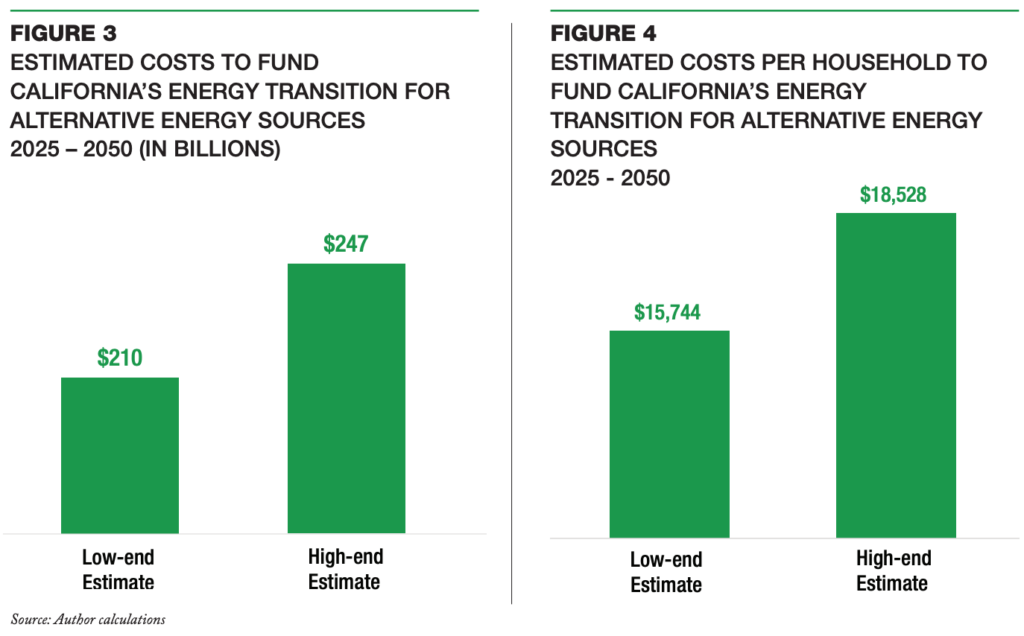
The authors add, “The costs of California’s energy transition go beyond the required expenditures to buy and install the new preferred energy resources. They also include the costs associated with decommissioning and dismantling the current natural gas and nuclear generation resources.”
Then there’s the cost of lost opportunities:
Forcing companies to invest their scarce resources into constructing the politically preferred alternative energy technologies or shutting down otherwise viable energy assets also means these same resources cannot be used for other purposes.
They also note that solar power isn’t as green as many think: “Solar panels are made from hazardous materials, which do not necessarily make them unique, but their makeup has the potential to create problems when end-of-life disposal is necessary…. By 2050, it is expected that tens of millions of tons of solar panel waste will have accumulated,” and the cost for disposal will be running $135 million per year.
Renewables aren’t benign. For example, the land footprint for solar in California is gigantic: an estimated 2.5 million acres, about 40% of it on land suitable for growing crops. Wind turbines present challenges such as disposing of retired turbine blades. And the spread of battery energy storage systems “has been accompanied by a rise in the frequency of spontaneous fires,” says the report.
The authors estimate that California “will incur a $4.1 billion disposal bill through 2050 that it must pay to properly dispose of its alternative energy infrastructure. On a per household basis, this equates to an additional $310.”
In an interview with The Daily Signal, Winegarden said of Senate Bill 100: “It’s a really problematic policy, because it’s not just economically destructive, but it’s also because of [California’s] size. It influences things well beyond our borders.”
The PRI scholars recommend that California repeal its mandates and instead, “the state should promote a market-based approach to global climate change.” They recommend nuclear generation as “an essential low-emission, affordable generator of electricity…. Simply put, without nuclear power, the likelihood of California reaching its emission targets while also turning over the automobile fleet from gas-powered cars to EVs is low.”
They conclude that the state must “establish an environment that harnesses the knowledge of millions of Californians who have the know-how and inclination to tackle the problem.” (PRI is the sponsor of this newsletter.)
Who’s Killing Coal? Financial Firms or Market Forces? The Data Provide a Clear Answer
Ken Paxton, the attorney general of Texas, along with the AGs of 10 other states, is suing the giant financial firms State Street, BlackRock and Vanguard Group for “illegally conspiring to manipulate energy markets, driving up costs for consumers.”
The suit charges the firms with “conspiring to artificially constrict the market for coal through anticompetitive trade practices.” And, just recently, the Trump administration’s Federal Trade Commission (FTC) and Department of Justice (DOJ) filed a statement of interest in the case related to antitrust and securities laws.
Paxton is one of the nation’s most controversial attorneys general. He was impeached, but then acquitted, by the Texas legislature in 2023 on claims that he abused his office. He is now running for U.S. Senate, challenging incumbent John Cornyn in the Republican primary next year.
According to a press release from Paxton’s office:
Over several years, the three asset managers acquired substantial stockholdings in every significant publicly held coal producer in the United States, thereby gaining the power to control the policies of the coal companies. Using their combined influence over the coal market, the investment cartel collectively announced in 2021 their commitment to weaponize their shares to pressure the coal companies to accommodate “green energy” goals. To achieve this, the investment companies pushed to reduce coal output by more than half by 2030.
But the claims in the lawsuit are unsupported by government reports on coal production.
In April 2025, the EIA published an analysis that showed that bituminous coal production actually peaked 35 years ago, and subbituminous peaked 20 years ago, long before 2021, when Paxton claimed the “cartel” allegedly conspired to reduce output.
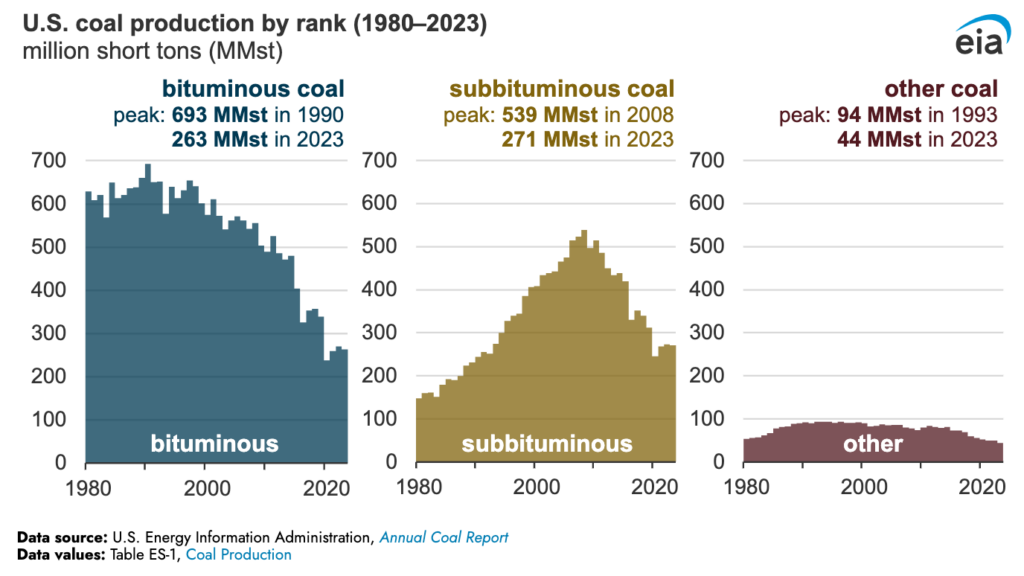
EIA data show that in 2001, US coal production was 1.127 trillion short tons; by 2020, that number had declined 535 billion short tons.
“Coal’s shrinking market share is nothing new,” wrote former EIA Administrator Guy Caruso in the Houston Chronicle on Feb. 10. “It’s the result of market forces, not the machinations of an investor cabal…. The ‘shale revolution’ made natural gas significantly more available and cost-efficient.” Caruso continued:
In 2006, natural gas became the second largest source of U.S. electricity, surpassing nuclear power. In 2016, natural gas took the top spot, surpassing even coal. And natural gas’s hold on that top spot has grown more secure since then: According to the latest data available from the U.S. Energy Information Administration, natural gas now accounts for more than 40% of U.S. utility-scale net electricity generation.
The U.S. transitioned away from coal, not because of a cabal, but because coal is comparatively costly to produce compared to natural gas. The New York Times reported that natural gas “started to replace coal from around 2005, when the fracking boom made large quantities of cheap natural gas available.”
Thanks to the fracking boom, prices of gas have declined, especially, said report from the International Energy Agency, “in Texas, Louisiana, and the East Coast…. The price swing sparked a switch coal to gas-fired generation in the power sector.”
Even coal companies acknowledge this shift in market demand. Peabody Energy, the world’s largest private-sector coal producer, started in its 2021 Form 10K, submitted to the Securities & Exchange Commission:
Gas-fueled generation has displaced and is expected to continue to displace coal-fueled generation…. These trends have reduced demand for our coal and the related prices. Any further reduction in the amount of coal consumed by electric power generators could reduce the volume and price of coal that we mine and sell.
Another large U.S. coal producer, ARCH Resources said in its 2019 annual report: “Domestic thermal coal markets were pressured by low natural gas pricing and continued expansion of subsidized renewable generation sources.”
Among the remedies sought by Paxton in his lawsuit is “that the investors should divest from the carbon-heavy coal companies they own. That, ironically, is the same thing that climate activists have been demanding for years,” reported Axios in December. Another irony is that the lawsuit has the potential to threaten the Trump Administration’s goal of unleashing American energy – a strategy in which natural gas is playing a key role.