
- President Trump chooses a Democrat and former Manchin advisor, David Rosner, to head the Federal Energy Regulatory Commission.
- “The reliability threat is not on the future horizon. It is now here,” says the departing FERC Chair, as a key capacity auction falls short of its reliability requirement.
- To keep the lights on and air conditioners humming, the Energy Department tells PJM that oil and coal plants near Baltimore must continue operating.
- In Colorado, a coal plant is on the verge of shutting down, but a surprising voice indicates, “Not so fast!”
- States and companies are trying to adapt as electricity use continues to set records.
- U.S. and EU reach a deal that will signals massive increases in shipments of American LNG.
In a Surprise, President Trump Chooses a Democrat Close to Joe Manchin as New FERC Chairman
While concerns mount over grid reliability and rising demand for electricity, President Trump has picked a Democrat to head the Federal Energy Regulatory Commission (FERC).
The selection of David Rosner came as a surprise. He is seen as a centrist and was formerly an aide to Sen. Joe Manchin, who chaired the Energy and Natural Resources Committee until his retirement from the Senate at the end of the last term. Manchin, who recommended Rosner to the Biden Administration as a commissioner in 2023, was a West Virginia Democrat who switched to Independent at the end of his term and then chose not to run for re-election.
Manchin was a strong advocate of an “all-of-the-above” approach to energy, with an emphasis on natural gas, and spent significant political capital attempting to pass legislation to streamline the permitting process for infrastructure such as pipelines and transmission facilities. Rosner shares this approach.
He has pushed for greater automation to speed the engineering process so that new projects can reach the grid more quickly. “Getting grid interconnection moving faster is essential to ensuring reliability,” he said in a March interview with E&E News. “We’re starting to learn about these new tools and platforms that just make this work faster, smarter, saves us time, solves the reliability and affordability problems that are facing the country.”
Rosner has focused on an especially difficult problem facing FERC in the short term: how to absorb the electricity demand from huge Artificial Intelligence (AI) data centers. “For FERC, questions came up about federal rules around co-locating power plants and data centers — a practice that would affect regional electric grids that serve big swaths of the country,” reported E&E News on Aug. 11. “We’ve got to figure out a way to unlock the efficiency of co-located load in generation,” Rosner said at a conference in November.
Rosner succeeds Mark Christie, a Republican who was appointed chair after Trump’s victory but served less than seven months in the position (he was on the commission four and a half years overall). Christie (see below) had taken a strong stand against utility companies “cost-shifting” the co-location expenses for data center construction onto “residential customers who are struggling right now to pay their monthly bills.”
Rosner’s FERC will have to face Christie’s worry that energy-intensive facilities will reduce “big dispatchable resources out of the supply stack” and put the costs on the back of consumers, as we reported in Issue No. 45 of this newsletter.
The Institute for Energy Research (IER) reported on Aug. 11 that, with the burden on consumers rising, “utilities want tech companies to pay more to connect their new data centers to the power grid.” IER noted that “Dominion Energy, operating in Virginia, which has the most data centers in the world, proposed a series of measures that would require data-center developers to commit to longer-term electricity contracts and agree to pay for certain amounts of power — even if they use less.”
The commission now has a 2-1 Democratic majority. Trump intends to fill the last two spots with Republican nominees now awaiting Senate confirmation: David LaCerte, a Louisiana lawyer who served as Trump White House liaison to the Office of Personnel Management, and Laura Swett, an energy attorney at the Vinson & Elkins firm. Presidents can name the FERC chair without Senate approval.
Rosner joined FERC a year ago. As we reported in Issue No. 37 of this newsletter, his “nomination was unwelcome in some quarters. ‘The only thing worse than a Joe Manchin staffer on FERC is a Joe Manchin staffer who used to work for a fossil fuel front group,’ said Lukas Ross, Friends of the Earth’s climate and energy deputy director, in a reference to the Bipartisan Policy Center (BPC), where Rosner was associate director of the energy project. (BPC is a centrist think tank, not a front group, but the comment shows that emotions run high.)
Rosner was approved by the Senate for a term that expires in June 2027 by a vote of 67-27. Three Democrats and Independent Bernie Sanders opposed him, as did 23 Republicans, including J.D. Vance, then a Republican Senator from Ohio.
The reliability of the grid is paramount for Rosner. During an October 2024 appearance at a meeting of a transmission-focused trade group, Rosner said, “We’ve been up and down and left and right on reforms to some of these markets over the past decade or two, and when you meet with people who lend money to people who invest in these things, they sort of tell you things like, we discount that revenue stream to zero, and that is not good.”
He added, “An unreliable grid is – full stop – unaffordable because none of our economy works without access to electricity.”
Industry organizations applauded Rosner’s elevation. Todd Snitchler, CEO of the Electric Power Supply Association, said that EPSA and its member companies look forward to working with Rosner “as FERC guides the nation’s power system through a time of rapid expansion and transformation. Chairman Rosner has demonstrated a reasoned and thoughtful approach to policy and leadership – qualities that will be essential as the nation works to meet rising electricity demand while maintaining reliability.”
Amy Andryszak, CEO of the Interstate Natural Gas Association of America, pointed out, “As a Commissioner, Chairman Rosner has shown his commitment to consensus building to advance the energy needs of all Americans. INGAA looks forward to working with Chairman Rosner and the rest of the Commission to develop the energy infrastructure necessary to deliver natural gas to homes and businesses across the country.”
In March, Rosner wrote to grid operators, “My priority is ensuring the reliable, affordable, and abundant energy that American families depend on to prosper and American businesses require to grow, including to power the artificial intelligence revolution and re-shore advanced manufacturing all across our country.” He has his work cut out for him.
On Departure, FERC’s Mark Christie Issues a Stark Warning: The Threat Is Not on the Horizon but Coming From Inside
The outgoing FERC chairman, Mark Christie, issued a stark warning after his attended his last meeting July 24. “The reliability threat is not on the future horizon. It is now here,” he said, pointing to the recent capacity auction of PJM Interconnection, the nation’s largest grid operator. “This auction fell short of its reliability requirement,” Christie said to reporters, citing the grid operator’s independent market monitor. “That’s the first time, I’m told.”
During his tenure as commissioner and chairman, Christie pushed to get more power to the grid faster. We can expect the same from Rosner.
“The goal of all this,” said Christie at his final meeting, “is to get new generation online faster and efficiently and safely.” He was commenting on a 180 megawatt (MW) energy infrastructure project that has “been in the queue eight years. The delay was so long that the original equipment that they spec’d in their application is no longer manufactured, and so they have to ask for a waiver for more time, so that we can plug in the new equipment into all the engineering studies, and make sure that that can be connected safely.”
Christie added, “You know, it’s just taken too long. The only way to solve those problems is with speed.”
At the PJM capacity auction, held two days before the FERC meeting, power providers offered commitments to provide back-up energy needed on the grid from mid-2028 to mid-2029. Because of high demand and constrained supply, the prices required by providers in the auction rose 22% from a year ago for most of PJM, setting a new record. As Christie noted, the auction also failed to meet the minimum reserve requirement for reliable service for the first time ever.
Last year, the auction shocked the energy world when the price came in at $269.92 per MW per day for much of the PJM footprint, compared to $28.92/MW-day for the previous year’s auction – an increase of about 800%.
The 22% increase this year, on top of last year’s, was no surprise. “This is what the load-growth era looks like for PJM,” said Molly Jerrard, head of flexibility at Enel North America, which helps communities transition to an electrified economy. Jerrard commented on the tightness of the supply-demand situation in a Utility Dive piece.
In its Aug. 11 report, cited above, IER noted:
Electricity demand has soared as artificial intelligence (AI) and data centers, along with increased electrification, have grown. Transmission planners are forecasting an 8.2% increase in U.S. electricity demand over the next five years, after 20 years of annual demand growth remaining below 1%. Electricity output has grown by 4% during the first 6 months of this year, with strong growth from solar and wind power.
IER pointed out that utility-supplied electric production hit 2,188 terawatt hours for the period for the first half of the year, the highest ever for the period. “Solar output grew by 32% over the past year, and wind production reached a record, growing by 6% for the first 4 months of this year over the same period last year. From January to June, fossil fuels produced 55% of the nation’s electricity, down from 56%.” Because of higher prices (see the section on LNG below), natural gas was responsible for 4% less generation than the year before.
Solar and wind generators are rising fast, but because of worries about the instability they can cause the grid, FERC under Christie approved new standards to increase reliability. The standards, which were developed by the North American Electric Reliability Corporation (NERC), specifically target “inverter-based resources” (IBRs), on which solar and wind rely.
The concern is that solar and wind generators aren’t able to respond to voltage and frequency disturbances quickly enough – a cause of the blackout in Spain and Portugal in May, as we reported in our Issue No. 48. The new FERC rules, T&D World summarized “require IBRs to remain connected to the grid during these disturbances to prevent sudden losses of power that could destabilize the electric system.”
The demand can’t wait. McKinsey, the consulting firm, estimated last year that global demand for electricity from AI data centers could grow 19% to 22% annually from 2023 to 2030, reaching up to 298 gigawatts (GW) in a high-growth scenario. This compares to 60 GW today. To avoid shortages, twice the capacity added since 2000 will be needed in one-third the time.
The International Energy Agency forecast that U.S. data centers will increase power consumption by 130% by the end of this decade, accounting for nearly half the growth in electricity demand.
Other sources of electrification, including electric vehicles and advanced manufacturing, are adding to the new energy crisis and raising utility bills. “The average electricity rate in June of 2025 was 6.7% higher than the rate in the same month in 2024,” reported Maritime Logistics Professional. “This means that the cost of electricity for households has risen at a pace that is more than twice as fast as the overall consumer price inflation in the United States during that time period.”
Edison Electric Institute expects utilities need to invest around $203 billion each year in 2025 and 2026, the most since the trade association started tracking such data a quarter-century ago. PowerLines reported last month that “utility rate increases requested and approved totaled…$29 billion in the first half of 2025.” That’s a record. During the same period last year, the figure was $12 billion.
As Christie foretold, the U.S. is going to have to make major changes to accommodate the demand for electricity, which the Trump Administration sees as essential in our competition with China. But against that backdrop, regulators have to be mindful of the increase in the financial burden on households and businesses. For Christie – and, we can assume, for Rosner as well – a high priority is permitting reform to speed infrastructure projects and innovation to build a sustainable, reliable grid for the 21st century.
Energy Dept. Tells Largest Grid Operator to Allow Fossil-Fuel Plants in Maryland to Continue Operating
On July 28, Secretary of Energy Chris Wright issued an order under Section 202(c) of the Federal Power Act (FPA) and Section 301(b) of the Department of Energy Organization Act. It began:
I hereby determine that an emergency exists within the PJM Interconnection, L.L.C. (PJM) service territory due to a shortage of electric energy, a shortage of facilities for the generation of electric energy, and other causes, and that issuance of this Order will meet the emergency and serve the public interest.
PJM (see above) is the nation’s largest grid operator, covering all or parts of 13 states and the District of Columbia. PJM serves 65 million people, mainly in the Mid-Atlantic and Midwest regions.
The order was meant to reduce “the threat of power outages during peak demand conditions for millions of Americans,” said Wright in a press release. “The Trump Administration remains committed to swiftly deploying all available tools and authorities to safeguard the reliability, affordability, and security of the nation’s energy system.”
The order, which PJM requested, allows the grid operator to continue to run units at the Wagner Generating Station in Anne Arundel County, Md. In issuing its order, the Department of Energy (DOE) agreed there is an “imminent electric reliability emergency” in the zone around Baltimore. Without the order, there could be blackouts, according to PJM’s petition to DOE.
Wagner originally used only coal for electricity generation. Its owner, Talen Energy, retired several coal units in 2023 and converted its Unit 3 to oil generation. That unit was slated to be retired in May, but it will remain operating until 2029.
Wagner’s Unit 4, which is coal-powered, was earlier allowed to “run no more than 438 hours, or 18.25 days, a year…under a separate 2020 consent order,” reported Utility Dive. That order was “prompted by an Environmental Protection Agency’s finding that the plant was a significant source of local air pollution.”
Wagner has only 80 hours left before hitting that 438-hour ceiling, and the DOE order says that “PJM assesses that if another heatwave similar to that which occurred in late June 2025 were to occur, there are insufficient run hours remaining because of the Operating Limit on Wagner Unit 4.”
Because the “inability to run Wagner Unit 4 could result in adverse reliability impacts to service in the Baltimore Gas and Electric (BG&E) territory, and within PJM’s service territory more broadly,” the DOE order will allow PJM to “dispatch Wagner Unit 4 when forecast temperatures are high, approximately around 92 degrees in the Mid-Atlantic region.”
The DOE emergency order illustrates the danger of fossil-fuel plant retirements in the face of rising demand for electricity, especially under conditions of extreme weather. In a February 2023 assessment that highlighted resource adequacy and grid reliability concerns in the coming years, PJM warned:
The growth rate of electricity demand is likely to continue to increase from electrification coupled with the proliferation of high-demand data centers in the region, [and] retirements are at risk of outpacing the construction of new resources, due to a combination of industry forces, including siting and supply chain, whose long-term impacts are not fully known.
These concerns were repeated the next month at a House Energy and Commerce Committee meeting on grid reliability. Testimony from PJM President Manu Asthana warned that “growing resource adequacy concerns” pose a major threat from “increased electrification and the retirement of existing resources.”
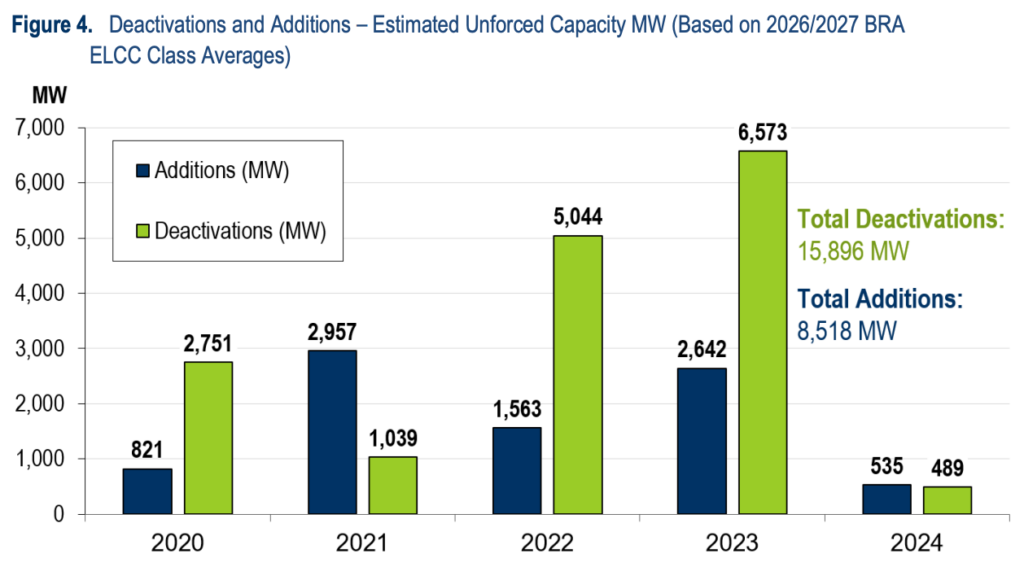
Asthana’s prepared testimony included a bar chart showing that between 2020 and 2024, plant deactivations involved 15,896 MW of capacity while additions amounted to only 8,518 MW.
President Trump laid the groundwork for the DOE emergency order when he issued Executive Order 14156, “Declaring a National Energy Emergency,” on his first day in office. That order began:
We need a reliable, diversified, and affordable supply of energy to drive our Nation’s manufacturing, transportation, agriculture, and defense industries, and to sustain the basics of modern life and military preparedness. Caused by the harmful and shortsighted policies of the previous administration, our Nation’s inadequate energy supply and infrastructure causes and makes worse the high energy prices that devastate Americans, particularly those living on low- and fixed-incomes.
DOE’s July 7 report titled, “Resource Adequacy Report: Evaluating the Reliability and Security of the U.S. Electric Grid,” concluded, “The existing generation retirements and delays in adding new firm capacity, driven by the radical green agenda of past administrations, will lead to a surge in power outages and a growing mismatch between electricity demand and supply, particularly from artificial intelligence (AI)-driven data center growth, threatening America’s energy security.”
Short-term solutions, such as the DOE Maryland order, will help, but experts of all political leanings understand that the U.S. needs long-term policies that allow energy infrastructure projects to be developed, financed and join the grid quickly. The term “emergency” is appropriate to describe the problem; now, we need a solution that meets the crisis.
In Colorado, Should a Coal Plant Be Shut Down?
While the DOE extended the ability of a Maryland coal plant to operate, enthusiasm for closing a coal plant is waning – even in unfamiliar places. It’s a phenomenon occurring elsewhere.
According to EIA, “Coal-fired power plants accounted for 27% of Colorado’s total in-state generation in 2024, down from 60% a decade ago.” One of those facilities, the Ray D. Nixon Power Plant, serves Colorado Springs, home to the U.S. Air Force Academy.
The Nixon plant, built in 1980, generates 260 MW of power. Two natural gas turbines nearby generate 56 MW. Colorado Springs Utilities (CSU), the municipal institution that operates the Nixon plant, says on its website, “To meet state regulations, we plan to close and decommission Nixon’s coal turbines and related equipment in 2030.”
But recently Travas Deal, CEO of the utility, warned that shutting down the coal plant at the end of 2029 could inflate bills and put consistent power at risk.
Deal said that CSU approached the Environmental Protection Agency (EPA) about keeping the Nixon plant open past 2029. He added, according to Colorado Public Radio (CPR), that “those conversations weren’t an attempt to go over the heads of state authorities, but rather a necessary step to eventually arrive at a workable solution.”
Deal told CPR News, “What we’re looking at is an option to utilize Nixon to help maintain reliability and to keep cost points as low as possible as we look for a longer-term decarbonization strategy.”
Colorado Springs has to cope with the difficult reality of a clash between rising demand for electricity and plant retirements forced by climate-change policies.
Colorado’s Climate Action Plan, enacted in 2019, requires public utilities to reduce their greenhouse gas emissions to just one-fifth of 2005 levels by 2030. The closure of the Nixon plant, ordered by CSU’s governing board in 2020, was a key component of the utility’s strategy to meet those mandated reductions.
A second CSU plant, Martin Drake, was shut down in 2022. The utility reported, ”Demolition efforts began in the summer of 2023. From that time through July 2024, the project consisted of more than 83,000 hours of labor and the removal of approximately 8,700 gross tons of metal, filling 770 truckloads.”
Deal, the CEO of CSU, considered using wind and solar, with battery storage, to replace coal. But in a statement earlier this year, he said that Requests for Proposals that were fielded in 2023 ended up with bids far higher than expected: 60% higher for wind, 50% for solar – the result, he said, of “energy providers around the nation pursuing similar resources.”
Deal cited other reasons for high costs: “a congested supply chain, high demand across the energy industry, raw material scarcity and potential tariffs and policy changes proposed by the new administration in Washington, DC.” He added:
These factors have not only increased renewable energy project prices, but they have also pushed out project completion timelines; with some completion dates several years into the future. Limited transmission line capacity is also adding significant cost to delivering power from these projects to our local electric grid.
At a press conference on July 31, Gov. Jared Polis, a Democrat, signaled he was open to reconsidering the Nixon plant retirement date. “Generally speaking, of course, coal is the most costly form of energy on the grid,” Polis said. “I think they [CSU] are just trying to figure out the date that makes sense to close down their higher-cost coal power plant…. “Whether it’s 2033, 2034, we want to do something that makes sense.”
Rising demand and constrained supply of electricity is encouraging a Democratic governor with a record of supporting greenhouse-gas-reduction measures to keep a coal plant open. Elected officials of both parties are recognizing that this kind of action may be necessary to prevent blackouts and hold down utility bills.
Record High U.S. Power Consumption Is Projected for 2025 – and Again for 2026; States Try to Adapt
In its short-term energy outlook, issued Aug. 12, the EIA projected record highs for U.S. power consumption in 2025 and 2026. Use will rise to 4,186 billion kilowatt hours (kWh) this year and 4,284 billion kWh next year from a record 4,097 billion kWh in 2024. Said EIA:
Electricity demand growth in our forecast is driven by the commercial and industrial sectors. We expect electricity sales to the commercial sector to rise by 3.0% in 2025 and 4.5% in 2026, driven largely by more demand from data centers, while electricity sales to industrial consumers rise by 2.0% in 2025 and 3.5% in 2026.
These forecasts are no surprise. The question is what to do about them. As the co-chair of the National Energy Dominance Council, Interior Secretary Doug Burgum called for existing power plants to boost production by 10% to 15% and urged faster permitting of new plants and transmission and natural gas pipelines. “Winning the AI arms race doesn’t just take software developers. It takes more electricity,” Burgum told a meeting of U.S. governors in Washington in February.
Burgum said, “the U.S. should avoid the example of Germany, which…de-industrialized because it moved too quickly off of fossil fuels as it races to compete with China to become a leader in power-hungry AI,” Reuters reported.
Some states are considering modifying policies and offering incentives to attract new power plants. Todd Snitchler, CEO of EPSA, which represent competitive power producers, said, “I don’t think we’ve seen anything quite like this.” The Associated Press reported:
In Missouri, utilities including Ameren and Evergy, as well as the Missouri Chamber of Commerce and Industry, labor unions and the state’s top utility regulator are backing legislation to repeal a nearly half-century old law preventing utilities from charging customers to build a power plant until it is operational.
The current law was approved in a 1976 voter referendum when states were looking for ways to stop utilities from forcing ratepayers to finance “upfront, potentially bloated, inefficient or worse, aborted power projects,” said the AP.
In Pennsylvania, Gov. Josh Shapiro, a Democrat, “wants to establish an agency to fast-track the construction of power plants and provide hundreds of millions of dollars in tax breaks for projects providing electricity to the grid,” reported the Institute for Energy Research. “Shapiro also suggested Pennsylvania may leave the regional grid operated by PJM Interconnection in favor of ‘going it alone,’ as he noted that it has been hard to get enough new generation projects off the ground and through PJM‘s queue.”
Pennsylvania State Senator Gene Yaw, a Republican, proposed a power plant-financing fund like the one in Texas, which established a $10 billion low-interest loan program after the state was hit by a deadly winter blackout in 2021.
Partly because of the change in the federal and state policy environment, companies in other parts of the country are planning large-scale construction projects to expand natural gas capacity.
Energy Transfer announced on Aug. 6 that it had reached a “positive financial investment decision” to build a $5.3 billion expansion of its Transwestern Pipeline facility, the “Desert Southwest Pipeline,” which will transport gas from the Permian Basin in Texas to markets in New Mexico and Arizona, increasing natural gas capacity in light of surging demand. The company intends to source steel from U.S. manufacturers, and hire up to 5,000 local workers, including union labor, during the construction phase.
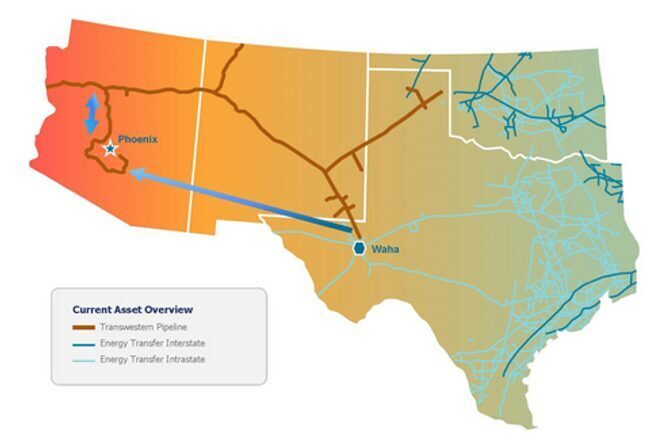
Two major Arizona utilities have already agreed to acquire natural gas capacity from the expansion: “The Arizona Public Service (APS) and Salt River Project (SRP) both announced that they would acquire capacity from the pipeline to support new gas-fired power plants. The agreements will provide the utilities with priority delivery of natural gas from the pipeline.”
Arizona’s population boom is contributing to growing energy demand, and the state is fast becoming a regional hub for data centers, with more than 100 currently operating in the state. Meta, Amazon Web Services, Google, and Microsoft all have a presence. The Desert Southwest project is expected to go into service before the end of 2029.
European Union Agrees on a Trade Deal That Will Boost U.S. Sales of LNG
The U.S. and the European Union signed a trade agreement on July 27, and a key part of the deal was the EU’s energy-purchase pledge. Said the Joint Statement issued by the parties: “The European Union intends to procure U.S. liquified natural gas, oil, and nuclear energy products with an expected offtake valued at $750 billion through 2028.”
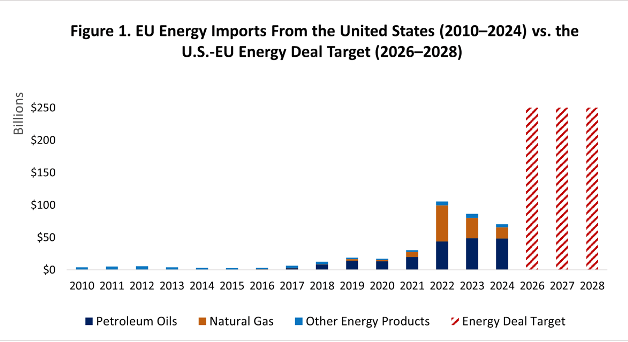
That would be a huge – and potentially unachievable — increase over the status quo. The American Action Forum (AAF), a centrist research and analysis group, noted that the U.S. “exported roughly $70 billion worth of energy products to the EU in 2024, and projected U.S. petroleum and natural gas exports to the bloc are about $207 billion in total for 2026–2028, meaning the EU would have to more than triple its current energy imports from the United States annually to fulfill the target.”
The energy purchase provisions are not legally binding at this point, and EU companies, not the bloc itself, make final import decisions. Below is a graphic representation from AAF based on data from the EU, of how much Europe would have to increase its purchases to meet the stipulations of the agreement.
But even if it can’t be full realized, the deal places LNG front and center as the main energy component in U.S.-EU relations, with the implicit aim of Europe acquiring U.S. natural gas instead of Russian. Achieving the specified gains would require massive infrastructure investment and trigger significant feasibility challenges, including how to meet commitments to other purchasers and how much domestic pricing would be impacted. The EIA projects that price of Henry Hub (Louisiana) gas, with its proximity to LNG terminals, will increase significantly over the n ext 10 years in part because of export demand.
Russian gas remains a wild card against the backdrop of peace talks in the Ukraine war. The EU has issued a directive that would ban Russian gas imports by the end of 2027, but the state of the conflict may be different by then.
“The stakes are huge,” said a Bloomberg report. “The EU purchased a total of €23 billion ($26 billion) in Russian energy in 2024, exceeding its military assistance to Ukraine last year. Russian imports still accounted for 19% of the 27-nation bloc’s total gas purchases last year, after LNG shipments surged to a record after Gazprom PJSC squeezed pipeline flows.” Still, Russian exports to Europe are down to one-sixth of pre-war levels.
Even if Russian sales to Europe bounce back, the U.S. – EU trade deal has a good chance of structuring a strong transatlantic partnership, helping encourage an infrastructure buildout in the United States.
The LNG supply chain itself has been embroiled in the kind of conflicts you might expect in a sector that has risen so quickly in importance. Shell, the fifth-largest international energy company, recently lost an arbitration case against Venture Global LNG, alleging they failed to deliver gas under long-term contracts. Venture Global won the case, in a decision affirming the company honored their contracts, that may represent a notable shift from the power of incumbent behemoths.
Venture Global uses a mid-scale LNG technology model to accelerate time to market. The model enabled the company’s Calcasieu Pass terminal to start exporting LNG years faster than traditional systems, strengthening global energy security and upholding 20-year commitments to provide low-cost LNG to long-term customers.
The Calcasieu Pass cargoes came at a critical time, supporting the world’s growing demand for natural gas in the face of tight supply occasioned by the Ukraine war and the new U.S. – EU trade deal.
The LNG industry suffered much of 2024 in limbo under a permitting “pause” imposed by President Biden that had threatened to become permanent with a Kamala Harris victory. Now, with the pause reversed and the U.S.-EU deal done, the sector has entered a full-fledged boom.