
- Natural gas generation projects are on the upswing. Developers don’t seem too worried that party change will reverse the Trump Administration’s course.
- FERC tells grid operators it wants to see better rules for additions of large loads.
- Business is good for utilities, but the Fitch bond ratings agency lowers its outlook for the sector because of political and regulatory risk.
- With its economy slipping, California changes its cap-and-trade system to lighten the burden for businesses and consumers.
- In large part because of rising utility bills, the ranking Democratic member of the House Energy and Commerce Committee joins the call for a moratorium on new data center.
What’s the Future for Natural Gas Generation of Electricity?
In 1990, natural gas was a minor source of electricity generation, outstripped four-to-one by coal and far behind nuclear power. Today, gas accounts for about 40% of generation, but its share has stagnated lately. This year, the U.S. will add seven times as much capacity from solar as from natural gas, according to the EIA. Wind and solar have surged to represent 17% of generation capacity.
The rise of renewables is the result of federal and state greenhouse-gas reduction policies as well as declining costs. But wind and solar are intermittent whereas natural gas, like coal and nuclear, delivers firm, dispatchable power.
Meanwhile, from the first day of the President’s second term, the Trump Administration has pumped new life into fossil fuels. So, if you’re a major utility or an independent provider of energy, should you be investing heavily in developing more power from natural gas?
Right now, as Jean Chemnick wrote June 23 in E&E News, “Demand is surging, and decarbonization goals are no longer in the driver’s seat.”
Two days later, in Lordstown, Ohio, local luminaries celebrated the completion of the $1.2 billion Trumbull Energy Center, which will provide 950 megawatts (MW) of power, generated by natural gas. Trumbull is owned by two Korean companies and Siemens Energy of Germany.
Ohio has become a hotbed of energy investment, because of its proximity to natural gas deposits and the passage of new state legislation. In May, the energy company Tenaska, based in Omaha, announced plans to add a 1.7 gigawatt (GW) natural gas power plant in Jefferson County, Ohio., near the Pennsylvania border Operations will begin in 2032 or 2033.
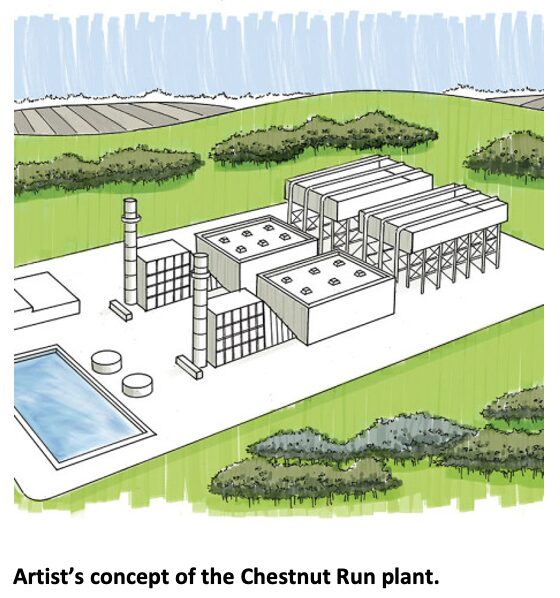
And in April, Chestnut Run Energy announced plans for a 1.3 MW natural gas-powered electric plant, a $2 billion investment, in Carroll County, Ohio, also in the eastern part of the state. The project is being developed by Advanced Power, with offices in Boston and Houston. The firm specializes in low-carbon and renewable power-generating facilities.
In a guest piece on the website of EPSA, the Electric Power Supply Association, Dylan Borchers, an energy attorney with the firm of Bricker Graydon Wyatt, gave credit for the Ohio boom to HB 15, legislation passed in 2025. “In just a single year,” Borchers wrote, “Ohio has gone from having virtually no large‑scale behind-the-meter (BTM) generation for data centers and industrial customers to hosting multiple gigawatts of new natural gas generation and battery storage.” He continued:
This wave of investment is not accidental. HB 15 fundamentally rewrote the rules for how large electric customers can self‑supply power in Ohio, while simultaneously accelerating the state’s permitting processes to match the pace of modern load growth.
Ohio is a case study of how smart legislating can encourage increased capacity at a time of impending electricity shortages and rising utility rates. Other states are also welcoming the construction of more energy infrastructure.
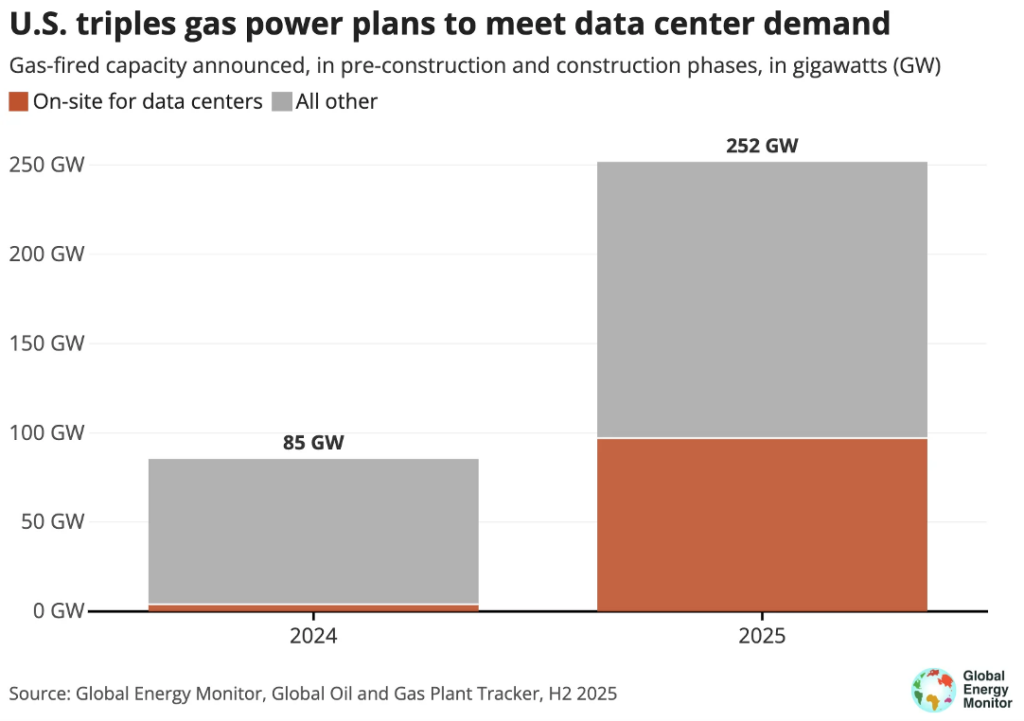
According to a Global Energy Monitor piece earlier this year, “The United States now has the most gas-fired power capacity in development — projects in the announced, pre-construction, and construction phases — surpassing China and accounting for nearly one-quarter of the world’s total.”
Data in the Global Oil and Gas Plant Tracker show that “the U.S. nearly tripled its gas-fired capacity in development in 2025, totaling almost 252 gigawatts (GW). If all in-development plants are built, the U.S.’ existing gas fleet would grow by nearly 50%, at an estimated cost of over US$416 billion in capital costs.”
Some of these plans may never reach fruition, and much depends on policy set in Washington. Donald Trump will leave just two and a half years from now – a much shorter timeframe than it takes to build a new gas-driven plant – and he may be replaced with a Democratic president and Congress.
The Trump Administration wants to stop future presidents from using the Clean Air Act to curb greenhouse gas emissions from the power sector, Chemnick writes, and “EPA is expected to soon transfer a supplemental proposal designed to make it impossible for a Democratic administration to use the landmark law to regulate power plant climate pollution.”
Will this effort succeed? Chemnick writes that “an examination of power providers’ planning documents [shows] the companies that supply electrons to the nation’s power grid…[expect] the Biden-era mandates for carbon capture and storage to go away.”
The number of new gas plants that have been proposed in 2025 “indicates that utilities no longer expect the Biden rule’s more stringent long-term requirements to kick in — that is, that new units start capturing 90 percent of their carbon by 2032 or run below 40 percent capacity,” Chemnick writes. “Such a requirement would have made those investments less cost-effective.”
She quotes Mike O’Boyle, director of electricity policy at Energy Innovation, a research firm, as saying:
The thing that you can objectively observe is the amount of power plants that are being announced and planned within service dates in the next two to five years is increasing. What the market is showing is that someone is willing to underwrite and finance and construct and build these projects.
Chemnick uses as an example Duke Energy’s plans for the Carolinas, where the giant utility expects load growth for the next 15 years to be eight times the growth of the previous 15 years.
The plan said that EPA’s proposed repeal of the Biden-era requirements would “help to enable flexibility for existing coal and new natural gas facilities. “But, added Chemnick, the Duke subsidiaries say they “continue to closely monitor the changing policy and regulatory landscape, recognizing that federal policy can shift quickly and impact planning decisions.”
State policy counts, too. North Carolina has a Democratic governor and Republican control of both houses of the legislature. In its plan, Duke notes “significant policy changes at the state and federal levels.” The document continues:
The Power Bill Reduction Act…eliminates the 70% interim carbon reduction goal and reduction goal and introduces new mechanisms for cost recovery and coal plant securitization. These changes provide new tools for managing the transition of the generation fleet while ensuring reliability and maintaining cost-effective service for customers.
Still, recent meeting notes for Duke Energy Kentucky show that the utility is considering a scenario in which a different kind of EPA from today’s “sets a new rule in 2030 that forces coal plants to retire and gas plants to retrofit with carbon capture and storage by 2037,” said the E&E article.
But, overall, Duke is counting on a mix of resources, with the largest increase coming from natural gas, which the utility sees increasing from 48,000 gigawatt hours (GWh) in 2026 to 95,000 GWh in 2040. Renewables will grow from 13,000 GWh to 45,000 GWh – a greater rate of increase but still trailing natural gas and nuclear (at 104,000 GWh) by a wide margin.
What appeared to be the most definitive comment came at the end of Chemnick’s piece, where she quotes Jeff Holmstead, an EPA official in the George W. Bush Administration who is now an attorney at Bracewell LLP:
In general, industry does not believe that a future EPA will impose [carbon dioxide] regulations that would threaten the reliability or affordability of the power supply, Sure, they recognize that there is future regulatory risk, but they believe that economic and political realities will keep a future EPA from going overboard.
The economic reality is that more infrastructure is needed as soon as possible. But there’s also a supply-chain reality.
Currently, building a new natural gas electric plant, or adding to a current one, is a challenging endeavor. If you order a gas turbine today, it will take five to seven years to be delivered. Prices are rising, and at GE Vernova, the world’s largest turbine manufacturer, there is a 100 gigawatt (GW) backlog. But all turbine makers are investing heavily in building more capacity.
Unsatisfied with How Grid Operators Are Responding to Demand from Large Loads, FERC Wants to See Better Rules
The Federal Energy Regulatory Commission (FERC) on June 18 told the six regional grid operators (RTOs) and independent system operators (ISOs) that their rules for connecting large loads in a time of rising demand need to be upgraded.
FERC wants tariff regimes that meet the new economic conditions that Artificial Intelligence and other drivers of increased electrification are bringing.
“In a unanimous, bipartisan vote, the five commissioners agreed that current tariffs are generally lagging behind the surge of data center load seeking to interconnect,” reported Latitude Media.
Still, FERC did not assert federal jurisdiction directly and “instead issued show-cause orders that require the RTOs and ISOs to justify their tariffs or revise them,” reported Maeve Allsup of Latitude. She added, “It’s a move that recognizes reform efforts already in regions including SPP [Southwest Power Pool] and PJM to address issues like co-location and flexibility.”
The RTOs and ISOs have to “provide justification within 60 days on why their current tariffs remain just and reasonable in the absence of clear and consistent provisions for large load customers—or alternatively to propose changes,” according to a fact sheet headlined, in unusually promotional fashion, “FERC Takes Action to Supercharge America’s Grid for Efficiency, Reliability, and a Bold Energy Future.”
The commission stated that the intention of these show-cause orders is “speeding the integration of large energy users, like data centers and manufacturing operations, onto the electric grid.”
The June 18 orders came in response to a notice of proposed rulemaking (ANOPR) issued by the U.S. Department of Energy in October. FERC said that its action meets DOE’s goals and “is critical to supporting the innovation economy, lead the global AI race, and reshore manufacturing jobs to the United States.”
Regulators face two big issues in response to rising demand: how to get more capacity quickly and how to keep costs down for consumers and businesses, especially those that are not triggering the added capacity. Those issues are often in conflict.
FERC found that the “ISO/RTO tariffs each lack adequate mechanisms to mitigate the risk of cost shifting among transmission customers,” said an analysis of the orders by the law firm Van Ness Feldman.
FERC is requiring cost-recovery agreements that include a minimum financial contribution from the large-load customer (based on the amount of power needed) “to reduce the cost burden to other network load customers by recognizing that, in addition to directly assigned upgrades for a large load interconnection, there is also an embedded cost to operating a grid with significant large loads” like those needed for AI data centers, said the analysis. (For more on potential obligations of large-load customers, see the section on the Ratepayer Protection Act below.)
Devin Hartman, a senior fellow at the R Street Institute, noted in an interview with Utility Dive that “FERC’s action is far more substantively ambitious than the ANOPR, and it enables region-specific investigation pathways that should be more effective than a uniform rulemaking.”
In a statement, FERC Chairman Laura Swett emphasized that solutions would not be one-size-fits-all but would be consistent with “respect for states’ rights” as well as “efficient markets and speed to power.” Swett said at the meeting:
Nothing in today’s orders intrudes either on the authority of states to select sites and permit generating resources or on the authority of states to set the rates, terms and conditions of retail sales of electricity…. We make clear that we act today to guard against cost-shifting among transmission customers, but the states have the responsibility to ensure that there is no cost-shifting among retail customers.
The six RTOs and ISOs that received the show-cause orders are: PJM Interconnection (PJM), Midcontinent Independent System Operator (MISO), Southwest Power Pool, California Independent System Operator (CAISO); ISO New England Inc. (ISO-NE) and New York Independent System Operator, Inc. (NYISO).
Gretchen Kershaw of the consulting firm Grid Strategies praised FERC for its regional approach but said she would like to see FERC act beyond the RTOs and ISOs. About one-third of the U.S. population, mainly in the West and Southeast, is not served by one of these grid operators. The fastest-growing state for electricity use, served by the Electric Reliability Council of Texas, is not affected by the orders.
Allison Clements, a former FERC commissioner agreed: “By punting on the tougher jurisdictional questions, FERC has left these customers without the cost and transparency protections that will be made available to families in RTO regions.”
FERC did, however, ask transmission owners outside RTOs to propose data center interconnection rules.
In the orders, FERC listed five categories of reforms that it wants the RTOs to address:
- Developing efficient transmission service application and study processes, including consideration of alternative transmission technologies
- Preventing cost shifting and requiring transparency into transmission cost
- Accommodating co-location arrangements and behind the meter generation
- Providing new transmission services for flexible large loads
- Developing a process to study generating facilities serving electrically proximate large loads and large co-located loads
For data center developers, FERC’s orders indicate that the agency is “committed to prioritizing projects that can prove they are real, financeable, operationally flexible, and capable of integrating with the grid without imposing unjustified costs on other customers,” said Jane Rueger, data center co-chair of the law firm Perkins Coie, quoted by Utility Dive.
Bond Ratings for Electric Utilities Are Deteriorating Because of Political and Regulatory Risk
Concerns over electricity rates are causing the outlook for utility and power sector to deteriorate, Fitch, the bond rating service, announced on June 12.
Fitch said the downgrade of the sector from “neutral” to “deteriorating” reflected “rising affordability concerns that are increasing political and regulatory risk for the sector.” The private ratings agency added:
While our 2026 outlook issued in December 2025 identified regulatory resistance to rate increases as a key watchpoint, developments in 1H26 confirm that this risk is materializing faster and more broadly than anticipated.
Fitch described a balancing act for utilities. Business is good.
“Sector fundamentals remain supportive,” said the agency in a press release. “Electricity demand is expected to grow 2.0%–2.5% annually through 2030, driven by data center expansion, electrification, and industrial reshoring.”
On the other hand, however, “the operating backdrop has become more challenging as customer bills continue to rise. With 36 states holding gubernatorial elections in November 2026, utility bills are emerging as a front-and-center campaign issue.”
The latest data from the U.S. Energy Information Administration (EIA) show that residential electricity prices have jumped 7.3% during the year ending April 30, 2026.
Some states — as politically diverse as Illinois, Montana and New Jersey (see the section on Rep. Pallone below) — are seeing double-digit percentage-rate hikes. Customers are outraged, leading politicians to demand rate freezes. The Associated Press reported last month:
Officials and lawmakers in at least six states — including Arizona, Indiana, Maryland, New Jersey, New York and Pennsylvania — are going to new lengths to try to block rate increases proposed by utilities. Some are pressing utilities to completely change their model for financing major system upgrades.
Even in Texas, which has been adding generation capacity faster than any other state, Gov. Greg Abbott sent a letter to state energy regulators on June 10 “saying they must take steps to prevent the cost of data center infrastructure from being passed on to residents,” Houston Public Media reported.
In the letter, Abbott directed the Public Utility Commission of Texas (PUCT) to take action to ensure that data centers actually lower residents’ energy bills when they connect to the grid and require data centers to pay for the costs of their electric infrastructure. Houston Public Media added:
Abbott said the agencies must submit a memorandum by July 17 outlining the steps they’ve taken, statutory limits to their authority and laws needed to take action. He also said the PUCT must act by the end of July to reduce residential transmission costs.
In a powerful illustration of the political costs of the issue, Gov. Mike Braun, a Republican, removed the chairman of the Indiana Utility Regulatory Commission (IURC) from office on June 22 after the agency agreed to a rate increase sought by AES Indiana.
Gov. Braun had appointed the chairman, Andy Zay, a former state senator, just six months earlier. The rate increase — $71 million — was “about 37% of what the utility initially requested and lower than a settlement agreement proposed in October,” the Indiana Capital Chronicle reported. Said Gov. Braun of the increase:
My top priority is affordability, which is why I am deeply disappointed by the IURC’s approval of another AES rate increase. Hoosiers have spent years tightening their belts and making tough financial decisions. It’s time for utility companies to do the same.
As we have frequently reported in this newsletter, the problem isn’t the cost of generating power but the expense involved in getting it to the people and businesses that need it – that is transmission over long distances and distribution to the end user.
For example, in our Newsletter No. 58, we stated, that an October report from Lawrence Berkeley National Laboratory, which looked at data from 2019 to 2024, “found that power price increases are being driven mainly by utility spending on distribution, transmission, disaster recovery, and some ‘clean energy programs,’” according to a summary by Institute for Energy Research.”
Fitch notes that utilities are planning “record capital spending of around $240 billion in 2026 to support load growth and improve system reliability and resilience. We expect annual sector capex to rise by a low- to mid-teens percentage rate during 2026-2030, adding to pressure on customer bills. These investments support credit quality over the longer term, but rising bills may make timely rate recovery more difficult.”
Fitch cited the PJM region, which includes all or part of 13 states, mainly in the Mid-Atlantic and Midwest regions, plus the District of Columbia, as the “clearest example of these pressures.” Fitch stated:
Data center-driven demand growth has pushed capacity auction clearing prices to more than $329/MW-day for the 2026/2027 delivery year from about $29/MW-day for 2024/2025…. Political and regulatory resistance has grown as these costs flow through to customers. Governors and state lawmakers have called for reforms to limit the impact on retail ratepayers.
S&P Global, which also provides securities ratings, took a different view in a report last month. The agency said that after six years of “downgrades mostly outpacing upgrades,” the utility industry is “entering a period of stability for at least the next two years.”
S&P, which sees capital expenditures by U.S. utilities totaling $1.3 trillion between now and 2030, also cited regulatory risks because of customer affordability concerns as data center demand rises and high capital expenditures are needed, but the agency concluded, “We generally expect issuers to maintain overall credit quality.”
Fitch noted that strong data center demand “could help utilities spread fixed costs across a larger customer base, benefiting residential customers…. Utilities are also seeking separate tariffs for data center customers to require them to bear the incremental cost of new infrastructure and prevent cost shifts to retail customers.”
Still, these benefits “are likely to emerge only over time and may not fully offset near-term bill pressure from elevated capital spending.”
How can the sector get back to a “neutral” outlook? If Fitch sees “evidence that affordability pressures are easing and that utilities can continue to recover rising investment needs without materially increasing regulatory lag or weakening credit profiles.”
Responding to Rising Utility Bill Pressure, California Revises Its Cap-and-Trade System
In a contentious meeting that stretched over two days, the California Air Resources Board (CARB) at the end of last month made changes to the state’s “market-based compliance mechanisms regulation,” another term for the cap-and-trade, or cap-and-invest, rules that some Northeast states are also modifying.
According to an Associated Press report on May 31, the move was “widely protested by environmental groups who said the changes would weaken the program and undercut efforts to curb planet-warming emissions. “
CARB was responding to the concerns of residents burdened with rising utility bills. Data from the EIA show that California had electricity costs in March that were the highest in the 48 contiguous states and twice as high as the U.S. average.
California’s cap-and-trade system, writes Jeff St. John of Canary Media, “was put in place in 2006, becoming the country’s first economy-wide emissions-trading mechanism for refineries, factories, power plants, and other major industrial sites. Together, these sources account for about 80% of California’s greenhouse gas emissions.”
The aim was to reduce carbon emissions 40% below 1990 levels by 2030. But the program, reported the Associated Press on April 16, “costs Californians an extra 24 cents a gallon at the pump and slightly more on their utility bills.”
A study last year by the Blue Sky Consulting Group found that “nearly 37% of the typical household’s monthly electric bill is attributable to state policies related to state-mandated public purpose programs (PPP), renewable energy requirements, wildfire prevention, and the cost shift from rooftop solar customers to non-solar customers.”
At a time when voters are concerned about affordability, it’s a burden that has attracted the attention of elected officials and regulators.
The cap-and-trade program sets a declining limit on total greenhouse gas emissions in the state from major polluters, including electric utilities. Companies have to reduce their pollution or buy allowances from the state or other businesses,
The changes CARB made to this program last month are complicated. As the AP explained:
The state will now give away up to roughly $3.5 billion worth of allowances to companies — mostly manufacturers and oil refiners — for free if they build projects that help them reduce their emissions. State regulators said it is designed to ensure major businesses don’t leave the state, but environmentalists say it runs counter to the purpose of the program.
Critics also say that if businesses don’t buy allowances, “it will mean there is less money to put toward programs designed to mitigate or reduce the impact of climate change,” reported the AP.
But there is no doubt that, at least marginally, the changes will reduce pressure on electricity costs.
The CARB decision comes the same time as a study by the Pacific Research Institute (PRI), the think tank that sponsors this newsletter, arguing that “bad policy” – including energy policy — has “cost California its economic edge.”
California’s share of domestic GDP has dropped in the past four years, private sector employment is shrinking, and residents are leaving. Energy expenses are one of three major reasons — together with taxes and housing costs — that the average Californian household “has a disposable net income that is 35.2 percent smaller than the national average,” said the study, co-authored by Wayne Winegarden and Kerry Jackson.
The “California Premium” for energy costs – above what the average American pays – is 12.4%. That’s despite California’s mild climate, which typically requires less heating in the winter and cooling in the summer.
“California’s average commercial and industrial electricity prices are exceptionally high compared to other large states and the U.S. average,” says the study. For example, commercial prices of electricity per kilowatt hour (kWh) average 198.6% higher than rates in Texas; 132.3% than in Florida; 36% and higher than in New York. Industrial prices per kWh are even worse: 251.7% higher than Texas; 153.3% higher than Florida; 134.6% higher than New York; and 162.8% higher than the U.S. average.
“These costs not only further increase the cost of living for Californians,” write Winegarden and Jackson. The costs also “make it harder for California businesses to grow and thrive.”
More evidence that California’s energy policy is holding back economic progress is that the state – despite its prominence in AI — is a laggard when it comes to developing data centers. A Los Angeles Times article on June 23 explained that “sky-high industrial electricity prices” are a major deterrent.
In addition, says the Times, “the state regulates the size of backup generators that keep the centers running when the grid goes down. That has limited most facilities to a fraction of the size that artificial intelligence increasingly demands.”
Said Mehdi Paryavi, chairman of the International Data Center Authority: “California isn’t even on the map today. Taxes are high, land is expensive, water is scarce, energy is difficult to find, communities are pushing back. There are all kinds of problems.”
Behind these costs are “troubling regulations such as the California Environmental Quality Act (CEQA),” says the PRI study. “Environmental mandates, such as the state’s cap-and-trade program, strict fuel standards, alternative generation mandates, and drilling moratoriums drive up the cost of energy.”
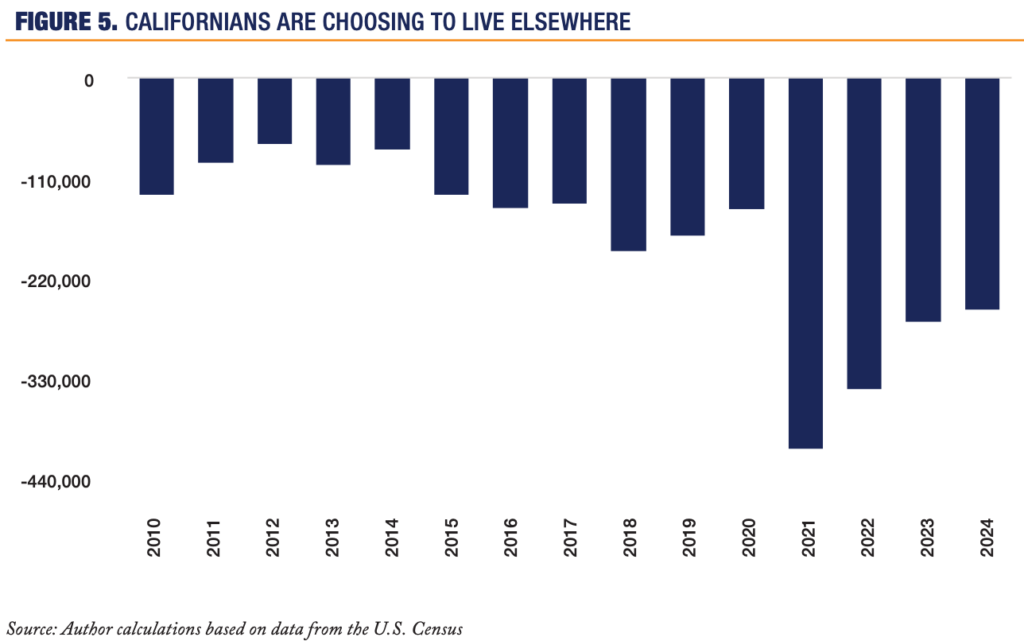
Californians are voting with their feet. The state leads the nation in net domestic out-migration, that is people exiting to live somewhere else in the U.S. During the period July 1, 2024, to June 30, 2025, some 229,100 residents fled. No other state comes close. New York was second at 137,600.
A study by the Public Policy Institute of California found that California has lost households at all income levels, not just among those in high tax brackets. Journalist Jim Geraghty summarized the situation last year:
U.S. News and World Report ranks each state on a wide variety of categories. In the most recent assessment, California ranked dead last in opportunity, dead last in affordability, 47th in employment, 47th in energy infrastructure, 46th in air and water quality, 45th in growth.
As we reported in Newsletter No. 60, environmental activists and a group of state lawmakers had been trying to convince CARB not to revise the status quo “because this proposal undermines the integrity of the program so substantially,” said Chloe Ames, a policy adviser at NextGen California, one of 45 organizations that signed a letter to CARB Chair Lauren Sanchez and Gov. Gavin Newsom (D).
Gov. Newsom, who has presidential ambitions, is fully aware of that his citizens are struggling with affordability. He has expressed concerns about high electric bills for the past two years. In our Newsletter No. 40, we quoted a Politico piece stating that Newsom’s ”decisions to postpone the closure of [California’s] last nuclear plant and to extend the life of some natural gas-fired facilities highlight what officials and experts say is the fact that the state with the most ambitious energy goals is far from achieving them.”
Slowly, elected officials and regulators in California are recognizing that their climate-change programs have been too aggressive and threaten to harm families and the economy at a time when affordability is the most important political issue, so they are making changes.
Commotion in Congress Over Data Centers and Permitting
At a hearing on June 24, Rep. Frank Pallone (D-NJ), the top Democrat on the powerful House Energy and Commerce Committee, called for a nationwide moratorium on new data centers.
The surprising move by Pallone, a powerful member of the minority, “exposed new divisions in Congress over how aggressively to regulate the fast-moving industry,” reported E&E News. In Pallone’s home state, residential electric utility rates have risen 13% for the 12 months ending April 30.
Pallone’s opening statement drew attention away from what was expected to be the main event at the energy subcommittee hearing: mark-up of the Ratepayer Protection Act. That bill, co-sponsored by Rep. Kathy Castor of Florida, the ranking Democrat on the energy subcommittee, and Rep. Gabe Evans (R-CO), did get reported out of the panel on a voice vote, but Pallone called it “not nearly enough.”
The bill would amend Section 111(d) of the Public Utility Regulatory Policies Act of 1978 to direct state regulatory authorities to weigh whether to establish a large-load standard applying to customers drawing 100 MW or more.
The legislation seeks to require data center developers to absorb costs for new generation, transmission, and other infrastructure improvements rather than spreading them across the ratepayer base. The bill has bipartisan backing in the House as well as support from Microsoft, Google and other technology companies.
But Politico reported, “Even if the Ratepayer Protection Act can get through the House, top Senate lawmakers are divided on how and whether to move forward with federal data center legislation.” The article continued:
“Some Democrats and environmental advocates seeking stricter oversight of data center development were more critical, potentially making it harder for the ‘Ratepayer Protection Act’ — or something like it — to become law any time soon.”
Left-wing members of Congress, led by Rep. Alexandria Ocasio-Cortez (D-NY) and Sen. Bernie Sanders (I-VT, have been pushing for a data center moratorium with legislation, but Pallone is an influential, more moderate voice. He said in his opening statement:
Americans across the county have expressed concern and opposition to the rampant construction of AI data centers and Congress should take this political groundswell seriously with a data center moratorium….. Democrats have been clear: Families around the country should not see their power bills rise by a single cent because of data centers.
At the hearing, Pallone noted that data center electricity use had doubled since 2017 and is forecast to represent 15% of all electricity consumption by 2030. He blamed data centers for rising utility bills.
“This simply cannot continue,” Pallone said, pointing to bans enacted in New Jersey towns such as Asbury Park, Red Bank, Old Bridge and Sayreville. “The City of New Brunswick put a stop to a data center plan after the community stood together to oppose the project. We need to follow in their footsteps here in Congress,” Pallone said.
He also warned of harm to water supplies and air quality and said that the growth of AI infrastructure was putting unprecedented strain on the nation’s power grid.
Most of the opposition to data centers is coming from local communities and states, including Texas (see above). The president of the Utah State Senate, who had been a major supporter of a large data center near the Great Salt Lake, was defeated in the Republican primary on June 23 in what the New York Times called “one of the most high-profile signs of the voter backlash to data center projects.”
The Utah project was backed by the celebrity investor and “Shark Tank” personality Kevin O’Leary. Utah in the state, said the Times, were “worried about how much energy it would consume and how its water usage would affect the drought-stricken Great Salt Lake.”
Federal elected officials are also feeling the heat from constituents. Earlier this year, Senate Minority Leader Chuck Schumer (D-NY) said that if Democrats retake the Senate, they will push for “strong, enforceable consumer protections” on data centers, noted The Hill, which also said, “President Trump, however, is highly unlikely to support a pause on data center construction.”
Meanwhile, on June 16, Sens. Catherine Cortez Masto (D-NV) and Tom Cotton (R-AR) introduced the Fighting for Reliable Energy and Ending Doubt for Open Markets (FREEDOM) Act, aimed at reducing regulatory delays for a broad range of energy infrastructure projects. It’s the latest permitting reform legislation to be considered by Congress.
The bill joins similar bipartisan House legislation from Reps. Josh Harder (D-CA), Mike Lawler (R-NY), Adam Gray (D-CA), and Don Bacon (R-NE). It would establish enforceable federal permitting deadlines, require agencies to issue decisions on routine permits within 90 days and complex permits within one year, and create expedited judicial remedies when agencies fail to meet those timelines.
An important feature of the FREEDOM Act is that it would limit the ability of federal agencies to halt or revoke approvals for projects that have already secured most required permits. Such revocations have raised havoc over the past year, but Republicans recognize that a Democratic Administration might turn the tables on them, revoking permits for coal plants, for example, that were granted by the Trump Department of Energy.
The FREEDOM Act is comprehensive and bipartisan, but it probably won’t advance on its own. Instead, it could influence a final decision on permitting in Congress, which has been considering reform for the past three years.