
- A study says that “narratives…of rapidly rising electricity rates are inaccurate or incomplete.” Can that be right?
- New Jersey and New York struggle with the effects of greenhouse gas policies on utility bills.
- Tech innovators turn their attention to the antiquated electric grid. What can be done to fix it?
- Grid operators and other experts debate the level of risk from increased demand and constrained supply. But cooperation is on the rise, food tasters unnecessary. FERC blesses SPP’s consolidated planning process.
- House energy panel holds a hearing to dive deeper into the effects of Winter Storm Fern.
Utilities Attempt to Dispute Reports of Rapidly Rising Electricity Rates and Push More Monopoly Power
Electric utility prices in the U.S. rose 7.1% in 2025, according to a year-end report from the U.S. Energy Information Administration (EIA). For residential customers, the increase was 6%, compared with an overall increase in the Consumer Price Index of 2.7%. Rates for commercial users, including data centers, rose 7.8%.
A PowerLines analysis, released in a 47-page report, found that in 2025 “electric and gas utilities requested nearly $31 billion in rate increases, more than double the $15 billion in rate increases requested by utilities in 2024.”
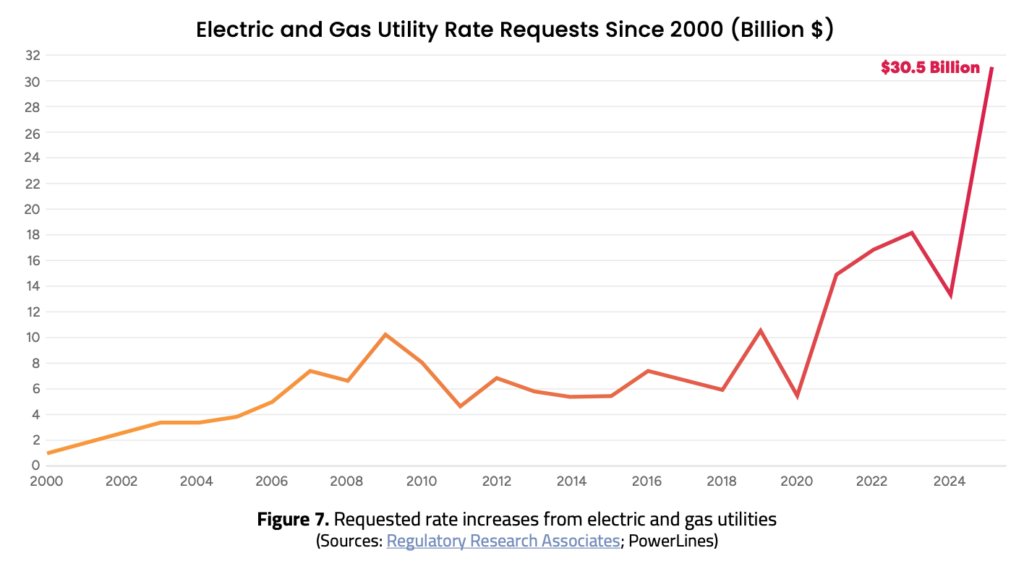
The Edison Electric Institute, the utilities’ trade association, responded by commissioning a study from Charles River Associates (CRA), which was released Feb. 2. Exelon, a large utility, also commissioned a CRA study, released last month, too.
The first study argued that “prevailing narratives that there is a broad national trend of rapidly rising electricity rates are inaccurate or incomplete.” Some states, especially in the Northeast, have seen large increases since they are “more susceptible to changes in wholesale electricity market prices because utilities there do not own generation.” The study also argues that California has been big increases “due to the cost of wildfires and wildfire mitigation,” plus costs associated with rooftop solar programs.”
It is true that the Northeast and California have seen large increases, but they aren’t alone. New EIA data show that 28 of the 51 states plus the District of Columbia experienced electricity price increases of 5% or greater – again, at a time when overall inflation was 2.7%. Those states were scattered across the country, including the South, Midwest, Rockies and Plains. Double-digit hikes occurred in such states as Indiana, Ohio and Washington.
The second CRA study zeroes in on PJM, the largest grid operator, and tries to make the case that customers in the region, which includes 13 states and DC would be better off in a “scenario in which utility-owned generation were more extensively used as a state- regulated complement to IPP [independent power producer]-developed generation.” The study focuses on capacity, or supply, costs.
EPSA, the Electric Power Supply Association, which represents competitive power producers, fired back with a Myth vs. Fact paper in response to the two CRA studies. We have reported in the past on EPSA’s first point, which is that bills are rising because of massive investment in getting power to customers on an antiquated grid, not in the cost of capacity or generation.
EPSA cites research by Energy Tariff Experts (ETE), “which analyzed 14 different utilities in PJM’s footprint over a decade and found that transmission, distribution, and state policies were the fastest growing parts of electricity bills. In fact, the share of electricity bills that came from energy generation and capacity prices remained consistent with historical averages.”
The ETE study is backed up by an October report from Lawrence Berkeley National Laboratory, which looked at data from 2019 to 2024 and “found that power price increases are being driven mainly by utility spending on distribution, transmission, disaster recovery, and some ‘clean energy programs,’” according to a summary by Institute for Energy Research. The Berkeley Lab study “also found that rates are rising faster in areas covered by investor-owned utilities.”
Another CRA claim that EPSA disputes is that utilities can only charge ratepayers once projects have been completed. “The CRA report concludes that AI data centers are not the cause of increasing prices because those data centers are not operational,” says the EPSA paper. But, in fact, utilities, with the permission of their regulators, can even recover costs for projects that never get built.
EPSA cites as examples the Mid-Atlantic Power Pathway, a $1 billion project by PEPCO and Dominion that was “abandoned and cost ratepayers $80 million despite never breaking ground” and the PATH transmission project between West Virginia and Maryland, “which cost ratepayers $250 million despite construction never beginning.”
An Issue Brief from the Manhattan Institute in December, analyzed
Construction Work in Progress, or CWIP, by which regulators allow utilities new capital projects to their rate base before completion. Researchers called CWIP “the most influential energy policy term that never appears on a household utility bill.” They said that “the arcane and expensive practice that “can add real dollars to what families pay every month.”
In our Newsletter No. 56, we discussed the report, which used, among other examples, Georgia’s Plant Vogtle Units 3 and 4. Approved in 2009 at $14 billion, costs ballooned to $37 billion, and the nuclear reactors did not enter service until 2023 and 2024.
As the Manhattan Institute researchers wrote, “A 2009 Georgia law designed to encourage nuclear construction allowed Georgia Power to roll CWIP into monthly bills as soon as concrete was poured. Customers effectively financed the project for 13 years before receiving a single kilowatt-hour of new nuclear electricity.” The report added:
Plant Vogtle’s trajectory makes the problems with CWIP vivid. Mounting construction setbacks from component redesigns, contractor bankruptcies, and pandemic-related labor shortages led to an explosion in the total price tag. Rather than face punishment, Georgia Power was entitled to earn over 10% return on that growing sum each year because CWIP was already in the rate base. For management and shareholders, the mushrooming budget did not threaten the project’s profitability; it enhanced it.
CRA asserts that independent power producers aren’t building fast enough to serve the demand in the PJM region. But EPSA cites factors outside of the IPPs’ control such as slow permitting proceses, state and local opposition to projects, labor shortages and supply chain issues. All of these factors have “made building new generation more difficult. Any company trying to build power plants will face the exact same barriers.”
Despite the obstacles, IPPs are investing in PJM and across the country, EPSA says. “Through its Reliability Resource Initiative, PJM is advancing 41 projects representing approximately 8,000 MW of generation. PJM has also signed agreements with 63.4 GW of projects to connect to the grid, but they have yet to be brought online due to red tape by state officials.”
Monopoly utilities apparently see the current crisis caused by the increase in demand for electricity as an opportunity to denigrate or eliminate competitors. But the story is more complex.
In a Fortune piece on March 17, Joshua Macey, a professor at Yale Law School, calls for structural reforms as the antidote to rising utility bills. He points out that current state regulatory systems create “a perverse incentive to overspend” on the part of utilities. “If a utility earns an 8% return, it makes $80 on a $1,000 investment, but only $8 on a $100 one – even if the cheaper option delivers the same economic or reliability benefits.” Macey continues:
In addition to reducing returns, regulators should also tie profits to specific performance criteria such as lower rates or improved reliability. Performance-based rates have been piloted in the UK with early signs of success. When properly designed, performance-based regulation can encourage utilities to make better use of system through energy efficiency, demand response, and grid-enhancing technologies.
New Jersey and New York Struggle With the Effects of Emissions Targets on Utility Bills
In 2025, New Jersey residential electricity prices rose 17%. That’s two and a half times the national average and more than six times the rate of overall inflation.
The state’s new governor, Mikie Sherrill, a Democrat, campaigned on freezing utility rates, and in her Executive Order No. 1 on Jan. 20, she ordered the Board of Public Utilities to “provide for Residential Universal Bill Credits (‘RUBCs’) to offset increases in the cost of electricity supply due to take effect in 2026.” That’s not exactly a freeze, but for many residents it would have a similar effect.
Now we are learning that the money for those RUBCs will come from funds raised through the Regional Greenhouse Gas Initiative (RGGI), a cap-and-trade program that has been criticized as a source of those higher electric bills.
RGGI, which has been adopted by 10 Northeast states, has already raised $950 million for New Jersey, and Politico’s Climate Wire reported on Feb. 20 that the new subsidies that Sherrill wants “could redirect future funding from energy efficiency and building electrification.”
Concurring with Sherrill, three New Jersey officials issued a statement: “Our agencies recognize that the current cost of electricity has reached the point of crisis for many residents.” They said they will “use available uncommitted and future RGGI proceeds to offset bill increases stemming from the rise in the price of electricity, especially for vulnerable families struggling to make ends meet.”
Cap-and-trade systems, like those prescribed by RGGI, place a limit on emissions and allow businesses to buy and sell permits to let them emit greenhouse gas. The cost of the permits is typically passed on to consumers, who foot the bill for policies aimed at mitigating climate change.
Gov. Josh Shapiro of Pennsylvania, a Democrat, is extricating his state from RGGI, as we noted in our Newsletter No. 54. The Commonwealth Institute, a Pennsylvania think tank, cited economic models estimating that the RGGI would increase residents’ electric bills by a further 30%. The foundation also pointed to polling that “indicates that RGGI is an unpopular policy for Pennsylvanians, whose survey responses show that energy affordability is a higher priority for them than combating climate change (68 to 32 percent).”
A white paper on the effects of RGGI by the economic consulting firm Tabors Caramanis Rudkevic (TCR) last year found that the “PJM wholesale market would provide lower cost energy to consumers and result in lower system-wide carbon dioxide (CO2) emissions were RGGI not implemented in any PJM state.” The research stated:
RGGI negatively affects consumers within the PJM footprint both economically and environmentally. Indeed, continuation of the RGGI program in its current form causes an increase in annual system-wide CO2 emissions of 2.9 million short tons and an increase in annual cost to serve consumer load in every PJM pricing zone totaling $1.8 billion across all zones.
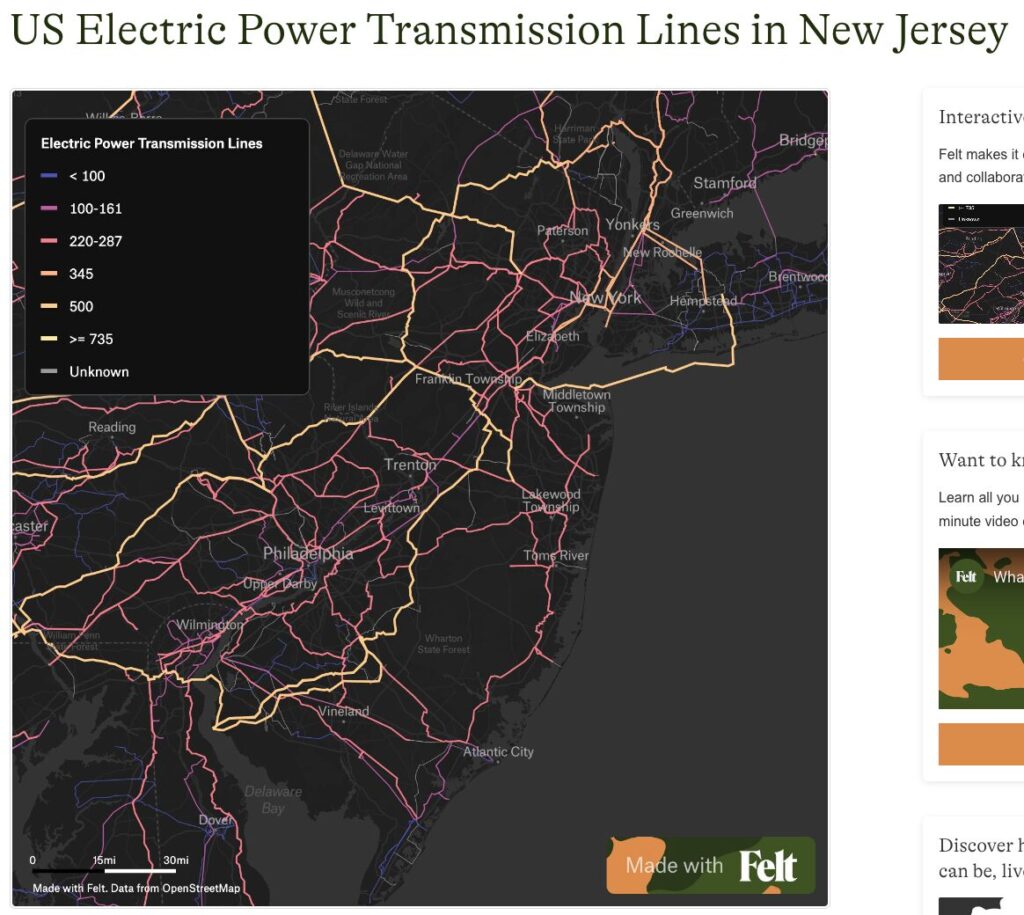
Meanwhile, on March 20, Gov. Kathy Hochul of New York, a Democrat, announced she was proposing changes to the state’s Climate Act, a 2019 law that requires reducing greenhouse gas emissions 40% by 2030 and 85% by 2050, alongside 100% zero-emission electricity by 2040. Hochul wrote in an op-ed in Empire Report that “the undeniable fact is we cannot meet the Climate Act’s 2030 targets without imposing new and additional crushing costs on New York businesses and residents.”
Absent changes in the law, she wrote, “the impact of meeting the Climate Act’s 2030 targets would be staggering—more than $4,000 a year for upstate oil and natural gas households, and $2,300 more for New York City natural gas households. And gas prices at the pump would jump an additional $2.23 per gallon above where it would otherwise be.” She continued:
As Governor, I can’t let that happen. While I am still committed to working toward our targets, with all the stress our residents are under, New Yorkers expect their elected officials to prioritize affordability. They are suffering from high costs every single day and I for one will not ignore their cries for relief.
Specifically, Hochul proposed amending “the law to require regulations to reduce statewide greenhouse gas emissions to be issued at the end of 2030. We are seeking to change what emission limits the regulations are tied to – including a new 2040 target as well as the existing 2050 statewide emission limits.”
She noted that “a number of other states with aggressive climate goals are also struggling to meet them given the current federal headwinds and have had to make amendments.”
Consider New Jersey. In effect, Sherrill is keeping RGGI intact and using the funds it generates to reimburse residents that are paying higher rates because of RGGI itself. As a result, RGGI won’t throw off as much money for the programs it is supposed to benefit. Critics say that a better solution would be to leave the RGGI compact entirely and let market forces act freely.
The Grid Is the Problem
Some of the smartest minds in America are now focusing on a problem that has festered for too long: how to deliver power efficiently to the families, businesses and factories that need it.
Technology companies need that extra power to run data centers to develop and enhance Artificial Intelligence applications. We have reported in this newsletter on bold moves, such as the agreements Meta, the parent company of Facebook, struck in January with Vistra, Oklo, and TerraPower to upgrade existing nuclear power plants and build future advanced reactors as a way of powering data centers. The deal would allow Meta to procure up to 6.6 gigawatts (GW) of existing and new energy by 2035.
Recently, the White House signed a Ratepayer Protection Pledge with Amazon, Google, Meta, Microsoft, OpenAI, Oracle, and others. “Big Tech companies are committing to fully cover the cost of increased electricity production required for AI data centers — and that would mean prices for American communities will not go up, but in many cases, will actually come down,” President Trump said on March 9.
Under the terms of the agreement, companies are responsible for funding their own power supply, grid infrastructure upgrades, and separate rate agreements with utilities, including paying for reserved capacity even when their facilities aren’t using it.
The details are unclear, but what is certain is that the big tech companies have a great deal of skin in the energy game. They are looking closely not just at immediate needs but at the entire structure of the power-delivery system. What they see is enormous waste, including an outdated grid that was built for short periods of peak use and is underutilized the rest of the time. The solution is not just additional generation resources but more efficient use of the existing grid.
To that end, Google and Tesla and several other companies, including Carrier Global, the air conditioning and heating giant, started an advocacy coalition called Utilize to devise and support policies to improve the process of transmission and distribution.
A March 10 press release from Utilize cited a recent analysis from Duke University that concluded that the electric grid operates at just 53% of capacity on average. Said Pier LaFarge, CEO of Sparkfund, a firm which helps utilities deploy and manage energy sources and is a member of the Utilize coalition: “What’s amazing is, the grid is only at peak 50 to 200 hours a year out of 8,760.”
The Duke study, said the Utilize press release, “estimates that 76 to 215 gigawatts of additional demand could be served on existing systems while remaining below historical peak conditions for all but a limited number of hours, illustrating how improved grid utilization can help serve new load without immediately requiring major new infrastructure investments.”
The core argument behind Utilize is straightforward: electricity costs are driven by the ratio of grid infrastructure cost to the electricity sold over it. If the grid sits idle most of the year, built to handle a few peak-demand hours that rarely come, consumers pay more per kilowatt-hour than they need to.
Utilize coalition members backed a bill in Virginia, which is now awaiting the signature of the new governor, Abigail Spanberger, a Democrat, that “would direct Appalachian Power Co. and Dominion Energy, the state’s two predominant vertically integrated utilities to gather and report detailed data on the their grid utilization,” reported Canary Media’s Elizabeth Ouzts on March 3.
The information would be used by regulators to establish a timeline to optimize grid usage. “The bill directs officials to give special consideration to ‘non-wires alternatives’” to vast new capital investment, wrote Ouzts, adding: “Many experts say the information the measure would require is itself meaningful. Utilities have long resisted gathering and reporting such metrics, in part because doing could hurt their case to build out more infrastructure that pads their bottom lines.”
LaFarge of Sparkfund also pointed to the loss of electrons as they travel from the point of generation to the customer, especially along lower-voltage alternating-current distribution lines. Ouzts quoted Charles Hua, executive director of the non-profit PowerLines, as saying, “Local poles and wires – that is, the distribution grid – is really not that efficient. But you never would really know because there’s not a ton of transparency around spending.”
Hua also explained the math: Increasing grid utilization divides the fixed cost of the poles and wires – roughly the same numerator – by more electrons, a much higher denominator. “Therefore,” he said, “you’re lowering the per-unit price of electricity, and you’re lowering utility bills for customers.”
But there’s another element as well. When utilities build more infrastructure — more poles, more wires, more power plants — they also get to profit from those investments. They can’t make a profit from their operating expenses, the cost to keep the existing system running. “If they were in the apple business, they get paid for planting more trees, not growing more apples,” said Amit Narayan, the co-founder and CEO of GridCARE, quoted in a Washington Post piece, which added:
According to some experts, that leads to an overbuilding of the electricity grid — raising prices even more for customers. Researchers and some companies say that there is a possible solution: Add new customers to the grid, but not during periods of peak demand. That means a data center, for example, that could be disconnected from the grid during the hottest five days of the year — thus soaking up excess capacity during lulls in demand without needing to build new power plants or lines.
Some Grid Operators Take Exception to NERC’s Assessment That They Are at ‘Extreme’ and ‘Elevated’ Risk; Others See Reliability Dangers
We reported in our Newsletter No. 57 on the “resource adequacy challenges” identified by the North American Electric Reliability Corp. (NERC) in its sobering “Long-Term Reliability Assessment” (LTRA). At a recent meeting of the Gulf Coast Power Association (GCPA) in New Orleans, the CEOs of two regional transmission operators (RTOs) took exception.
NERC’s report rated Midcontinent Independent System Operator (MISO) “high risk” and Southwest Power Pool (SPP) “elevated risk.” John Bear of MISO sent a letter to NERC “calling for a more nuanced approach to assessment” and complained that the NERC report failed to take into account “MISO’s expedited generation process, which he argued would more than eradicate NERC’s predicted 7-GW shortfall beginning in winter 2008/29,” reported RTO Insider on Feb. 26.
Bear also said NERC’s conclusion ignored the annual resource adequacy survey the RTO produces in partnership with the Organization of MISO States. That survey projected between a 11.4-GW and a 14.1-GW surplus by the 2030-31 planning year.
SPP’s CEO Larry Nickell agreed that “the whole story is not being told,” particularly when comes to factoring Expedited Resource Addition Study (ERAS) projects into SPP’s capacity projections. ERAS is meant to accelerate the interconnection of certain projects onto the grid to prevent a supply crunch in the coming years.
More than 4.8 GW, or two-thirds of MISO’s projects seeking expedited ERAS connection, are natural gas plants, with renewable energy and battery storage projects making up the rest, reported E&E News in December. The Federal Energy Regulatory Commission (FERC) approved SPP’s ERAS process in July. The grid operator expects to add 10 GW to 13 GW of power under ERAS and use Artificial Intelligence from Hitachi and Nvidia to find smarter upgrade solutions.
Still, not everyone at the conference was so sanguine about grid operators’ ability to handle load growth that Nickell called “astounding and never seen before in our careers” – especially in the face of plant retirements often driven by state emissions-reduction goals.
GCPA’s executive director, Barbara Clemerhagen, said that regional transmission organizations might be fielding “dangerous levels” of data center demand, according to the RTO Insider article on the conference, “especially considering that MISO’s reserve margins have fallen from about ‘24% to potential shortfalls in a short period of time.’”
Clemerhagen asked if the “gobbling of gigawatts” by Meta, Google, Amazon and other tech companies in the RTOs footprint could actually become a positive growth story. “We want economic growth,” said Nickell, “but we have to have the reliability.” Large loads could help reduce the rate burdens of other customers but only if those loads “commit to their share” of costs.
Meanwhile, on Feb. 23, the Midwest Reliability Organization (MRO), one of six regional entities created by NERC, issued a risk assessment report for 2026 that found the center of the U.S. at “extreme” risk of “uncertain energy reliability,” a condition that has prevailed since 2024. The report stated, “While electricity demand continues to climb, the projected supply from current and future combined generation is declining, creating significant uncertainty across the MRO footprint.” The report added:
Across the MRO region, accelerating retirements of dispatchable power plants before adequate energy is available, limited transmission capacity, and barriers to timely deployment of new infrastructure are increasing the risk of energy shortfalls.
In addition, MRO concluded that “material and equipment unavailability” escalated from a “medium” to “high” risk. The report cited “accelerating utility investments competing for the same electrical equipment required by hyperscale data centers and industrial facilities.”
Also at high risk were: generation outages during extreme cold weather, supply chain compromise, inadequate inverter performance and modeling, malicious insider threat, and nation-state threats. That last categories were assessed shortly before the U.S.-Israeli attacks on Iran touched off a wider conflict in the Middle East.
On an upbeat note, Bear said that MISO and SPP had gone from frosty distrust to cooperation, “touching base several times as weather event unfurl,” RTO Insider reported. Bear joked, “We had lunch today without food tasters.”
MISO had excess power to give SPP during Winter Storm Uri in 2021, and SPP handed over spare power to deliver to MISO during Winter Storm Fern this January. “Without these seams agreements in place, that power would not have been exported or imported. At some point, you have to be comfortable that seams exist.”
Barely a week after the conference, MISO and SPP announced that they are considering two sets of 500-kV transmission projects to “provide reliability, economic and transfer benefits across their southern seam, according to adraft report,” said a Utility Dive article on March 9. The projects would bolster the grid along the RTOs’ mutual border in Arkansas, Louisiana, Oklahoma and Texas.
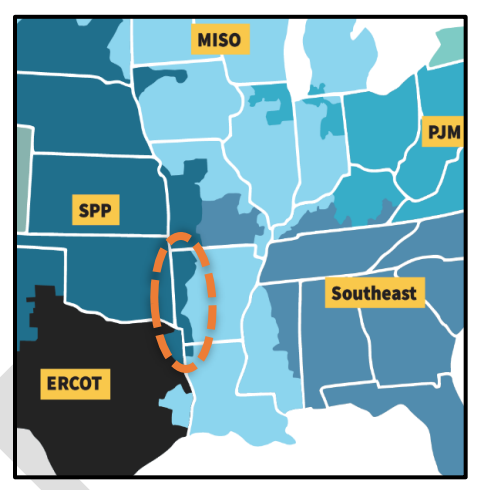
Then, on March 13, FERC approved SPP’s proposal to combine its generation interconnection and transmission planning into a single Consolidated Planning Process. In the fall, SPP will “publish the first Generalized Rate for Interconnection Development-Contribution (GRID-C), a standardized rate to cover system upgrade costs that gives project developers greater upfront cost certainty before they commit to the interconnection process,” SPP said on March 16, according to a Utility Dive report.
FERC Commissioner David Rosner said in a statement released with the agency’s decision:
SPP and its stakeholders have risen to the occasion with one of the most innovative, common-sense proposals presented to the Commission since the inception of open access transmission service. This proposal will get transmission built smarter and connect new generation faster, helping to make energy more reliable and affordable in the SPP region.
It’s clear that despite the defensiveness over NERC’s disturbing forecasts, RTOs like SPP understand the crisis they are facing. Certainly, smarter use of transmission and interconnection is part of the answer to the current electricity squeeze.
House Hearing Throws More Light on How Winter Storm Fern Was Weathered
As we reported in our Newsletter No. 57, grid operators, utilities, and public officials breathed a sigh of relief after a major storm two months ago caused fewer outages and less damage than expected.
Winter Storm Fern, which began Jan. 23, brought snow, sleet and freezing rain across 34 states — from the Rockies to the Plains, the Mid-Atlantic, New England and the South. It was followed by an Arctic front that kept temperatures low across the country. On Jan. 28, the low in Jacksonville, FL, was 28 degrees; Boston broke a 125-year record with 17 inches of snow.
Analysts agree that the power sector was better prepared than for Winter Storm Uri in 2021, a more powerful storm. Now, we are getting even more detail and learning how close the U.S. came to a Uri-style breakdown.
“Winter Storm Fern was a near-miss event,” said the CEO of NERC at a post-mortem U.S. House hearing on March 17 titled “Winter Storm Fern Lessons: Supplying Reliable Power to Meet Peak Demand.”
NERC’s chief executive, James Robb, pointed out that despite outages that affected one million Americans, the bulk power system “performed with resilience, without the need for operator-initiated load shedding, said Robb. Still, he said, there were “significant operating challenges, [and] these outcomes should be no cause for complacency. The wide array of actions to manage Fern may have had far different results with a larger, longer, colder storm.”
In his opening statement, Rep. Bob Latta (R-OH), the chairman of the subcommittee on energy of the House Energy and Commerce, reminded the audience that the U.S. stands “on the precipice of tremendous growth in our nation’s electricity demand” and must “shore up the reliability crisis” and find ways “to power next-generation industries.”
Rep. Marriannette Miller-Meeks (R-IA), a subcommittee member from Iowa, expanded on Robb’s remarks: “The lesson from Winter Storm Fern is that we’re asking more of the grid in every region and increasingly relying on emergency tools and extraordinary coordination to navigate conditions that are becoming more common, not rarer.
“At the same time, we’ve layered on emergency orders, special directives, and broad must-run orders that, in some regions, effectively over-procure generation and crash prices. These tools helped us through Fern, but they’re not a sustainable business model for a grid that’s about to serve even larger loads.”
Chairman Latta’s conclusion was that “our nation needs dispatchable energy and a lot more of it.” Like Latta in pointing to NERC’s worries going forward, NERC’s Robb’s stated:
Current trends show that the proportion of variable generation coming onto the system is rising, while the proportion of dispatchable or “firm” resources is declining. As older fossil-fired generators retire and are replaced by more battery and solar PV resources, the resource mix is becoming increasingly variable and weather-dependent. This trend also affects the supply of essential reliability services (ERS) needed for grid stability. These factors present a critical challenge that must be well understood and planned for.
Rep. Julie Fedorchak (R-AL) asked Robb about the effect of “premature retirements of baseload resources such as natural gas and coal.” Robb answered that those facilities not only provide added energy production but also “create the special sauce that keeps the grid operating. They create frequency, they create voltage, and they create the ability to control those within very tight parameters, which is what allows the high-voltage transmission system to operate.”
During the summer, NERC’s Long-Term Reliability Assessment (see above) projects that coal and natural gas-fired generation’s share in peak generating capacity will decline from 62% of the resource mix today to 48% by 2035.
“Resources for meeting peak demand will be more variable, as wind, solar, battery, and hybrid generation’s potion of the resource mix climbs from 12% today to 34% in 2035,” said Robb in his written testimony. He added:
While there are substantial amounts of wind, solar, and battery resource installed capacity on the grid currently, their contribution to on-peak winter capacity is limited at just 7% of the resource mix.
Winter demand often peaks during periods of darkness and during weather conditions that are not favorable for renewable generation. “As a result,” said Robb, “the winter peak resource mix leans heavily on coal and gas-fired generation, combined at 65%, and another 28% of nuclear, hydro, and other resource types.” As for Fern itself, Robb said to the committee:
Significant generation outages, including an accumulative loss of 2.8 GW overnight Friday, January 30. These outages were far below the scale observed during Winter Storms Elliot and Uri. Natural gas, coal, and nuclear resources provided most of the generation during the event, while renewable resources contributed modestly.
He continued, “In New England, fuel oil and natural gas kept the lights on, underscoring the criticality of the Everet LNG terminal in Massachusetts. The storm was not as cold as initially forecast, and widespread closures of schools and businesses reduced demand, relieving pressure on the system.”
In his written testimony, Michael Goggin, executive vice president of the research firm Grid Strategies, stated that, contrary to some claims, “Coal units that have received Department of Energy (DOE) mandates to continue operating performed particularly poorly during Winter Storm Fern, as documented by DOE’s own data.” The three plants – Campbell, Schahfer and Culley – achieved, on average, only about one-third of their nameplate output.
“This poor performance is to be expected for coal plants that were slated for retirement because their equipment has reached the end of its useful life. In many cases their owners have also deferred maintenance and capital expenditures in anticipation of their retirement, further exacerbating their performance.”
Goggin concluded his written testimony this way:
The primary solution to reliably meeting load growth is to let markets work and to respect utility planning and regulatory processes. Electricity markets are inherently self-correcting as they send price signals to increase supply when demand is growing faster than supply.
State utility commissions oversee planning processes that have successfully kept pace with growing demand for more than a century, including periods of load growth that were faster than today’s. Interfering with those market and state regulatory processes can only result in less efficient outcomes.
Also testifying was Brett Mattison of Southwest Electric Power (SWEPCO). He had a different view of coal, which, he said provided 53% of SWEPCO-owned generation during the storm even though on average it makes up only 31% of the utility’s resource mix. In addition, natural gas (25% of power during Fern) and wind (22%) units also performed well.
But Mattison warned that “in areas where [gas] units are served by a single pipeline or located at the end of the system, cold weather curtailments by gas pipeline and fuel providers can and do occur.” Also, sleet or freezing rain – as occurred during Winter Storm Heather in 2024 – “can result in icing on blades or towers which presents a safety and operational issue for wind turbines and may force shutdowns.