
- As their constituents suffer from higher utility bills, governors in the Northeast, all Democrats, are scaling back their renewable energy programs and emissions goals.
- A Senate hearing probes what to do about a bulk power system under stress.
- In a potential victory for future energy investment, Supreme Court rules that a critical Louisiana wetlands case belongs in federal court.
- Another lawsuit attacks the behavior of large asset managers owning coal company stock. The action could backfire, hurting energy investment broadly.
- Confusing policies are thwarting the buildout of data centers and spooking investors.
- Executives will be retried in massive Ohio utility scandal.
Democratic Governors, Worried About Affordability, Cut Back on Their Climate-Focused Energy Programs
Politico on March 30 ran a piece headlined, “The affordability crunch is pushing Democrats to scale back climate ambitions.” Adam Aton and Marie J. French wrote,
In a bid to quickly lower electricity costs, a growing number of Democratic-governed states are pulling money away from programs to save power and boost renewable energy, often by cutting charges on utility bills or redirecting those funds toward customer rebates.
Democratic governors in New England the Mid-Atlantic “are retreating from the blue-state climate model that defined the Biden era: utility-bill charges, public subsidies and strict mandates aimed at cutting emissions and building a cheaper, cleaner grid, even if the payoff would come years later.”
These officials are targeting “even the climate goals they once championed” because they see the policies “as politically and financially untenable. Those policymakers say it’s a necessary response to soaring utility bills that have come to dominate cost-of-living concerns – and good politics, too, as affordability is emerging as a defining issue of the midterms.”
Aton and French highlighted Rhode Island, where Gov. Dan McKee is pitching cuts to taxes and policy charges that comprise about one-quarter of the state’s residential utility bills. The charges were directed toward programs that would help meet the state’s Renewable Energy Standard deadline. McKee’s budget proposal would stretch that deadline to 2050.
“The biggest hardship I hear from Rhode Islanders right now is their growing energy bills,” McKee said after he proposed pushing back Rhode Island’s renewable energy standard, curb and rework solar incentives, and cap utilities’ ratepayer-funded energy efficiency spending.” He said his proposal would save ratepayers $1 billion over five years. Politico reported:
Those moves, if they pass the Legislature, would torpedo the state’s aggressive climate timelines. Rhode Island’s Act on Climate compels the state to cut emissions 45 percent below 1990 levels by 2030. And its clean electricity law requires all-renewable energy by 2033, underpinned by major offshore wind solicitations — all policies undertaken by McKee.
In a similar piece on April 11, the New York Times reported, “In Massachusetts, lawmakers are eyeing cuts to a program that adds charges to utility bills to fund heat pumps and efficiency upgrades, while Gov. Maura Healey has pursued a flurry of energy policy changes to address affordability.”
Another Democrat, Gov. Josh Shapiro of Pennsylvania, a possible presidential candidate, is extricating his state from the Regional Greenhouse Gas Initiative (RGGI), a cap-and-trade pact among Northeastern states, as we noted in our Newsletter No. 54.
The Commonwealth Institute, a Pennsylvania think tank, cited economic models estimating that the RGGI would increase residents’ electric bills by 30%. The foundation also pointed to polling that “indicates that RGGI is an unpopular policy for Pennsylvanians, whose survey responses show that energy affordability is a higher priority for them than combating climate change (68 to 32 percent).”
Last year, Connecticut lowered its 40% renewable energy goal for 2030 to 29%. Democratic Gov. Ned Lamont said at the time that “electric bills are too damn high.” Connecticut is one of the few states where those bills have declined in the past year.
Gov. Wes Moore of Maryland, another potential Democratic candidate for president in 2028, backed legislation passed April 13 by the Maryland General Assembly that “cuts utility energy efficiency spending by lowering carbon emissions reduction targets,” saving the average family at least $150 a year, according to Utility Dive.
A press release from Gov. Moore’s office stated that “the bill allocates $100 million from the Strategic Energy Investment Fund to offset utility fees and lower energy bills for Marylanders, and temporarily adjusts near-term EmPOWER goals to ensure a sustainable trajectory while recognizing real-world challenges around high-utility costs.”
EmPOWER is a state program, enacted in 2008, “to incentivize energy efficiency and conservation efforts.” It is funded with surcharges on utility bills.
In New York, Democratic Gov. Kathy Hochul, who is running for re-election in November, announced on March 20 that she was proposing changes to the state’s Climate Act, a 2019 law that requires reducing greenhouse gas emissions 40% by 2030 and 85% by 2050, alongside 100% zero-emission electricity by 2040.
Hochul wrote in an op-ed in Empire Report that “the undeniable fact is we cannot meet the Climate Act’s 2030 targets without imposing new and additional crushing costs on New York businesses and residents.”
She added, “As Governor, I can’t let that happen. While I am still committed to working toward our targets, with all the stress our residents are under, New Yorkers expect their elected officials to prioritize affordability.”
Meanwhile in New York, “developers are signaling they may walk away from projects after the New York State Energy Research and Development Authority declined to renegotiate contracts to account for higher costs tied to tariffs and inflation,” reported FingerLakes.com on April 14. “Industry expectations for profit margins — typically around 8% — have tightened, with some developers opting to abandon projects rather than accept lower returns.”
The article added, “The potential cancellations could significantly impact New York’s renewable energy pipeline at a time when the state is already behind pace on targets established under the Climate Leadership and Community Protection Act.”
In addition, as we reported in Newsletter No. 58, the new governor of New Jersey, Mikie Sherrill, also a Democrat, has ordered the Board of Public Utilities to “provide for Residential Universal Bill Credits (‘RUBCs’) to offset increases in the cost of electricity supply” that were set to take effect this year. The money for those RUBCs will come from funds raised through the RGGI, a program that has been criticized as a source of those higher electric bills. Moving the funds will mean that programs to promote more clean energy will necessarily be delayed.
The Times pointed out that these states’ “ambitious targets look increasingly out of reach. Various states had aimed to reduce emissions roughly in half by 2030 and nearly zero them out by midcentury. Yet New York’s emissions have barely budged since 2021, while carbon dioxide from New England’s power plants has increased the past two years.”
Many Democratic officials blame President Trump for the elimination of tax breaks for solar panels and electric cars and for his animosity to giant offshore wind farms that were supposed to produce clean power. New York’s plan, for example, “calls for 9,000 megawatts of offshore wind by 2035, enough to power 6 million homes. Currently, only 1,800 megawatts are set to come online,” reported the Times.
But White House opposition isn’t the only factor. Said the Times:
The Northeast has for years had some of the nation’s highest electricity rates, partly driven by local policies. Some Democratic governors, worried about looming electricity shortages, now want to reconsider longstanding taboos against expanding nuclear power or natural gas pipelines.
The Northeast is not the only region where officials are scaling back. California regulators have proposed changes to cap-and-trade rules “in response to concerns from lawmakers about electricity prices and economic worries from industry,” reported the Associated Press on April 16.
Cap-and-trade “is crucial to achieving goals that include reducing greenhouse gas emissions to 40% below 1990 levels by 2030.” Like New Jersey, where Gov. Sherrill backed similar changes, cap-and-trade funds direct billions of dollars to incentives for public transit and electric vehicles.
“The program,” the AP reported, “costs Californians an extra 24 cents a gallon at the pump and slightly more on their utility bills.”
Clearly, electric bills will be major issues in the mid-term elections coming up in little more than six months. Massachusetts has the highest residential rates in the nation, followed by California. New EIA data for January 2026 – the latest so far — show that the average price of electricity for residential users rose 9.5% compared with January 2025. That’s an astounding increase, and for some states it was far more.
Residents of New Jersey are paying 17.5% higher rates for their electricity compared with last year. But Democratic states aren’t the only ones suffering. In Oklahoma, rates have risen 14.4% in the past year; in South Dakota, 13.2%; Louisiana, 12.2%; and in Ohio, 12.6%.
As Demand Rises and Plant Retirements Increase, the Bulk Power System Is Under Stress. What to Do?
Sen. Mike Lee (R-UT), the chairman of the Energy and Natural Resources Committee kicked off a sobering hearing of the full panel on March 25 on “The State of the Bulk Power System” this way:
We’re facing a growing imbalance between supply and demand. We in the United States have retired dozens of gigawatts of reliable, dispatchable generation. For a time that may have been manageable. Demand was relatively flat, and the system had some margin. But that’s no longer the case.
Among the witnesses was Liza Reed, director of climate and energy policy at the Niskanen Center, a Washington think tank. She stressed the importance of an “all of the above” generation strategy with stronger policies to link transmission among regions.
She pointed out that during Winter Storm Fern in late January, “all major resource types experienced some level of stress or underperformance in at least one region. At the same time, each resource made important contributions to keeping the system operating: gas, coal, nuclear, renewables, and storage all supplied significant power when it was most needed.”
She explained that “not one resource is sufficient on its own,” adding:
Reliability depends on how these resources work together. Transmission enables the system to draw on complementary strengths across regions. Relying too heavily on any single fuel source creates both reliability and economic risks, since each fuel source faces its own weather-related operational concerns and supply problems.
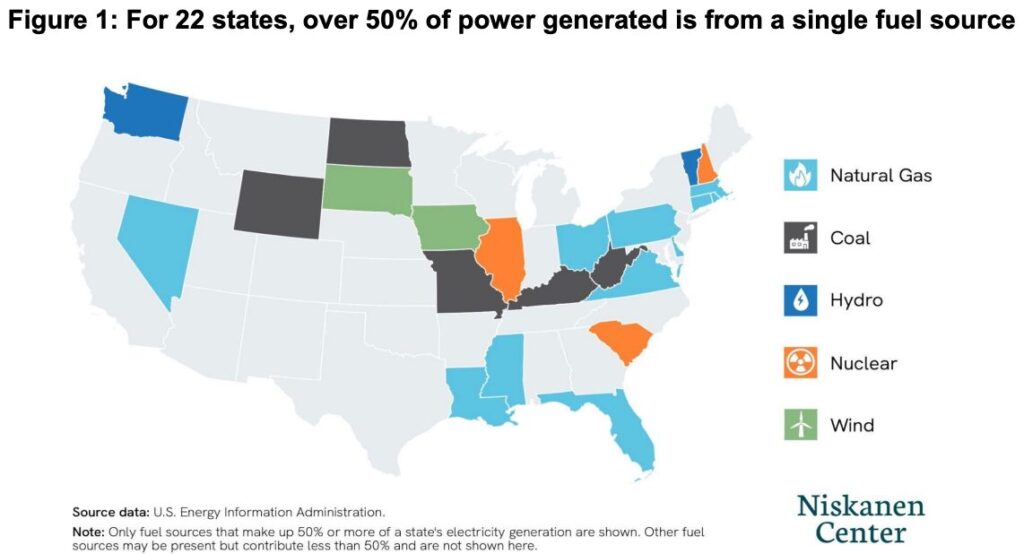
Unfortunately, as Reed showed in the graphic below, “data from the U.S. Energy Information Administration reveal that 22 of the 48 contiguous states rely on a single energy source for 50 percent or more of their electricity mix in 2025, often leading to mismatches between energy supply and demand.”
Reed emphasized that more interconnected transmission between regions is a necessity. She said that “at the highest level, we have three distinct grids, between which there is very little power transfer”: Eastern Interconnection, Western Interconnection, and the Electric Reliability Council of Texas (ERCOT).
“Within the eastern and western interconnection, there is further distinction into planning regions and then individual utility footprints. These planning regions are important because they are the areas where groups of utilities have come together and agreed to co-plan their transmission systems and coordinate their operations.”
She cited FERC Commissioner David Rosner’s praise of the interconnection planning process of the Southwest Power Pool (which we wrote about in Newsletter No. 58). She also noted:
PJM approved a process in 2025 to ensure dispatchable projects had their interconnection agreements in hand quickly, allowing them to move ahead of other projects that were in the queue. But the projects that came out of PJM’s expedited process still needed billions of dollars of grid upgrades.
Said Reed: “Interregional transmission is essential to electricity affordability…. If transmission ties had been expanded by 1 GW between regions, comparable to one new transmission line, ratepayers would have seen up to $183 million in value between January 23 and February 3, 2026.
Travis Fisher, director of energy and environmental policy studies at the Cato Institute, a free-market think tank, told the committee that Congress should address the current crisis in demand and rising utility bills “by reducing regulations, removing barriers to energy production and delivery, and creating opportunities to expand power supply at the rapid pace of American entrepreneurship.”
He added that the U.S. was “still reeling from the previous administration’s poor energy policies” which have meant that “thermal generators are retiring at a rapid pace…. Retirements are at risk of outpacing the construction of new resources, due to a combination of industry forces, including siting and supply chain, whose long-term impacts are not fully known.”
Fisher also expressed concern that the queue at PJM, the largest grid operator, “is composed primarily of intermittent and limited-duration resources,” such as solar. He said:
Given the operating characteristics of these resources, we need multiple megawatts of these resources to replace 1 MW of thermal generation. High prices in the recent PJM capacity auction are further evidence of strain on the PJM system. Capacity prices rose nearly ten-fold between 2023 and 2024, highlighting the increases in new demand.
Also testifying was Todd Snitchler, CEO of the Electric Power Supply Association (EPSA), a trade group representing competitive power providers. He warned the committee that because of concerns about a lack of capacity, “some have seized on this discussion to advocate for allowing investor-owned utilities to once again build and operate power plants, reversing nearly 30 years of restructured experience.”
This proposition, he said, “is rooted in the requirement that the cost of investing in this new generation would be paid for – with an agreed-upon guaranteed rate of return – through retail electricity rates.” But if the capacity becomes “unnecessary before the end of its useful life, or the technology itself obsolete, ratepayers still foot the bill plus the return on equity.” But, he added:
Even with the guaranteed profit through a captive rate base, no generation developer has a silver bullet for navigating permitting and siting challenges.” In fact, he said, “Permitting reform is perhaps the most impactful benefit that Congress can provide the energy industry to improve reliability and assist in affordability efforts.
As for other obstacles, Stichler stated, “While improvements have been made, every generation developer faces the same interconnection and permitting processes, regardless of the regulatory framework. Similarly, chronic workforce and supply chain shortages (particularly for natural gas turbines and substation equipment) pose the same challenges to all developers and are not somehow overcome with a guaranteed ROE.”
Future Energy Investment May Be the Winner in a Supreme Court Ruling Involving Louisiana Wetlands
This newsletter has frequently reported on the legal battle in Louisiana over land loss and erosion in the state’s wetlands. On April 17, the U.S. Supreme Court agreed in Chevron USA Inc. v. Plaquemines Parish, La., that energy companies facing dozens of lawsuits over the environmental damage can move their cases from state courts to federal.
The New York Times called the unanimous ruling “a significant victory for oil companies, led by Chevron and Exxon Mobil.” While the companies were supported by the Trump Administration, the Louisiana parishes (akin to counties) were backed by the state’s conservative Republican governor, Jeff Landry.
In a Dec. 12 opinion piece in the New Orleans Times Picayune, James K. Glassman, a former senior fellow at the American Enterprise Institute, criticized Landry, saying that the parish suits “run directly counter to Donald Trump’s energy goals” and will discourage future investment in critical fossil fuels in the state.
Glassman wrote that, with the lawsuits that have been filed, “Landry and his friends in parish governments and local law firms are creating a hostile climate that will discourage the state’s remaining private-sector growth engine from making new investments.”
Chevron argued that its crude-oil production during World War II came at the behest of the U.S. military and, therefore, the matter deserved to be in federal court. Such a court would likely be a more friendly venue compared to state courts, where judges are elected and often have a cozy relationship with plaintiffs’ attorneys.
A Wall Street Journal editorial that praised the decision pointed out that a state judge overseeing the original trial “received campaign donations from the plaintiff firm leading the raid and made procedural rulings in the plaintiffs’ favor. A local jury awarded Plaquemines [Parish] $740 million in damages—equivalent to about $33,200 per resident.”
In its recitation of the facts, the Supreme Court decision stated:
In 1978, Louisiana enacted the State and Local Coastal Resources Management Act, which prohibited certain uses of Louisiana’s coastal zone, including oil production, without a permit. The Act exempted uses legally commenced before 1980. In 2013, Plaquemines Parish and other parishes filed 42 state-court suits against oil and gas companies under the Act. They alleged that the companies lacked permits and that some uses, although initiated before 1980, were illegally commenced and therefore not covered by the exemption.
The case focused on a narrow question. In his opinion for the Court, Justice Clarence Thomas wrote, “No party disputes that Chevron ‘act[ed] under’ federal officers when it performed its refining duties. We thus decide only whether this suit, which implicates Chevron’s wartime production of crude oil, ‘relat[es] to’ Chevron’s wartime aviation-gasoline refining for the military. We hold that it does.”
Another High-Stakes Court Case Could Have a Dampening Effect on Capital Deployment to Meet Energy Demand
Like the Louisiana litigation, a high-stakes anti-trust lawsuit against major asset managers threatens to limit the kind of capital investment that’s necessary to meeting electricity capacity and transmission needs.
In November 2024, Ken Paxton, the attorney general of Texas (and a candidate for the Republican nomination for U.S. Senate) joined 10 other states, all with Republican leadership, in suing three of the largest institutional investors in the world — BlackRock, State Street Corporation, and Vanguard Group – “for conspiring to artificially constrict the market for coal through anticompetitive trade practices,” according to a press release Paxton issued. The release continued:
Over several years, the three asset managers acquired substantial stockholdings in every significant publicly held coal producer in the United States, thereby gaining the power to control the policies of the coal companies. Using their combined influence over the coal market, the investment cartel collectively announced in 2021 their commitment to weaponize their shares to pressure the coal companies to accommodate “green energy” goals. To achieve this, the investment companies pushed to reduce coal output by more than half by 2030.
In May of this year, the Justice Department and the Federal Trade Commission filed a statement in support of the states’ lawsuit. “This case is about alleged anticompetitive conduct that increased energy prices for ordinary American consumers and businesses,” it said.
The Republican AGs and Trump Administration believe that the lawsuit will help the coal industry, which has been in long-term decline.
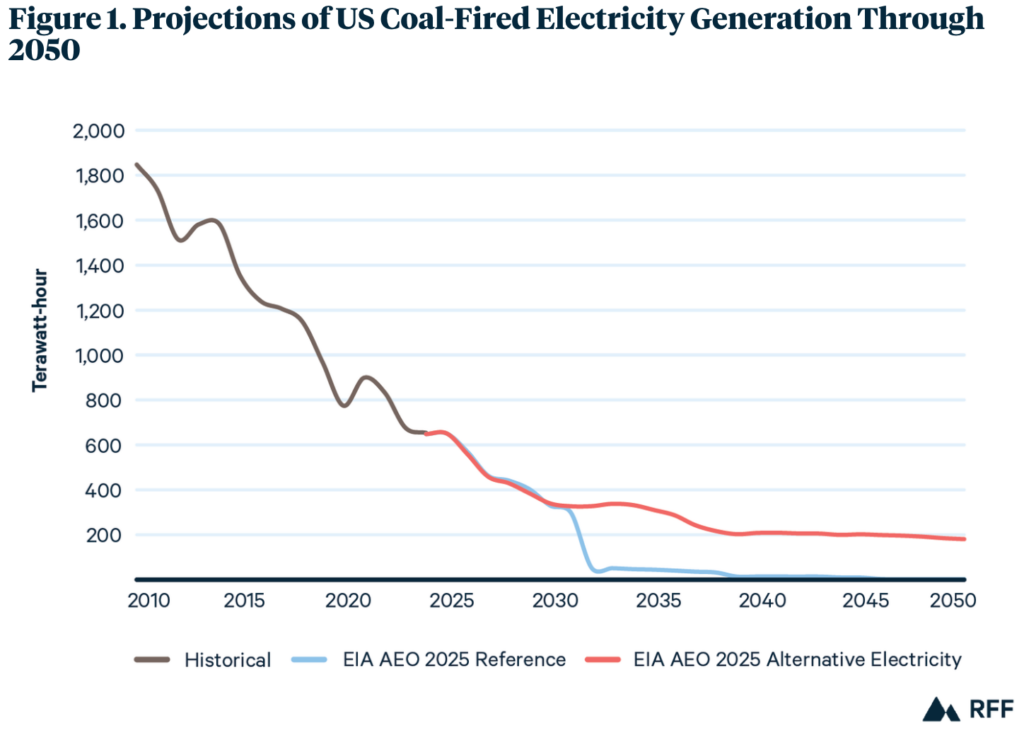
Over the past 10 years, coal has gone from accounting for 1.2 billion megawatt hours (MWH) of power to 737 million MWH while natural gas has increased from 1.4 billion to 1.8 billion. The Trump Administration has been trying to increase coal’s contribution by keeping coal plants open beyond scheduled retirement dates.
But the governors and the White House are misdiagnosing the main cause of coal’s decline, which is economic. Coal could make a comeback, but that would require vast amounts of private capital. More broadly, these legal efforts intended to support energy producers may instead starve them of the capital necessary to ensure reliability.
The New York Times reported that “one of the possible solutions sought by Mr. Paxton and the other states was for the firms to divest from coal entirely, which had provoked concern, since cutting the coal sector off from the world’s biggest financial firms could hurt the industry.”
Rick Perry, the former governor of Texas, criticized the suit in an op-ed in The Washington Times in August: “If successful, this lawsuit could force an estimated $18 billion in coal-related holdings off the books of these major asset managers,” he wrote.
This February, Vanguard settled with the 11 states for $29.5 million in an agreement that also blocks the firm “from supporting efforts to fight climate change.” The settlement did not include forced divestment; however, records show that shortly after the settlement, Vanguard dumped coal holdings.
For example, as of a March 27 filing, Vanguard’s ownership of shares of Peabody Energy, the number-one U.S. coal producer, fell from 14,693,000 shares (worth about $600 million) to zero. The stock plummeted from that date to the present from about $40 a share to about $26.
Wayne Winegarden, senior fellow at the Pacific Research Institute, which sponsors this newsletter, wrote, “If institutional investors are pressured to liquidate coal-related holdings, coal producers could face higher capital costs and reduced access to financing.”
BlackRock noted in a statement that, “by pursuing forced divestment, the Attorneys General are undermining the Trump administration’s goal of American energy independence. Forcing divestment will harm coal companies’ ability to access capital and invest in their businesses and jobs, likely leading to higher energy prices for Americans.”
This story goes beyond coal. Threats to capital investment in energy remain. There is a need for affordable, reliable generation from all sources, and that means more investment from all power sources – not less.
Winegarden concluded his piece this way: “Energy policy should focus on outcomes: affordability, reliability and security. That requires reducing barriers to investment across all viable baseload sources, including coal, natural gas and nuclear…. Starving reliable power of capital is a risk the grid cannot afford.”
In Newsletter No. 47, we reported that the Federal Energy Regulatory Commission (FERC) was contemplating lowering the threshold from the current $10 million for requiring commission approval of an investment firm’s purchase of a utility company’s securities.
“Increasing the stringency of the blanket authorization would have adversely impacted the U.S. energy industry,” wrote Winegarden in Forbes. He warned that creating additional investment barriers would hurt utilities’ ability to raise the necessary capital, hindering their ability to expand capacity and improve the current energy infrastructure.
“Thankfully,” he wrote, “FERC agreed.” Mark Christie, who was then FERC chairman, wrote that “public utilities face already large and still growing capital needs, including to fund investment in greatly needed utility assets, such as power generation.”
‘Energy Policy Vacillation in the U.S. Is Spooking Investors’
Despite April action in the House around the edges, permitting reform continues to be delayed in Congress, and data centers are facing opposition at the state and local level and suffering from a clogged supply chain and a lack of electric power.
Bloomberg reported on April 1 that “almost half of the US data centers planned for this year are expected to be delayed or canceled.” During the fourth quarter, the U.S. added 25 gigawatts (GW) of data center capacity, according to the consultancy Wood Mackenzie. That was 50% less than in the third quarter.
The Maine legislature on April 14 passed a bill banning the construction of new data centers through November 2027. The Wall Street Journal reported that “at least 10 other states are advancing similar bills over concerns that power demand from data centers could harm the environment and increase electricity prices. Some local municipalities and counties, including in Indiana and Michigan, have already imposed construction pauses.”
A plurality of the public blames data centers for rising utility bills, but that charge may not be justified. For example, a March 19 study by the Institute for Energy Research states:
There is no statistically significant correlation between the number of data centers in a state and its current electricity prices. In fact, prices in the top ten data center states are virtually identical to the average across other states. Furthermore, there is no statistically significant relationship between data center concentration and faster increases in electricity rates.
A piece by Christian Britschgi in the April issue of Reason magazine, the publication of a libertarian think tank, extolled the virtues of data centers as developers of highly productive Artificial Intelligence with relatively little disruption. “Data centers consume a tiny portion of the nation’s water,” wrote Britschgi, “While they’re not the prettiest buildings to look at, they mean less noise, fumes, and traffic than almost any other land use one could care to name.” The article continued:
“Their power consumption is gargantuan. But data centers’ electricity demands are also driving secondary innovations in the world of energy efficiency and power generation. In short, it’s hard to imagine an industry that gets more juice from the olives it squeezes…. We should all stop worrying and learn to love them.”
Emily Forgas, Akshat Rathi and Zahra Hirji of Bloomberg write that there is another “big reason,” besides public opposition, for the slowdown in data center construction: “the shortage of electrical equipment, such as transformers, switchgear and batteries. They are needed not just for powering AI, but also for building out the grid that is seeing increased consumption from electric cars and heat pumps.” The reporters add:
US manufacturing capacity for these devices cannot keep up with demand, and the scarcity has caused data center builders to rely on imports…. “There’s not enough domestic capacity to go around, so people are pretty much forced to go to the export market,” says Benjamin Boucher, senior analyst with Wood Mackenzie.
Instead, most parts are manufactured in China. Prior to 2020, it took 24 to 30 months to get components. Now, wait times run up to five years, Bloomberg reported, and imports are beset with high tariffs and domestic content rules.
Meanwhile, the Trump White House, like the Biden Administration before it, keeps intervening in energy markets. All of these obstacles prompted energy editor Tim McDonnell of Semafor to write on April 16 that “energy policy vacillation in the US is spooking investors and leaving the country less prepared to compete in the global economy.”
McDonnell noted that while domestic oil and gas production have insulated American “consumers from the worst impacts of the Strait of Hormuz closure, global business and government leaders have told me…that dirt-cheap electricity — put another way, dollars per unit of AI processing power — is the most important metric for future economic competitiveness” and that China has a huge lead.
“If this is going to be a race between China and the US to build energy, we might as well call it a day,” Joe Dominguez, CEO of Constellation, the Baltimore-based energy supplier, said at the Semafor World Economy conference “We are very far behind.”
How to catch up? McDonnell writes that there is “no shortage of capital poised to pour” into electricity infrastructure. “But a lot of it is waiting on the sidelines for the mess of US energy bureaucracy to get sorted out: Permits that are granted and withdrawn capriciously, tax credits that come and go, technologies that fall in or out of favor in successive administrations, and endless legal battles all amount to dangerous barriers to investment.”
The battle is not so much petrostate-vs-electrostate, as some analysts have framed it, but, as McDonnell puts it, “a tussle over which country looks like a more stable investment climate.” With an authoritarian government directed by the Communist Party, China doesn’t have to worry about democratic niceties like popular opposition to unhealthy or unsightly development.
But the problems today run deeper. “I was surprised to hear several times from policymakers and project developers that, in the power sector, the US investment risk profile increasingly resembles that of an emerging market in Africa or South Asia,” wrote McDonnell.
As he introduced his committee’s hearing last month, Sen. Lee (see above) pointed out that it was one in a series on “the importance of permitting reform.” Congress remains deadlocked over what many consider the most critical first step toward ending the delays that are keeping the U.S. from meeting the current crisis.
In Massive Ohio Utility Scandal, Executives Will Be Retried After a Hung Jury
A retrial is scheduled for Sept. 28 in the case of two Ohio utility executives accused of bribery after the first trial ended in a hung jury on March 31.
In closing arguments during the six-week trial, the state prosecutor told a jury that the executives had “rigged” the state’s regulator with a $4.3 million bribe, “a corruption that paid off big,” reported Cleveland.com.
On trial were Chuck Jones, the former CEO of FirstEnergy Corp. who was fired in 2020 because of the scandal, and Mike Dowling, a former lobbyist. (FirstEnergy serves 6 million customers in the Mid-Atlantic and Midwest and currently has a market capitalization of $28 billion.) The two were accused of leading the campaign to bribe the former chairman of the Public Utilities Commission of Ohio, Sam Randazzo, who was charged in the case but died by suicide in April 2024.
Jones faces up to 33 years in prison; Dowling, up to 50 years. Charges include bribery, telecommunications fraud, and conspiracy.
The bribery was successful, prosecutors said, in “the passage of scandal-ridden House Bill 6, which gave a $1.3 billion ratepayer bailout to two aging nuclear power plants,” said Cleveland.com.
In a subsequent article, Cleveland.com reported that the jury voted, 10-2, to convict Jones and 8-4 to convict Dowling.
We first wrote about the scandal in our Newsletter No. 3 in August 2021. A month earlier, FirstEnergy announced that it reached an agreement with the U.S. Attorney’s Office for the Southern District of Ohio to pay $230 million in a settlement after allegations that the company had bribed Ohio officials to ensure passage of a ratepayer-funded bailout.
According to Utility Dive, First Energy admitted “that company executives paid money to public officials in return for official action” – an admission that “has led to stakeholders raising questions about utility dark-money and political spending.”
In 2023, the former Speaker of the Ohio House of Representatives, Larry Householder, was sentenced to 20 years in prison after being convicted in federal court of “leading a racketeering conspiracy to receive nearly $61 million in bribes” in connection with HB 6, according to the U.S. Attorney’s Office. Matthew Borges, the former chair of the Ohio Republican Party, received a five-year sentence.
The Ohio Capital Journal reported in 2024:
The Ohio scandals are no fluke. They are part of a generational resurgence of fraud and corruption in the utility sector, according to a Floodlight analysis of 30 years of corporate prosecutions and federal lawsuits…. Over the past five years, at least seven power companies have been accused of fraud or corruption. Seven industry executives have pleaded guilty or been federally indicted, along with a handful of appointed and elected officials.
The Capital Journal, a non-profit news organization, continued, “Utility fraud and corruption — in Florida, Illinois, Mississippi, Ohio, and South Carolina — have cost electricity customers at least $6.6 billion.”
Canary Media explained that prosecutors provided jurors with evidence during the trial that was incomplete or confusing. “The judge’s rulings also kept jurors from learning about FirstEnergy’s admission in a deferred prosecution agreement that it paid the $4.3 million to Randazzo’s company shortly before he became chair of the Public Utilities Commission of Ohio. In return, FirstEnergy expected Randazzo to pass HB 6 and otherwise further the company’s priorities ‘as requested and as opportunities arose,’ the company admitted in the agreement.”
Jones and Dowling were also indicted in January 2025 by the U.S. Department of Justice (DOJ) on charges of participating in a racketeering (RICO) conspiracy. “The RICO conspiracy as charged in this case is punishable by up to 20 years in prison,” said the DOJ in a press release.