
- Winter Storm Fern wreaked far less damage than expected. What was the reason?
- FERC commissioners and House committee members worry about natural gas pipeline hold-ups, deficient grid operations, and a lack of power capacity.
- Large sections of the U.S. face resource inadequacy in the coming years, says a new NERC report.
- U.S. Supreme Court hears oral arguments in a critical case for oil and gas exploration.
- As data center power use draws controversy, a survey finds the Southeast the most accommodating region for developing more electricity.
- The Trump Administration repeals the greenhouse-gas endangerment finding. What does that mean for vehicles and power plants?
The Nation Weathers Winter Storm Fern With a Mix of Resources; Natural Gas Is the MVP
“Three weeks shy of five years since a winter storm overwhelmed Texas’ power grid and left millions freezing in the dark, Texans experienced another weekend of barren grocery shelves, closed schools and an intense focus on the integrity of its electrical grid,” wrote Paul Cobler and Camila Maia in The Texas Tribune on Jan. 29.
But there was a big difference. While the 2021 catastrophe, Winter Storm Uri, triggered the most massive electric grid failure in Texas history, causing roughly $100 billion in economic damage and 246 deaths, this time the power grid remained stable throughout the period of intense demand.
The Electric Reliability Council of Texas (ERCOT), the state’s grid operator, stated in its Jan. 28 post-event report:
During Winter Storm Fern, ERCOT successfully managed the Texas electric grid through a period of extreme cold and freezing precipitation, utilizing available tools and resources to ensure electricity demand was met safely and reliably…. There were no systemwide power outages.
Why? Texas over the past four years has laid on more generation supply of all kinds, relying on a balanced mix with strong reliable or dispatchable resources to keep the lights and the heat on. EPSA, the trade association for competitive power providers, also noted, “Conservative operations and precautionary measures ensured that sufficient power generation would be available to cover the event and maintain reliability.”
In the Midwest, U.S. Secretary of Energy Chris Wright credited “President Trump’s actions saving America’s coal plants” with preventing hundreds of deaths. He pointed in particular to the J.H. Campbell coal-fired plant in Michigan that was originally scheduled to shut down on May 31, 2025. Emergency DOE orders have kept it open. On Feb. 17, DOE renewed those orders, prolonging the life of the plant, which can produce more than 650 MW of power, through May 2026.
Republicans have gone on the offensive since Winter Storm Fern battered roads and energy infrastructure with heavy snow, ice and freezing rain. In floor speeches, committee hearings and interviews, they argue that one thing prevented the energy grid from collapsing: reliable and affordable power from natural gas, coal and nuclear plants.
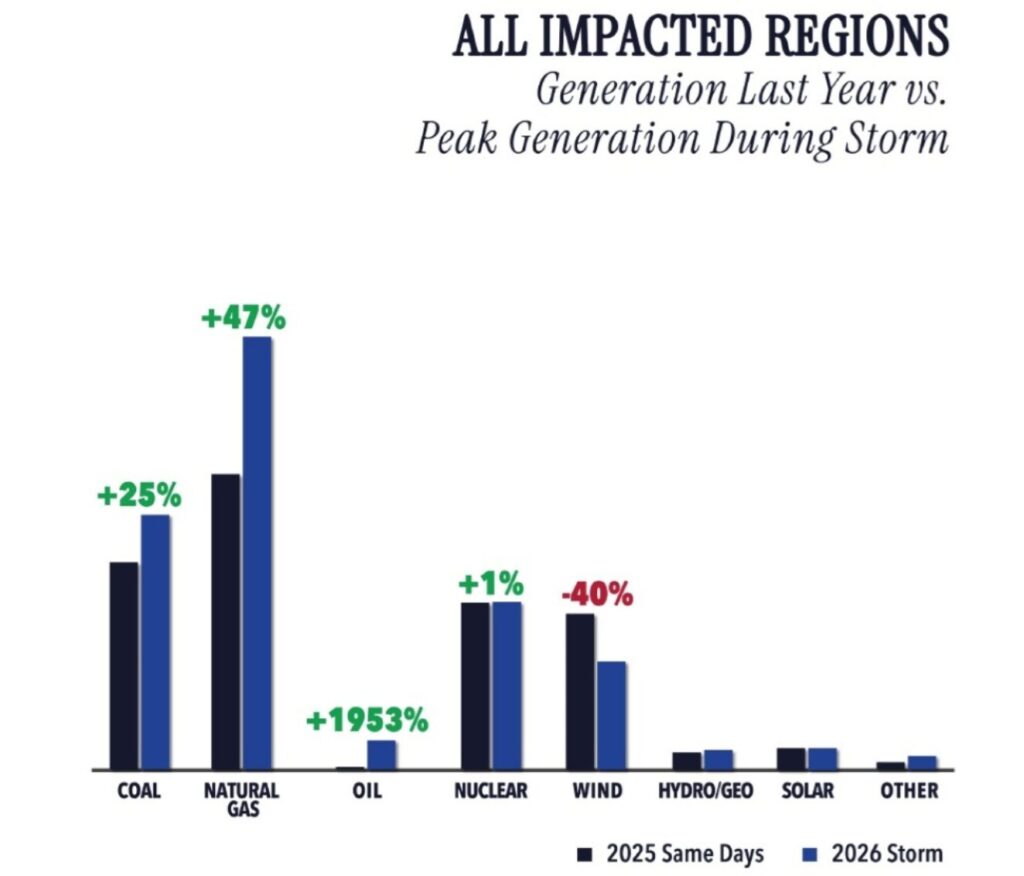
Secretary Wright called coal “the MVP of recent winter storms” – though natural gas was relied upon far more. During the week of Fern, “coal accounted for 21% of all electricity generation in the Lower 48 states,…up from 17% the previous week. Coal was the second-largest source of energy used for electricity, following natural gas, which contributed 38%. Nuclear was third at 18%,” said a Jan. 28 report from the Energy Information Administration.
Despite the Campbell extension, MISO “experienced significant unplanned outages due to the extreme cold,” according to the grid operator’s post-event report. MISO admitted that “there was a lack of clarity in operating instruction” and that forecasting needs to improve.
New England uses fuel oil as back-up generation, and EIA pointed out that from midday Jan. 24 to early Jan. 26, petroleum was the number-one energy source.
But across the nation, natural gas was the real MVP. According to DOE, during peak generation as Fern was hitting hardest, natural gas generation increased 47% over normal for the time of year.
Some of the worst outages struck the South. “Ice-coated lines and fallen trees severed service for more than 300,000 customers in Tennessee and over 140,000 each in Mississippi and Louisiana at the height of the storm.” In Mississippi alone, at the height of the storm, one in eight customers in the state lost power Sunday. The storm reminds us that the grid itself, rather than particular sources of generation, is the bigger problem the U.S. has to solve.
Another storm brought heavy snow mainly to the Northeast in the last week of February. At its height, the storm caused 300,000 customers to lose power in Massachusetts. “Other states facing major outages are New Jersey, Delaware, Rhode Island, New York, Maryland, Connecticut, Virginia and Pennsylvania,” reported NBC News.
At an Oversight Hearing, FERC Commissioners Show Concern About Capacity Lacking for Pipelines and Electricity
The House Energy & Commerce subcommittee on energy held an oversight hearing on Feb. 3 with all five FERC commissioners. One of the major topics at the hearing, titled “Advancing Affordable and Reliable Energy for All Americans,” was obstacles to natural gas pipelines.
The issue was particularly cogent for the Northeast because of Winter Storm Fern. Rep. Troy Balderson (R-Ohio) asked the new FERC Chair, Laura Swett, what steps FERC “is considering taking to expedite the construction of needed energy infrastructure projects?” Balderson noted that opponents claim that liquefied natural gas (LNG) exports are raising domestic prices, “but they ignore the factors that actually increase natural gas costs for consumers, such as the lack of pipeline capacity during the storm.”
Swett responded that it was “really shocking for me coming out of the storm…that, in the Northeast during Fern, 40 percent of generation came from fuel oil or diesel, and that’s simply because we don’t have enough gas infrastructure to bring gas to New England. So, I fully agree with you. That’s why we are looking to, wholesale across the board, take a hard look at our permitting actions. And when it comes to pipelines in particular, we are trying to streamline our NEPA process.”
Rep. August Pfluger (R-TX) asked Swett “how are you balancing the affordability mission when you have states like New York that actually kill pipeline projects?” She responded:
That is a 100-billion-dollar question. Effectively, under the regime that Congress has created, and the Clean Water Act, states have the ability to veto a project if they do not give a certification, and that is a problem that FERC simply cannot work around.
Swett added that “if Congress saw fit to change that, we would be happy and ready to implement any directives.”
Rep. Pfluger then asked if it was Swett’s belief that having more pipeline capacity would lower prices? The Chair answered, “The proof is in the pudding. The fact that areas that don’t have enough gas are paying maybe 300 times what they should, as you said, is unacceptable. That is not a just and reasonable rate for Americans.”
The issue of data centers and electricity rates also came up. The chairman of the subcommittee, Rep. Bob Latta (R-Ohio), told the FERC commissioners:
Winning the AI race, reshoring manufacturing jobs, and lowering energy costs are not mutually exclusive. When done properly, research continues to show that the growth of large energy users like data centers and manufacturing facilities can help stabilize the grid and make electricity more affordable.
In his prepared opening statement, Rep. Frank Pallone (D-NJ), the ranking member of the full committee, noted that “power prices have spiked across the country” and cited a recent report that utilities had asked for a record $31 billion in rate increases in 2025, double the amount in 2024.
In particular, Pallone criticized PJM Interconnection, the grid operator for New Jersey and all or part of 12 other states and the District of Columbia. The Congressman said, “Our nation’s grid operators have proved themselves simply incapable of hooking up power to the grid fast enough – in no small part because their plans to expand the power grid are completely unfit for this day and age. I have made clear over the past year my displeasure at PJM,…but while they are one of the worst offenders, they are not the only ones who have been caught asleep at the wheel.”
David LaCerte, a Republican commissioner who recently joined FERC, expressed concern that, unless the U.S. moves more quickly to add power, we will lose the Artificial Intelligence race. “While China has been adding new electric capacity – with new infrastructure – to its grid at a staggering rate in preparation, the US is attempting to catch up with the interconnection bottlenecks of the last decade.” He added:
It is incumbent upon FERC to play a leading role in reforms that will ensure American data centers and chip manufacturing can get the energy they need – on time and on target – to ensure America has the energy it needs. Failure to meet the moment at a time when our adversaries are in direct competition could jeopardize our national security and America’s global competitive advantage.
You can watch the full hearing here.
A Majority of Regions ‘Face Resource Adequacy Challenges Over the Next 10 Years,’ Says a New NERC Report
The North American Electric Reliability Corp. (NERC) issued a sobering “Long-Term Reliability Assessment” (LTRA) late last month and presented the findings Feb. 19 at a FERC meeting. “The overall resource adequacy outlook for the North American BPS [Bulk Power System] is worsening,” said the report. NERC found “that 13 of 23 assessment areas face resource adequacy challenges over the next 10 years.”
The problem, of course, is rising demand from AI data centers and other big users of electricity and, at the same time, constrained demand – in part because of the retirement of natural gas- and coal-powered plants to meet state zero-emissions goals.
These factors, along with the antiquated grid, are boosting utility bills, which, according to the latest report from the Bureau of Labor Statistics, rose 6.3% for electricity and 9.8% for gas over the 12 months ending Jan. 31 – compared with 2.4% for inflation overall.
Summer peak demand is forecast to grow by 224 gigawatts (GW) during the decade. That is an increase of more than 69% over the forecast made by NERC a year ago and a 24% increase over 2025 peak demand.
“Winter demand growth continues to outpace summer demand growth with 246 GW of growth forecast over the next 10 years, reflecting the evolution of electricity usage,” said a NERC media release on Jan. 29. Of the 246 GW needed for winter, NERC says that just 16 GW of new supply has so far been approved. Even with another 167 GW of “prospective” supply, there is a shortfall of 63 GW.
John Moura, director of Reliability Assessment and Performance Analysis, at NERC, said that the “assessment is not a prediction of failure but an early warning on the trajectory of risk. The path forward is still manageable but only if planned resources come online and on time.”
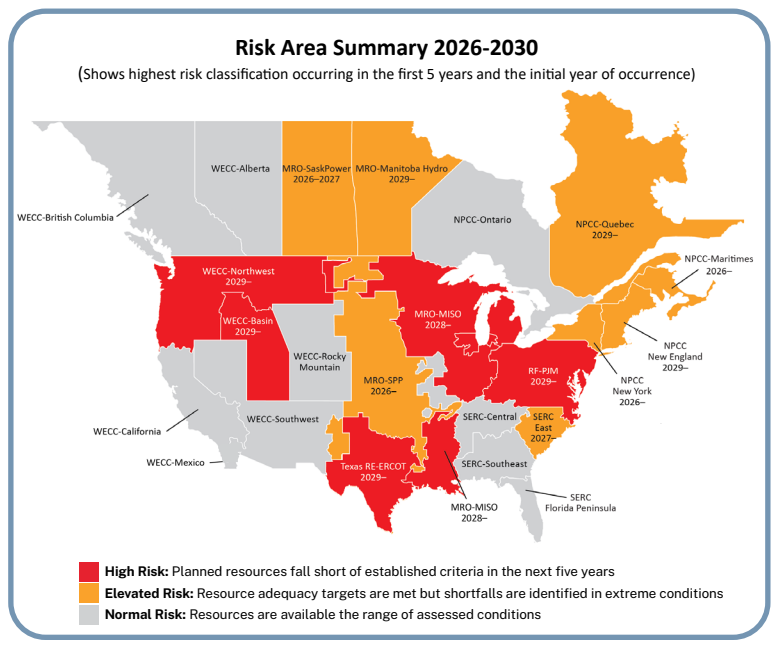
Especially dire is the outlook for 2029 and 2030. The LTRA assesses that the MISO (Midwest) region, PJM (mainly Mid-Atlantic but also parts of the Midwest and South), and West and Northwest regions of the U.S. are all at “high risk” for 2029 and 2030. NERC says that in high-risk areas, “planned resources as of July 2025 would result in energy shortfalls that exceed resource adequacy targets or baseline criteria for unserved energy or loss of load.”
In addition, PJM, Texas, the West, Southwest, and New York are at “elevated risk” – a notch below high risk – for the years 2026, 2027 and 2028. Other regions are at elevated risk only for 2027 and 2028. Not a single region escapes the elevated risk category over the next five years.
For the Northwest, the LTRA comments:
Rapid forecasted demand growth is driving the need for more resources. Resource additions nearing completion are predominantly solar PV [photovoltaic], battery, and wind, leading to a more variable resource mix. Periods of unserved energy are projected for both summer and winter.
For the East, “resource additions do not keep pace with escalating demand forecasts and planned generator retirements,” said the LTRA.” With projected resources, supply shortfalls would occur in below-normal winter temperatures, resulting in unserved energy.”
Bulk power system capacity “fell short of projections this year,” said Mark Olson, NERC’s manager of reliability assessments. “And that was the case last year as well,” he added. Delays in connecting new resources and unanticipated generator retirements are the cause of the miss, reported Utility Dive.
Todd Snitchler, CEO of EPSA, responded to the LTRA by stating in a press release:
Reliability is best served by competitive electricity markets that send clear, durable development signals—not by policy interventions that create misalignment between supply and demand. In order to address the warnings NERC’s LTRA sets out, it will require getting market signals right while addressing permitting and siting delays, supply chain bottlenecks, and other barriers to development.
Snitchler stressed that competitive power suppliers “are already delivering investment signals, and suppliers are responding—announcing more than 12,000 megawatts of new generation and updates in PJM alone since 2024.” He added that “natural gas–fired generation and other dispatchable resources remain essential to maintaining reliability, particularly during extreme weather events.”
U.S. Supreme Court Hears Louisiana Case With Major Impact on U.S. Oil and Gas Production
We have reported several times – most recently in our Newsletter No. 55 — about the landmark case involving drilling in Louisiana’s wetlands near the mouth of the Mississippi River. The ruling will have a major impact on U.S. oil and gas production.
On Jan. 12, the U.S. Supreme Court heard oral arguments in Chevron, et al. v. Plaquemines Parish, La., et al., which centers on the petroleum industry’s effort to move a plethora of lawsuits against it from state to federal court. Louisiana’s judges are elected, and the industry believes it has a better chance to prevail before U.S. judges. (Here is a transcript of the hearing.)
SCOTUS Blog, which covers the High Court, reported that a lawyer for Chevron and other oil and gas companies argued that the case should be moved “under a federal law, known as the federal officer removal statute, that gives federal courts the power to hear state court cases filed against ‘any officer (or any person acting under that officer) or the United States or of an agency thereof, in an official or individual capacity, for or relating to any act under color of such office.’”
The companies’ lawyer, Paul Clement, argued that the conduct at the center of the case “effectively amounted to a joint venture during World War II to get as much oil out of the ground, transport it to the refineries that the government was helping to finance to expand, all in an effort to get petroleum products and in particular aviation gasoline onto the war front.”
Several Justices, reported SCOTUS Blog, “expressed concern about the potential reach of the companies’ position.” The report added:
That concern, combined with the dearth of questions for Louisiana Solicitor General J. Benjamin Aguiñaga, who represented the challengers, and the absence of Justice Samuel Alito (who did not participate in the case because he has a financial interest in a parent company of one of the defendants), made it difficult to predict who will ultimately prevail.
In a brief filed in November, the state of Louisiana, with Plaquemines and Cameron parishes, argued that Chevron and other companies “have no grounds to move lawsuits against them to federal court because local communities have raised claims against them under a state coastal protection law,” reported Politico’s EnergyWire.
The Trump Administration, deeply concerned about U.S. energy dominance, is backing Chevron. If the company ultimately loses, the decision will almost certainly discourage future investment in fossil fuels in Louisiana and perhaps elsewhere in the U.S. as well.
The 43 lawsuits originally filed by Louisiana jurisdictions contend that the energy business is responsible for land loss and erosion in the state’s wetlands over more than 80 years. In April, the first of the cases reached a jury verdict in Plaquemines Parish with a judgment against Chevron of $745 million. The decision, reported the Associated Press, “could set a precedent leaving other oil and gas firms on the hook for billions of dollars in damages.”
In responding to a question from Justice Kavnanaugh about the “fairness of the state court system,” Clement responded:
You can see this is a threat to federalism, but in some ways I think it works hand in hand with federalism because we’re not saying that they [the parishes] don’t get their chance to prove their case in court. It just has to be proven in a federal court. If they can prove their case in federal court, then everybody’s going to accept the outcome and they’re not going to view it as something that’s a product of local prejudice.
One remarkable aspect of the case is that Louisiana Gov. Jeff Landry, a Republican, is supporting Plaquemines and other parishes (akin to counties) despite the fact that Landry is a staunch supporter of President Trump.
The Southeast Is the Most Accommodating U.S. Region for Development of Electricity to Power Data Centers
As technology companies make massive investments in electric power to run their data centers, the investment research firm Morningstar last month released an analysis of which areas of the country are the most accommodating to development.
The winner is the Southeast, which gets a top ranking in all three categories: regulatory environment, grid capacity and energy prices. Morningstar concludes the region has “top-notch regulation; access to low- cost energy; support for grid investments to attract growth.” In second place is the Mid-Atlantic, home to by far the most data centers currently. It receives the highest rating for grid capacity and slightly lower marks for regulation and costs.
The other regions, in order, are: the Midwest, Central & Texas (which gets poor marks for capacity, with the comments: “renewable energy growth creates reliability issues; Texas faces grid concerns”), Southwest, West Coast, and Northeast in last place (“high energy prices; history of tough regulation; clean energy goals stretching already tight grid”).
Tech companies are desperate for electric power. Recently, Amazon outbid a utility company, Puget Sound Energy (PSE) in an auction for a massive solar project in Oregon, “leaving the utility concerned about a larger competition for resources with energy-hungry artificial intelligence companies,” reported the Seattle Times on Feb. 6. The paper added:
Amazon will pay $83 million for the proposed project, which could become one of the largest solar farms in the United States once completed, with 1.2 gigawatts of solar generation capacity and an equal amount of battery storage. It’s approved to take up 9,442 acres, about the size of West Seattle, with the capacity to power several hundred thousand homes.
“We are used to being kind of the only buyers for these things as utilities, and now there are other buyers who are a little bigger than we are,” said a PSE spokesperson.
Amazon announced earlier this month that it would spend $200 billion in 2026 on “data centers, chips and other equipment,” making what Bloomberg called a “colossal bet on artificial intelligence” when you consider that Amazon’s cash flow last year was $140 billion.
Amazon CEO Andy Jassy said the money would mainly go to the Web Services cloud unit, and most of that would be for AI development.
Meanwhile, Alphabet, the former Google, this year will double its capital expenditures – mainly for AI and cloud investment — to between $175 billion and $185 billion. Meta Platforms, the former Facebook, is similarly raising its capex by 73% over last year, and Microsoft is setting records as well.
As the tech giants spend, the public is skeptical. A Politico/Public First poll announced Feb. 17 found that nearly half of those surveyed believe that the increase in data centers will be an issue in the November mid-term elections. According to The Hill, “the poll also found that 37 percent of respondents would support a new data center built in their area, while 28 percent were in opposition and 28 percent could not say.”
In an article headlined, “Data Centers Are the Enemy We’ve All Been Waiting For,” the liberal New Republic argued on Feb. 17 that the fact that the Administration had to assure the public that tech companies would have to pay the bill for new large-load electricity was evidence that “the mass revolt against data centers is working.”
Reported E&E News on Feb. 23:
Governors from both parties are jockeying to attract data centers to their states, hoping for an economic boost. But they also worry about the message that sends to voters, who blame data centers for driving up the cost of electricity.
There is no doubt that the public is blaming data centers for higher utility bills but the evidence is actually mixed. Utility Dive reported that the CEO of PG&E in California says that revenues from data center growth have helped the company “cut rates 11% since 2024.”
A Lawrence Berkeley National Laboratory study in The Electricity Journal in December found that the increase in utility bills over the past five years was driven by multiple factors, with a significant portion coming from updating the distribution and transmission infrastructure of the aging grid.
And a new 2026 report by Charles River Associates for the Edison Electric Institute found that data centers were generally not the cause of rate increases in areas where prices rose. In fact, said the Lawrence Berkeley study, “States with the greatest price decreases typically exhibited increasing customer loads.”
Some 70% of power lines were built over 25 years ago, many dating back to the 1960s and 1970s. “Think of it like replacing old plumbing in a house—utilities need to update these systems to keep electricity flowing reliably to all customers,” states an Amazon press release.
Consequences of the EPA’s Repeal of the 2009 Greenhouse Gas Endangerment Finding
On Feb. 12, the Environmental Protection Agency (EPA) finalized its rescission of the 2009 Greenhouse Gas Endangerment Finding by the agency. The finding served as a prerequisite for, among other measures, regulating emissions from new vehicles. “This is about as big as it gets,” President Trump said at a White House announcement.
While the decision will have immediate effects on the sale of new cars and trucks, it also “clears the way for the E.P.A. to repeal limits on greenhouse gases from stationary sources ,…such as power plants and oil and gas wells,” the New York Times reported. In an analysis, the Washington, DC, law firm Venable said that “rescission would…narrow federal regulation of power plants…, meaning that fewer or simpler greenhouse gas-related permit conditions would be imposed on such sources.”
According to EPA’s website, the agency found 16 years ago that “the current and projected concentrations of the six key well-mixed greenhouse gases—carbon dioxide (CO2), methane (CH4), nitrous oxide (N2O), hydrofluorocarbons (HFCs), perfluorocarbons (PFCs), and sulfur hexafluoride (SF6)—in the atmosphere threaten the public health and welfare of current and future generations.”
Today’s EPA stated:
Absent this finding, EPA lacks statutory authority under Section 202(a) of the Clean Air Act to prescribe standards for GHG emissions. Therefore, EPA also finalized the repeal of all subsequent GHG emission standards from its regulations for light-, medium-, and heavy-duty on-highway vehicles and engines. This is the single largest deregulatory action in U.S. history and will save Americans over $1.3 trillion.
EPA, in a Fact Sheet about its decision, said the savings that would ensue “will make vehicles more affordable for everyday Americans, with EPA projecting over $2,400 in savings for new cars and trucks.”
This newsletter has followed the saga of the Biden Administration’s tailpipe regulations, which stemmed from the endangerment finding, since Newsletter No. 24 in May 2023. The rule, titled “Multi-Pollutant Emissions Standards for Model Years 2027 and Later Light-Duty and Medium-Duty,” went into effect in 2024 and was meant to require that electric vehicles (EVs) constitute a majority of cars sold in the U.S. by 2032, with another 16% being hybrids.
At the time, Sen. Mike Crapo (R-ID), now chairman of the Finance Committee, said, “The Biden Administration’s rule on tailpipe emissions sets unrealistic and unachievable standards that go too far at restricting vehicle choices for American families and pushes our country toward a greater dependence on China.”
In addition, we noted, “The rapid shift to EVs required by the tailpipe rule could increase electricity demand beyond the capacity of the electric grid.”
Said EPA:
The rescission of the Endangerment Finding removes a predicate finding that had served as the foundation for federal greenhouse gas regulation from motor vehicles for more than 15 years. While it does not affect other regulatory programs directly, it does mark a significant shift in the agency’s overall approach to greenhouse gas regulation.
A coalition of health and environmental groups sued the EPA on Feb. 18 in a case filed in the D.C. Circuit over the repeal of the endangerment finding.
The Environmental Defense Fund, an advocacy group, said it estimated that the finding would increase the nation’s greenhouse gas emissions by 10% over the next 30 years. But Interior Secretary Doug Burgum said on Fox News that carbon dioxide “was never a pollutant. When we breathe, we emit CO2. Plants need CO2 to survive and grow. They thrive with more CO2.”