
- PJM, the largest grid operator, holds a capacity auction for standby electricity. The cost was high, but it appears that new supply trying hard to meet rising demand.
- FERC holds two technical conferences in July. One focused on PJM, the other on innovative software uses.
- The nation’s security agencies are warning of Iranian-inspired attacks on U.S. utilities. Dozens of water plants in at least seven states were targeted.
- The nation’s utilities asked for record rate increases in the most recent quarter.
- Higher utility bills and stretched electricity resources were on the minds of Senators at a recent FERC oversight hearing.
- Can permitting reform finally pass in this Congress – even in the lame-duck session?
- Western states create a pact to speed the construction of much-needed transmission lines.
What Does the $16 Billion PJM Capacity Auction Tell Us?
On July 14, PJM Interconnection, the largest U.S. regional transmission organization (RTO), held its annual capacity auction to ensure that it has enough reliable back-up power for the 12 months beginning mid-2028.
The results showed again that the PJM region, like the rest of America, needs more and more electricity. The question is how well the market is responding. There are different interpretations.
During the auction, power plants and energy resource owners bid to be paid a fee “just to be available on standby to produce electricity when demand is high, rather than paying for the actual electricity consumed,” as the Federal Energy Regulatory Commission (FERC) explained.
PJM set a cap of $325 per megawatt (MW) day and, in the end, procured 138,318 MW of capacity generation and demand response — a program by which customers agree to reduce their use of electricity, usually for a payment, when the grid is under stress. The capacity bids totaled $16.4 billion. Below is the PJM footprint.
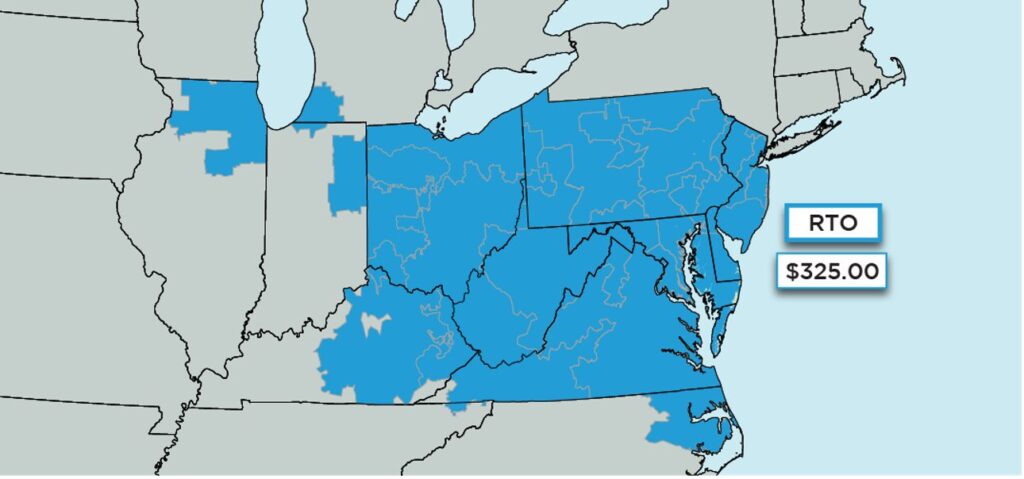
But the amount procured in the auction fell 6,831 MW shy of what PJM needed. “The committed supply,” said PJM, “is less than what would be required to meet the one-event-in-10-year reliability standard.” So on July 28, PJM announced it would hold a one-time backstop auction in September to address the shortfall.
“We knew that the shortfall was coming, but the outcome demonstrates that the current system doesn’t work to bring online new capacity or stimulate demand response, the two things we need the most,” said Julia Hoos, head of USA East at Aurora Energy Research, as reported by Utility Dive.
“Data center load growth is degrading grid reliability, and it’s raising prices to the Governor Shapiro-negotiated cap,” said Robert Routh, Pennsylvania state lead for climate and energy policy at the Natural Resources Defense Council, quoted in an article in the Ohio Capital Journal on July 30. “So, unless PJM and states take action, this picture will continue to worsen for the foreseeable future.”
But in the same article, Todd Snitchler, CEO of the Electric Power Supply Association (EPSA), said the auction price reflects the competitive electricity generating industry’s willingness to invest to meet the increased demand. Recent year-over-year record lows had discouraged investment in power supply, he said.
“Competitive power suppliers are already responding,” Snitchler added. “New supply is coming; the issue now is to address getting it connected to the system as quickly as possible.”
PJM said that without a price collar, “the auction would have cleared at nearly $555/MW-day across PJM’s footprint and $777/MW-day in PJM’s Commonwealth Edison zone in northern Illinois,” Utility Dive reported.
Although for the second consecutive year, PJM’s reliability target was not met with the initial auction, the reserve margin of 14.7% “remains at a robust level and is similar to the level planned for in other regions,” wrote Sharon Theodore on the website of EPSA, which represents competitive generation providers.
Theodore continued:
Lawmakers and policymakers should focus on preserving and strengthening competitive markets at this critical time to bring new generation online. Efforts should build on progress to accelerate permitting and sitting processes, streamline the interconnection process, enhance load forecasting accuracy, and ensure market rules support the investment needed to meet unprecedented demand at all levels of government – federal, state, and local.
Governors of the PJM states, mostly in the Mid-Atlantic and Midwest, that comprise the PJM footprint had complained about previous open-ended auctions, which produced soaring prices and higher utility bills. The July auction was the third with a cap, approved by FERC.
The 2024/2025 auction produced a price of just $29 per MW day. For 2025/2026, that figure skyrocketed to $270 for most of the regional transmission organization’s footprint and to $444 for Dominion Energy and $466 for BGE, utilities that mainly cover Virginia and Maryland. The huge increase – the result of rising demand and the retirement of fossil-fuel plants — provoked the initial political backlash.
Last year, the auction came in at the FERC-approved cap of $329, a 22% increase. Now, for the first time in four years, the auction price has leveled off – although the extra capacity auction is still to be held.
Still, the July “auction results show that demand for electricity continues to grow faster than electricity supply,” said David Mills, PJM’s CEO. He added:
PJM recognizes how this supply-and-demand imbalance impacts the reliability of the system and costs for consumers. We are working with government and industry leaders on multiple fronts to restore that balance by bringing on new generation as fast as possible and managing the growth of new load on the grid.
In an article on its website about the auction, PJM noted that in June the RTO “began facilitating new bilateral, long-term agreements between large load customers and generation providers. These contracts – often spanning 10 years or more – would allow buyers to secure supply from new generation, storage or demand-side resources.”
Mills said that PJM’s “initiatives are critical to keeping the lights on while allowing states to protect their everyday electricity customers.”
FERC Holds Two Technical Conferences in July
PJM’s performance in general was the subject of discussion at the Commission-Led FERC Technical Conference on July 23 in Washington.
The conference looked at PJM’s “governance and stakeholder processes, with a particular focus on identifying and evaluating concrete, actionable reforms to improve PJM’s ability to address operational and market needs in a timely and efficient manner.”
FERC Chair Laura Swett told the conference that PJM has until the end of September to agree to governance reforms or FERC will impose them.
“PJM is facing a grave legitimacy crisis,” Swett said. “Some transmission owners are openly discussing leaving the RTO altogether. Put plainly, market participants have lost confidence in PJM’s decision-making abilities.”
Utility Dive reported that “potential reforms discussed at the meeting include increased board independence, a formal role for states at PJM, and giving states the right to file proposals at FERC — called ‘filing rights’ — while also expanding PJM’s filing rights.”
Highlighted at the meeting were the ability of PJM members to fire the regional transmission organization’s board members as well as PJM’s stakeholder process, which can be long and end without concrete results. Stated Utility Dive:
PJM uses a sector-weighted voting system in its stakeholder process, with a two-thirds majority of a sector-weighted vote required for a measure to pass. Under the system, members are divided into five categories — electric distributor, end-use customer, generation owner, other supplier and transmission owner.
An effect of the voting system is that two sectors can block a measure they don’t like — which has happened repeatedly, especially on contentious issues, the RTO Governance Research Network said in comments filed at FERC.
FERC issued a notice inviting post-conference comments from stakeholders, with submissions due by August 21, 2026, to further solidify next steps and tangible actions. Said Swett:
The PJM governance conference proved to be extremely productive, sparking valuable dialogue among participants. Now is the time to build on that momentum by bringing bold and actionable ideas to the table. I strongly encourage every stakeholder to fully engage in this process, because, together, we have the opportunity to deliver a transformative outcome for PJM.
FERC also held a staff-led two-day technical conference on July 7 and 8. It focused on software and brought together “experts from a broad range of backgrounds including electric power system operators, software developers, government, research centers, reliability organizations, and academia for the purposes of stimulating discussion, sharing information, and identifying fruitful avenues for research, including research on improving software for increased efficiency, affordability, and reliability of the bulk power system.”
Among the topics of panel discussions were grid-enhancing technologies (GETs) that get more out of the existing electric grid (see below as well), load forecasting, energy storage as a transmission asset (with five presenters from the Argonne National Laboratory in Illinois), the Southwest Power Pool’s consolidated planning process, a presentation by two GE Vernova scientists on using AI for grid operations and electricity markets, flexible interconnection studies, open-source grid planning tools, and modernizing resource adequacy for an energy-constrained grid.
You can see many of the presentations by going here.
FBI Sends ‘Urgent Warning’ to U.S. Utilities Over Iranian Cyberattacks
As the war with Iran continues, federal agencies are “urgently warning” about Iranian state-backed hackers targeting U.S. water and energy providers.
Shortly after the warning, cyberattacks on U.S. water systems were revealed by federal officials to have occurred in states including Minnesota, Michigan and five others. The attacks, reported the New York Times on Aug. 1 “may be far wider, officials and experts warned, as the authorities raced to safeguard the nation’s water supply against an assault that increasingly appeared to be the work of Iran.”
A July 22 cybersecurity advisory was issued by seven federal agencies, from the FBI to the Department of Energy, warning utilities and other organizations “of ongoing cyber exploitation of internet-connected OT [operational technology] devices—including PLCs [programmable logic controllers] manufactured by Rockwell Automation/Allen-Bradley, Schneider Electric, Siemens, and potentially other manufactured PLCs—across multiple U.S. critical infrastructure sectors.”
The advisory, which followed one in April where security agencies pointed to activity bearing a resemblance to cyberattacks in 2023 carried out by the CyberAv3ngers, reported Politico.
“The group, affiliated with Iran’s Islamic Revolutionary Guard Corps, hacked into and defaced Israeli-made digital control panels at multiple U.S. water treatment facilities in Pennsylvania…shortly after the Oct. 7, 2023, attack on Israel by Hamas militants and after subsequent strikes by Israeli forces in the Gaza Strip.”
More recent attacks are occurring. According to the FBI, hackers “broke into one critical infrastructure provider and changed the controllers’ programming logic to disable processes that handled critical shutdowns and alarms,” reported TechCrunch. The feds said this allowed “systems to enter unsafe conditions without notifying operators of the anomalies.”
Four days after the advisory, a coordinated cyberattack struck dozens of municipal water systems in Minnesota. The New York Times on July 30 reported that the attack “was probably the work of Iranian hackers, according to U.S. and state officials and others familiar with the matter, a potential act of aggression that comes at a precarious moment in the U.S. war against Iran.”
The attack is credited with “shutting down one city’s water treatment plant, forcing others to disconnect automated equipment, and triggering a statewide emergency response involving the FBI, CISA, and the EPA,” according to a TechTimes report on July 29, which continued:
Security researchers at Tenable believe the attack bears the hallmarks of CyberAv3ngers — a hacking operation formally attributed to Iran’s Islamic Revolutionary Guard Corps and one of the most documented state-directed threats to U.S. water infrastructure.
At the center of the current Iranian campaign is CVE-2021-22681, a critical authentication bypass in Rockwell Automation’s Logix controller family. “The flaw is architectural: the cryptographic key Rockwell’s Studio 5000 Logix Designer software uses to authenticate communication sessions with Logix PLCs is embedded in the software in a recoverable form,” reported TechTimes.
“Anyone who can extract that key — and Iranian-affiliated actors have clearly done so — can impersonate legitimate engineering software and gain direct, unauthenticated access to any internet-facing Logix controller. Once connected, the attacker has engineering-level privileges: they can download project files, upload modified logic, disable alarms, and alter what operators see on their screens.”
Decryption Digest reported that CyberAv3engers hit U.S. water treatment and energy facilities in March, flooding operators’ SCADA screens with falsified sensor readings.” SCADA, which stands for Supervisory Control and Data Acquisition system, is the nervous system of a facility. The Iranian group is threatening networks “that deliver drinking water and electricity to millions of Americans.”
A survey by the consulting firm PwC last year, before the current hostilities with Iran began, found that 83% of energy, utilities and resources (EUR) executives identified cyber attacks as a serious or moderate risk — compared to 77% of executives in other sectors.
In a publication in June, PwC said that threat actors “are actively targeting important US infrastructure. Their tactics often go beyond data theft — they usually aim to disrupt, disable and destabilize. These attacks are increasingly sophisticated, leveraging geopolitical tensions and advanced tools to target the grid.” The firm recommended a 100-day cybersecurity review to ensure that utilities are protected.
For example, PwC advised matching long-term growth investment with matching cybersecurity upgrades:
Emerging technologies, such as advanced metering infrastructure, AI-driven grid automation and distributed energy resources, can impact the attack surface in ways that traditional security models weren’t built to manage. If cybersecurity investment doesn’t keep pace with innovation, the sector could unintentionally scale its vulnerabilities alongside its assets.
So far, there have not been major Iranian attacks on electric utilities, but Kimberly Mielcarek — vice president of the North American Electric Reliability Corporation (NERC), which runs the Electricity Information Sharing and Analysis Center — said that the organization sent an “all-points bulletin” to energy sector members about the threat, encouraging “industry vigilance.”
Nation’s Utilities Ask for Record Rate Increases
With concern over electric bills mounting, a report by PowerLines, issued July 14, found that the nation’s utilities asked for $9.2 billion in rate increases from public utility commissions in the second quarter, “breaking last year’s Q2 record of $7.3 billion in new requests.”
So far, utilities have requested $18.6 billion in hikes this year. At that pace, the requests will easily top last year’s record $31 billion, which doubled the figure for 2024.
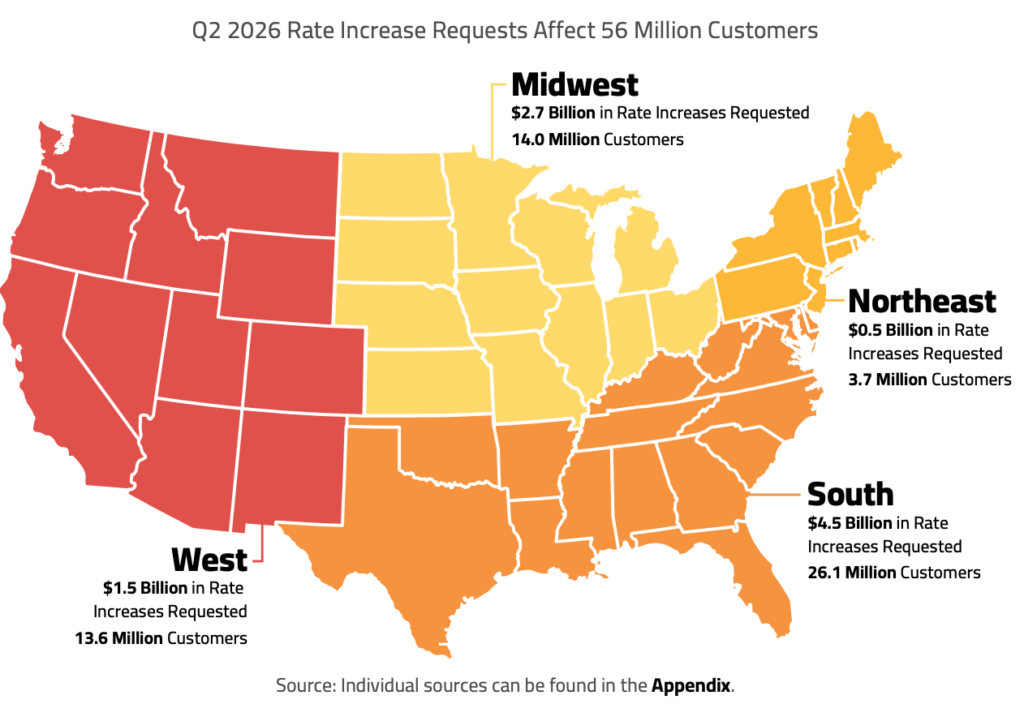
The requests by utilities to state utility commissions “will be felt across more than 56 million U.S. customers,” said the PowerLines report, which cited “a growing spending spree by utilities and rising consumer anxiety over rising power bills, particularly during periods of extreme heat, when electricity is necessary to maintain human health and safety.”
The report added:
Investor-owned utilities are planning to spend at least $1.4 trillion in capital expenditures by 2030, which could be felt for years to come through future rate increase requests. Meanwhile, more than 2 in 3 consumers reported their electric or gas bill has increased this year, and more than 3 in 4 are worried their bills will continue to rise.
Half the requests for increases came from utilities in the South, with the Midwest next at about 30% of requests.
Said the report: “Oncor in Texas requested the largest single increase this quarter, at $1.2 billion, driven largely by its 5-year transmission and distribution spending plan—a $45 billion investment focused on meeting demand from oil and gas industry and data centers in the Permian Basin. Dominion Energy in Virginia, meanwhile, requested $1.5 billion across three rate requests, the largest of which proposes to raise rates by $1.1 billion.”
The largest requests in the Midwest came from DTE Energy and Consumers Energy, both of Michigan, and from Wisconsin Electric Power.
Also in July, a report by Lawrence Berkeley National Lab found that utility bills have risen as a share of income since 2023, particularly for the 20% of ratepayers at the bottom of the income scale. One-third of households earning less than $50,000 per year pay at least 5% of their income toward electricity, according to the report. “Bill burdens have increased in 27 states and Washington, D.C. over the past seven years, with D.C., Pennsylvania, California and Maryland notching the biggest increases,” said Utility Dive.
In a Senate Hearing Spotlight: Large Loads and Their Financial Burden on Consumers
The growth of large loads and the burden they are placing on constituents were major concerns of Senators when the Energy and Natural Resources Committee held a FERC oversight hearing on July 22.
The chairman, Sen. Mike Lee (R-UT) kicked the hearing off by asking how FERC’s recent orders on interconnecting loads from data centers and other big power users could ensure reliable, affordable energy as electricity demand rises. Lee said that expanding reliable electric infrastructure is critical to maintaining U.S. economic growth and competitiveness, but how can consumers be protected from higher costs?
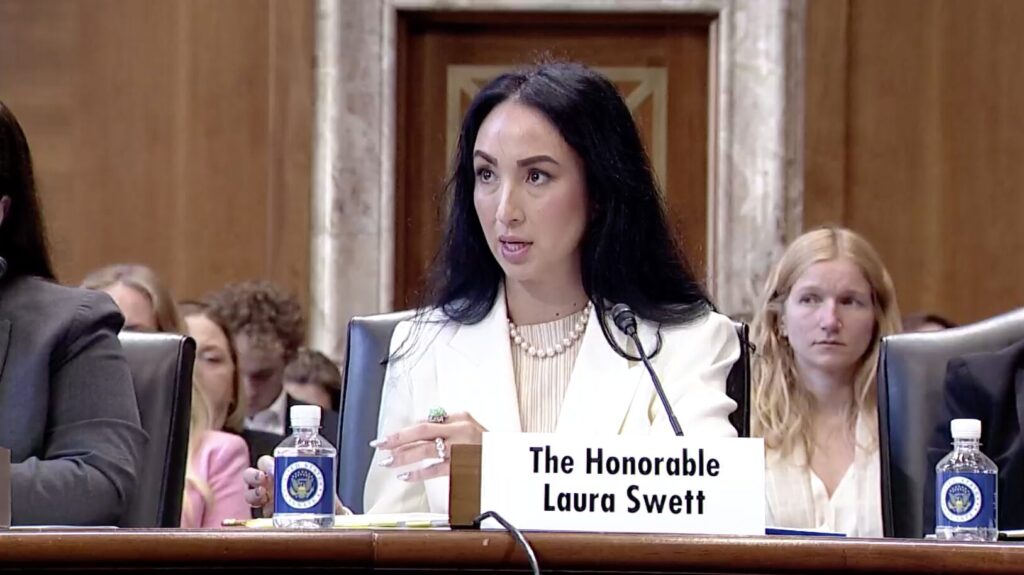
“At no point in its history,” said Laura Swett, the FERC chair, in her prepared testimony, “has FERC advanced more comprehensive set of reforms designed to safeguard American consumers.” Swett added a personal note:
For many households, higher utility bills are debilitating burdens with personal consequences. I understand this firsthand from living in a household whose monthly bills caused me deep anxiety as a child. The weight of that financial stress remains with me and informs my resolve to ensure that families across the country are not forced to shoulder unnecessary costs.
The Energy Information Administration (EIA) reported recently that for the 12 months ending May 31, electricity costs for residential users rose 6.2%, or about two-thirds more than the Consumer Price Index as a whole. For several states, the increase was more than 10%. Those included New Hampshire, New Jersey, Pennsylvania, Illinois, Ohio, Maryland, Virginia, Montana and South Dakota.
At the hearing, Swett responded to Lee by pointing out that FERC issued orders in June requiring, for example, faster study timelines to discover how load located near generation can reduce unnecessary transmission expansion. FERC is also requiring each region to report on how it plans to address the nation’s growing generation shortfall, as we reported in our Newsletter No. 61.
FERC on June 18 told the six RTOs and independent system operators (ISOs) that their rules for connecting large loads in a time of rising demand had to be upgraded.
Sen. Cindy Hyde-Smith (R-MS) asked a similar question: What is FERC doing to ensure large-load customers, such as data centers, pay the costs associated with the infrastructure they require rather than shifting those costs onto residential ratepayers?
Swett answered that FERC closely scrutinizes agreements to ensure transmission upgrades required by large-load customers are paid for by those customers.
Commissioner David Rosner, a Democrat who was briefly FERC chair himself, noted that pending orders require contracts that protect against stranded costs if projects are delayed or abandoned and ensure large-load customers are responsible for upfront infrastructure costs. In addition, the commission is proposing greater transparency by requiring utilities to identify network upgrades built specifically for large-load customers, so state commissions can allocate costs appropriately.
Also in her prepared testimony, Swett took a swipe at previous FERC commissioners.
Under her leadership, she said, “We are realigning our environmental review practices with the Commission’s statutory role as an economic regulator—a fact that appears to have been lost on several of my predecessors.”
Since she joined the commission late last year, she said:
FERC has proposed significantly expanding blanket authorizations for routine natural gas pipeline activities and initiated parallel streamlining efforts for LNG and hydropower facilities to ensure that maintenance, repairs, and upgrades can proceed without burdensome, case-specific reviews.
She added that FERC, in general, was trying to “reduce administrative friction while preserving full statutory compliance.”
The ranking member of the committee, Sen. Martin Heinrich (D-NM) opened by emphasizing the importance of preserving FERC’s independence. He also argued that the Trump Administration is contributing to higher electricity prices by delaying the deployment of 73 gigawatts (GW) of solar, 43 GW of energy storage, 30 GW of onshore wind, and 16 GW of offshore wind.
Heinrich asked the commissioners what steps Congress should take to encourage deployment of advanced transmission technologies (ATTs), which can maximize existing infrastructure while improving reliability and affordability.
ATTs are specialized hardware and software systems that increase the efficiency of the grid. Grid-enhancing technologies (GETs), a subset of ATTs get more out of transmission lines. Examples are dynamic line ratings (using real-time weather data to boost power flow), advanced conductors (which redirect electricity toward underused lines) and topology optimization (shifting the path of grid networks with the lay of the land).
Swett responded to Heinrich by saying that FERC’s June transmission planning order requires utilities to analyze these technologies, but the Federal Power Act limits the commission’s ability to require construction of specific transmission facilities. Congressional action would be needed to provide FERC with broader authority.
Commissioner Judy Chang, a Democratic appointee, also said that a role for Congress could be expanding FERC’s authority over ATTs. She added that the commission could require transmission owners be rewarded through rate treatment for adopting the most advanced available technologies.
Answering a question from Sen. Angus King (I-ME) about the use of Artificial Intelligence to improve efficiency, David LaCerte, a FERC Republican appointee, said that AI is helping to reduce backlogs that have slowed interconnections. In one Midwest example, the use of AI reduced queue processing times from approximately 686 days to fewer than 10 days.
In his written testimony, LaCerte said:” I am of the opinion that durable permitting reforms must be enacted in the 119th Congress. My view has been reinforced as a Commissioner, where I have witnessed, firsthand, how difficult it is for companies to invest in infrastructure.
Several Senators raised the issue of hydropower, which is on the rise despite less copious snowmelt. Sen. Catherine Cortez Masto (D-NV) asked how FERC is preparing for the growing demand for hydropower licensing, with more than 40% of the non-federal hydropower fleet requiring relicensing by 2035?
Commissioners Rosner, LaCerte, Chang, and Lindsay See, a Republican appointee, all agreed that the licensing and relicensing processes should be simplified and streamlined.
The Long Trail to Permitting Reform
Can permitting reform pass – at long last – in this Congress?
“Advocates and lobbyists are sounding the alarm that senators are running out of time to reach a bipartisan permitting reform overhaul by the August recess — a goalpost identified by negotiators — as they struggle to overcome daunting political hurdles in a midterm election year,” reported E&E News on July 13.
The House has left for recess already, and the Senate calendar indicates the chamber will be in session through Aug. 7 – though President Trump is demanding that Majority Leader John Thune (R-SD) keep the Senate in session as long as necessary to pass the SAVE America Act, with its provisions that could affect the Nov. 3 mid-term elections. Both houses will be back in September for a few weeks, then depart for all of October and return in November and December for the lame-duck session, but with major holidays intervening.
The Senate has a full plate, and “the window of opportunity there is starting to close this Congress,” said Jason Grumet, CEO of the Clean Power Association
According to Josh Siegel of E&E, “Negotiators are aligned on the broad contours of a potential deal but are haggling over the details that could make or break a potential agreement.”
Democrats, wrote Siegel, “have shown openness to negotiating changes to bedrock environmental laws like the National Environmental Policy and Clean Water acts, while limiting lawsuits that often stall or kill projects — key demands of Republicans and the Trump administration.”
But the big hang-up remains the administration’s attacks on solar and wind power. Democrats are especially focused on establishing rules to restrain the president’s power to cancel approved energy project permits. The Republican offer also includes proposals to streamline environmental and historical preservation reviews and ease some transmission permitting.
What about the lame-duck session? Said Grumet,“That’s a very freighted strategy, particularly if you anticipate a change in leadership. Imagining that a newly elected Democratic House is going to want to pass legislation that was developed without their involvement, or with very little involvement, it’s always a very tough argument to make.”
Conversations with lobbyists, however, hint that the November/December period is a good possibility.
Before the August recess, the House was active. On July 23, Rep. Brett Guthrie (R-KY), the chairman of the Energy and Commerce Committee, released a discussion draft of legislation titled, “Permitting Our Way to an Energy Resurgence (POWER) Act (Bill Text).”
A committee press release stated:
It combines 19 committee bills intended to accelerate pipelines, power generation, transmission, and industrial development. The package is designed to serve as the House Energy and Commerce Committee’s marker in broader permitting negotiations now underway in the Senate, although it remains unclear whether the House will consider the full package or how much of it could be incorporated into a bipartisan agreement.
Reporting on the POWER Act, Fox News stated, “Beyond permitting, the mammoth legislation seeks to shield ratepayers from price hikes by requiring data centers to bear the costs of grid upgrades.” The bill would also “give dispatchable power plants priority over intermittent sources such as wind and solar in interconnection queues, expand federal regulators’ authority to keep power plants online and overhaul portions of the Clean Air Act.”
Among its many provisions, the POWER Act would: streamline New Source Review permitting processes for companies to require modern power lines that carry more electricity than the current grid, direct the Department of Energy (DOE) to study AI technologies to increase efficiencies and get more out of the existing grid, require state public utility commissions (PUCs) to consider a strategy to make data centers pay their own way, require those PUCs to examine the costs of their green-energy mandates, and empower FERC to keep reliable power plants running for up to five years if retiring them threatens grid capacity.
Among the package’s most consequential provisions is legislation from Rep. Troy Balderson, R-Ohio, that would check the federal government’s ability to issue far-reaching environmental regulations. His measure requires federal agencies to submit major actions affecting electricity generation to FERC for review to ensure they do not negatively impact grid reliability.
So will permitting reform pass? “The downfall of permitting is always that everybody thinks they can cut this deal in the lame duck, or we’ll be able to cut this deal in September. And the longer you wait to put the bill out there, the longer you go without figuring out what your real problem is. Who can you really get to yes and who are you losing?” said a former House GOP aide active in permitting talks, quoted by E&E.
Western States Form a Pact to Speed Transmission Grid Expansion
At a meeting of the Western Governors Association on June 30, a bipartisan group of 11 governors agreed to create a pact to speed permitting and coordinate on regional transmission grid expansion
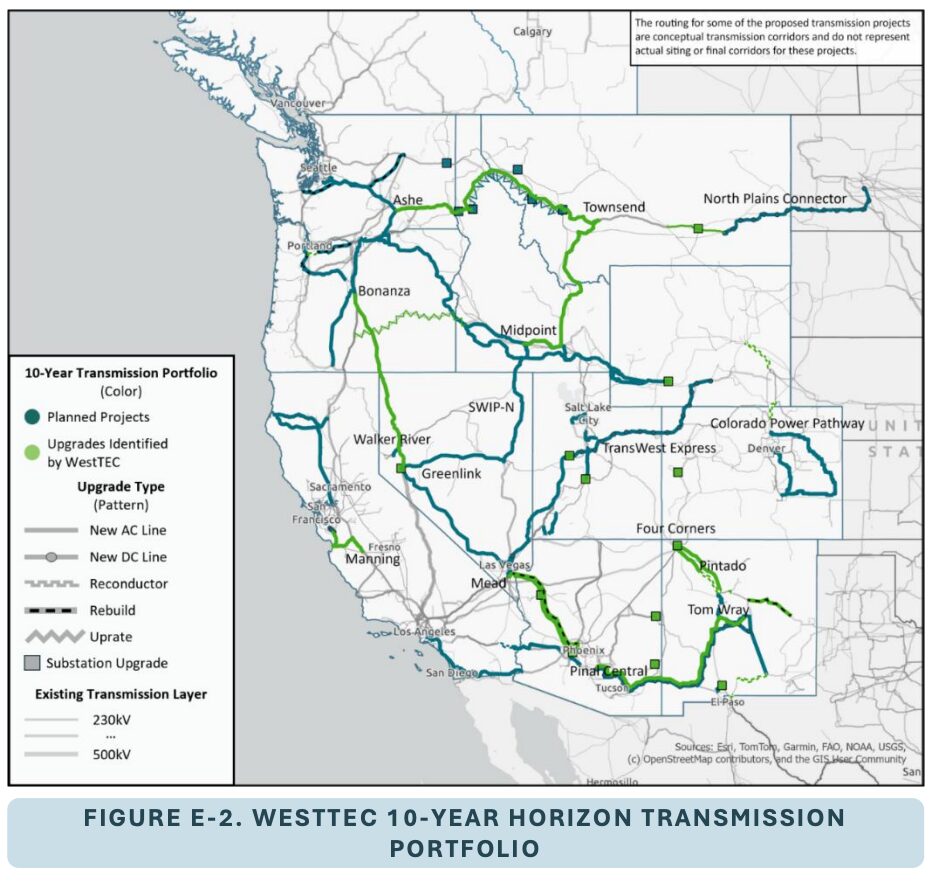
They signed a joint agreement creating a Permitting Alignment and Coordination Task Force (PACT) to serve as a forum on expedited transmission permitting in the West. At the meeting, they also endorsed the results of the Western Transmission Coalition (WestTEC) needs study.
The study “assesses needs to not only support reliability, but also to promote open, competitive markets by reducing bottlenecks that restrict choice and limit access to lower-cost power,” said the agreement. It added, “Investing in a well-connected western grid is the key to unlocking the diverse energy generation resources in the West.”
The study, published in February, found the region needed 12,600 miles of new transmission lines over the next decade, at a cost of roughly $60 billion.
The governors who signed the letter were led by the association’s chair, Spencer Cox (R-UT), and included Govs. Jared Polis (D-CO), Mark Gordon (R-WY), Joe Lombardo (R-NV), Brad Little (R-ID), Tina Kotek (D-OR), Greg Gianforte (R-MT), Kelly Armstrong (R-ND), Katie Hobbs (D-AZ), Michelle Luhan Grisham (D-NM), and Bob Ferguson (D-WA).
“The WestTEC study provides a credible, data-driven blueprint that developers and states can use to build the infrastructure needed to meet future energy needs,” said Sarah Edmonds, CEO of Western Power Pool, in a press release.
“Since we announced …results, many people have asked, ‘Now what?’ What comes next is building the projects recommended in the study, and that requires partnerships and collaboration across the West. This is a perfect example.”
Edmonds continued, “In transmission development, there are the three P’s – planning, permitting and paying. WestTEC has focused on planning. This announcement and creation of PACT will help Western states lead the way in clearing the permitting hurdle.” Added Emy Lesofski, energy advisor to the governor and director of the Utah Office of Energy Development:
Getting energy to where it’s needed, when it’s needed, is just as important as generating it in the first place. Think of the grid like the roads and highways connecting our communities. It doesn’t matter how much is produced if you can’t move it to where people actually live and work. Utah and other Western states are united on this because it’s just common sense: a stronger, more connected Western grid means lower costs, greater reliability, and more opportunity for every state in the region.
The West, unlike nearly all the rest of the U.S., does not have an RTO or ISO. Instead, the Western Power Pool is a non-profit cooperative of electric utilities that coordinates reliability programs instead of operating a centralized wholesale electricity market.