
- Grid operators and energy experts warn grid reliability is at stake, a “five-alarm fire” at FERC technical conference.
- On the eve of Democrats’ victories in off-year elections, Mid-Atlantic lawmakers gather to find ways to keep a lid on their constituents’ rising utility bills.
- Could this finally be the year for streamlining the process for granting permits for energy infrastructure projects? Bipartisan support exists, but obstacles to a comprehensive package remain.
- Saying she backs an “all-of-the-above” energy strategy at a time of high demand and tight supply, New York Gov. Kathy Hochul joins New Jersey in signing off on a severely-delayed natural gas pipeline.
- Pennsylvania Democrats and Republicans combine to back two Hydrogen Hub projects with federal funding in limbo.
A ‘Five-Alarm Fire’ Over Grid Reliability
At the annual Federal Energy Regulatory Commission technical conference Oct. 21 on grid reliability, Jim Robb, president of the North American Electric Reliability Corp. (NERC), minced no words in describing the problems of the power grid.
“The risks to reliability continue to mount,” he said. “We’re seeing … an increasing number of small-scale events and near misses that continue to reinforce what we can’t call anything but a five-alarm fire when it comes to reliability.”
At the same time, he said, “[t]he reliability of the power grid is extremely high.” The problem is not the present but the near future, with electricity supply failing to keep pace with demand amid uncertainty about how much load may be coming online.
FERC commissioners agreed with Robb. David Rosner, a Democratic appointee who was serving a brief term as chairman at the time, was quoted by Utility Dive as saying:
I see our grid as needing every single megawatt, every single electron and every single molecule we can get to meet demand on those peak days and peak hours. That means we need to make sure that we’re studying faster, we’re giving permits faster and unlocking all different types of energy infrastructure that are needed.
Jennifer Curran, senior vice president of planning and operations for the Midcontinent Independent System Operator (MISO), told the conference, “Where we are today…is not safe because we are in a tight reserve margin situation….The best thing we can do is get better at quickly dealing with the uncertainty and having as much built-in infrastructure as we can to really provide that balance of reliability and economic efficiency.”
Curran warned, however, that “getting the transmission built to help provide those connections and provide that optionality within the system is something that’s really important, and it takes a long time.”
Also showing concern was Commissioner Judy Chang, another Democratic appointee, who warned that risks and uncertainties are “coming to a head.”
Importantly, so are the costs. “We are reaching a point where bills are becoming incredibly difficult for people across the country,” and dealing with some of those challenges will be costly, according to FERC Commissioner Lindsay See, a Republican appointee who joined the commission last year.
FERC is dealing with demand-side pressures from data centers, which do the computer-crunching for artificial intelligence (AI) applications. The Department of Energy predicted last December that data center load growth would “ double or triple by 2028” and could use as much as 12% of all U.S. electricity, up from 4.4% in 2023.
The tough challenge for regulators is shielding ratepayers from costs associated with making capital investments to provide additional electricity for data centers, which provide benefits for some of the richest tech companies.
At the conference, said the same Utility Dive report, Tricia Pridemore, a commissioner at the Georgia Public Service Commission (PSC), said that with appropriate guardrails, large data centers can help reduce electric rates.
In Georgia, said Pridemore, firms that need large loads enter into 15-year contracts to pay for all the new generation, transmission and distribution. The PSC recently approved a plan for Georgia Power to add 10 GW of capacity to meet growing demand, which the commission estimates that, contrary to the claims of consumer advocates, will actually reduce residential rates by $2.64 a month.
Yet the problem is not just generation. It is transmission and distribution – getting the power to customers throughout America’s aging electric grid. According to the Breakthrough Institute, a liberal research non-profit, today’s challenges can be traced to 90-year old regulatory decisions that have constrained utilities to being regional entities and removed incentives to interstate transmission planning.
PJM Interconnection, the nation’s largest grid operator, covering 13 states and the District of Columbia, has a queue of active requests to interconnect with the grid that amounts to 103 GW of electricity according to Berkeley Lab. The queue is so long that when PJM called for applications for fast-track interconnection, it received 94 requests under a program called the Resource Reliability Initiative (RRI).
There is little doubt that permitting reform can reduce long queues and unnecessary delays to new energy online quicker. Under the special RRI process approved by FERC, reported Utility Dive, PJM can “consider adding up to 50 shovel-ready projects that meet certain reliability and commercial operation date criteria to the just-started interconnection Transition Cycle 2, which already contains about 550 projects totaling about 50 GW in nameplate capacity.”
Permitting reform will help add generation; yet ultimately, America needs a long-term solution to transmission inadequacies in order to put downward pressure on electricity rates. The U.S. requires massive investment in a more integrated, modernized, well-planned system to meet demand.
Carlos Casablanca, managing director of distribution, planning and analysis at American Electric Power, a large utility based in Ohio, defined the problem: “We are seeing…a lot more costs coming. The build-out needs to occur to accommodate large loads and also [develop] the resources that are required to both address retiring generation [and] meet the need from the large loads. So anything we can do in the planning space to prepare for what’s coming and optimize as early as we can, it’ll help. It’ll pay dividends down the road.”
Mid-Atlantic Officials Gather in Harrisburg to Discuss How to Keep a Lid on Constituents’ Utility Bills
One week prior to the November elections for governor in New Jersey and Virginia, Republican legislators from across the Mid-Atlantic region gathered in Harrisburg, Pennsylvania to discuss how to keep a lid on rising utility bills and improve grid reliability in the face of rising regional demand, stultifying regulations and policies that aim to reduce greenhouse gas emissions but present obstacles to boosting needed power.
The lawmakers had reason for concern. As reported in our Newsletter No. 53, electricity costs were major issues in the November 3 elections, which were won handily by Democrats. According to the latest data from the Bureau of Labor Statistics, residential electricity costs have risen for the year ending August 31 by 13.4% in Pennsylvania, 11.2% in Maryland, and 21% in New Jersey – all more than double national increases.
At the Harrisburg state committee hearing, state Rep. David Rowe, chair of the Pennsylvania House Republican Policy Committee, set the tone by saying, “Families, businesses and communities across Pennsylvania, Maryland, New Jersey and Virginia are all feeling the same pressure. We share the same regional grid, the same transmission lines and the same responsibility to keep the lights on.” The grid operator for the states represented is PJM Interconnection.
According to public broadcaster WHYY, “Tuesday’s committee hearing came amid growing concern across the political aisle about electricity costs and power supply in the region. Public officials from both parties agree that more needs to be done to curtail rising costs for families and get new sources of power connected to the grid faster. But they disagree about how to get there.”
At the hearing, Republican lawmakers from Pennsylvania, New Jersey, Maryland and Virginia asked for policy guidance from representatives of the American Petroleum Institute, the largest oil and gas trade association; the Consumer Energy Alliance; the Commonwealth Institute, a conservative think tank; and from PJM.
Demand from data centers and advanced manufacturing has collided with limited supply in the Mid-Atlantic, with a major cause of higher rates being the cost of getting more electricity from the plant to the customer over an antiquated grid.
A recent report by Energy Tariff Experts and the Electric Power Supply Association (EPSA) examined the key drivers behind rising residential electricity bills across the PJM region, including Maryland, New Jersey, Ohio, and Pennsylvania. The report found that the generation component (that is, the cost of producing electricity at the plant) represents a minority of the average residential utility bills.
A study by the Lawrence Berkeley National Laboratory (Berkeley Labs) confirmed the EPSA study. As the Washington Post summarized in October, the researchers “found that the biggest factors behind rising rates were the cost of poles, wires and other electrical equipment — as well as the cost of safeguarding that infrastructure against future disasters.”
Policymakers in some Mid-Atlantic states have taken measures that critics say are counter-productive to solving the electricity crisis – but, in the face of rising utility bills, they are changing their positions.
Pennsylvania Gov. Josh Shapiro, a Democrat, provides a good example. His administration appealed a court decision that prevented the state from joining the Regional Greenhouse Gas Initiative (RGGI), a cap-and-trade program for power plant emissions. The state Supreme Court has yet to rule.
RGGI was unpopular among lawmakers at the Harrisburg event. Said Robin Grammer, a member of Maryland’s House of Delegates, “We want out of RGGI. We want out of the clean energy mandates.”
Cap-and-trade systems place a limit on emissions and allow businesses to buy and sell permits to let them emit greenhouse gas. The cost of the permits is typically passed on to consumers, who foot the bill for policies aimed at mitigating climate change.
The Commonwealth Institute cited economic models estimating that the RGGI would increase Pennsylvanians’ electric bills by a further 30%. The foundation also pointed to polling that “indicates that RGGI is an unpopular policy for Pennsylvanians, whose survey responses show that energy affordability is a higher priority for them than combating climate change (68 to 32 percent).”
Meanwhile, the state Senate, in a bipartisan vote last month, passed a bill repealing the state’s participation in RGGI. Then, in an about-face, Gov. Shapiro announced on Nov. 12 that he would abandon RGGI in upcoming state budget negotiations with Republicans.
Spotlight PA reported that Shapiro claimed that the state Senate Republican leadership has “used RGGI as an excuse to stall substantive conversations about energy and energy production.” Now that the excuse is gone, Shapiro said, he expects to see action on policy that “creates more jobs,” brings “more clean energy onto our grid,” and reduces “the cost of energy for all Pennsylvanians.” E&E News reported on Nov. 13:
Shapiro is now the first governor of any party to sign a law quitting RGGI, which covers power plant emissions from almost a dozen states. That fact landed like a thunderclap on the left, where Shapiro is viewed as an influential Democratic voice and a likely presidential contender.
In taking the action, Shapiro is following other Democratic officials, including Gov. Gavin Newsom of California, in prioritizing affordability over climate initiatives that can result in higher utility bills. As we reported in Newsletter No. 52, Newsom in September signed sweeping energy bills that “double-down on climate commitments like cap-and-trade and high-speed rail” but, at the same time, “open parts of California’s Central Valley to more drilling to stabilize gas prices, a policy that many Democrats have long opposed.”
Previously, in Newsletter No. 51, we reported on the controversy over when Colorado Springs Utilities (CSU) would have to retire the 45-year-old Ray D. Nixon coal-fired power plant. The scheduled date was the end of 2029, but closing the plant that soon would probably lead to higher utility rates and a possibility of blackouts.
At a press conference on July 31, Gov. Jared Polis, a Democrat, signaled he was open to reconsidering the Nixon plant retirement date. “Generally speaking, of course, coal is the most costly form of energy on the grid,” Polis said. “I think they [CSU] are just trying to figure out the date that makes sense to close down their higher-cost coal power plant…. Whether it’s 2033, 2034, we want to do something that makes sense.”
We reported at the time:
Rising demand and constrained supply of electricity is encouraging a Democratic governor with a record of supporting greenhouse-gas-reduction measures to keep a coal plant open. Elected officials of both parties are recognizing that this kind of action may be necessary to prevent blackouts and hold down utility bills.
Pennsylvania is the nation’s second-largest natural gas producer after Texas according to the U.S. Energy Information Administration (EIA); the agency further reports that gas is by far the largest resource for generating electricity in the state, with nuclear power second and renewables negligible. The dispatchable characteristics of natural gas ensure grid reliability and help constrain customer bills.
Pennsylvania is also the largest supplier of electricity to other states – a point that Rowe emphasized in Harrisburg. “Without Pennsylvania energy, the lights in Maryland, New Jersey and Virginia, they just simply go out,” he said at the meeting. “If we are not able to meet the demand of new industries, grow Pennsylvania’s energy generation, we are going to be in a very rough spot.”
Activity on Energy Permitting Reform Heats Up
Could permitting reform finally happen? With the reopening of the U.S. government following the budget shutdown, energy advocates have been pushing hard for legislation to streamline the process for approving energy infrastructure permits – as well as supporting legislation to bolster the nation’s aging electric grid to meet surging demand.
E&E Daily reported that “Grid Action, along with the Conservative Energy Network and several other groups,” was set to meet “with 30 congressional offices” over the first week in November “to lobby for transmission and permitting policies as lawmakers seek compromise on a bipartisan package.” Grid Action said in a press release:
The coalition’s priorities center on advancing reforms that support permitting and siting transmission and other critical energy infrastructure, alongside clearer guidance from Congress and FERC on how to plan and define project benefits across regions. Together, these steps would provide the regulatory certainty needed to accelerate grid expansion and modernization.
According to American Clean Power, energy projects on average take four and a half years to gain the requisite permits, while it takes six and a half years for transmission projects and sometimes up to 10 years
Other groups and companies on the Hill in early November included: Apex Clean Energy, Berkshire Hathaway Energy, the BlueGreen Alliance, the Clean Air Task Force, Ceres, Con Edison Transmission, EDP Renewables, Grid United, HASI, Invenergy, the National Audubon Society, National Grid, the National Wildlife Federation, the Niskanen Center, Quanta Services, RMI, SC Partners, the Solar Energy Industries Association, AES, the Nature Conservancy, ACORE and International Brotherhood of Electrical Workers Local 1245.
In September, a diverse group of business and energy organizations, led by the U.S. Chamber of Commerce, sent letters to House and Senate leaders calling for bipartisan permitting reform.
“The time has come to modernize our nation’s permitting systems so that our communities can build the infrastructure necessary to grow our economy, create good-paying jobs, and meet the challenges of today and tomorrow,” said the letter, which emphasized the need for predictability, transparency, efficiency, and stakeholder input. It added:
A modernized permitting system will help us build smarter, faster, and more
sustainably—we just need a system that keeps pace with our ambition. We urge Congress to work across the aisle to enact durable legislation this fall that reflects the urgency and opportunity before us. Our communities are ready to build.
In a separate letter published in September, the Natural Gas Council highlighted the impact on U.S. energy security: “Clear, predictable infrastructure permitting processes remain instrumental to achieving our shared economic, security, and climate-related goals…. The current processes to site and approve new and expanded infrastructure remain cumbersome, often stalling projects for years with duplicative reviews, unnecessarily burdensome approvals, and unending legal challenges.”
There is strong support in general for permitting reform, but the details of a bipartisan package have proven difficult to nail down. Joe Manchin, who has since retired from the Senate, may have sacrificed his political future when he traded his support for President Biden’s 2022 Inflation Reduction Act for a vote on permitting reform that never happened. The last serious attempt to pass legislation to reform the permitting process for infrastructure such as pipelines and transmission facilities failed last year.
In July, a bipartisan pair of members of the U.S. House introduced the Standardizing Permitting and Expediting Economic Development (SPEED) Act. Rep. Bruce Westerman (R-Ark), the chairman of the House Committee on Natural Resources, teamed up with centrist Democrat Jared Golden of Maine on legislation to modernize the National Environmental Policy Act of 1969 (NEPA) to help accelerate the permitting process and return the law to what they see as its intended purpose.
The bill will shorten timelines for permits, limit certain legal challenges, simplify environmental analyses, prevent procedural moves to stop projects in their tracks, and clarify when NEPA is triggered. One of the features is a 150-day deadline for filing claims.
Another bipartisan bill with a similar acronym — the proposed Streamlining Powerlines Essential to Electric Demand and Reliability Act (SPEED and Reliability Act), sponsored by Reps. Scott Peters (D-Calif.) and Andy Barr (R-Ky.) focuses on the permitting of electric transmission lines.
The bill tries to reduce the difficulties of permitting large interstate transmission lines by enhancing some federal authorities and removing others that are more political. For example, it would eliminate the power of the U.S. Department of Energy (DOE) to designate certain “corridors” – or wide transmission areas – as within the national interest and instead transfer the authority to FERC to apply to specific projects.
According to an analysis by the R Street Institute, a think tank:
The thinking behind the SPEED and Reliability Act is that although the federal government currently has the authority to expedite the permitting of significant electric power transmission lines through its designation of national interest electric transmission corridors, this authority is almost never used.
The authority, writes Philip Rossetti, an R Street resident senior fellow, “is complicated, rarely applicable to real projects, and opposed by states and localities that might be impacted. The reformed approach would centralize authority within FERC to focus on approving proposed (rather than theoretical) projects while expanding state and local engagement to address concerns of project opposition, though this federal backstop authority is only utilized if the state-level process fails or is impossible.”
To improve state and local participation, the bill mandates a one-year period of engagement before FERC can permit a project. It also aims to clarify “cost allocation,” by which those who benefit from new federally permitted transmission (e.g., lower electricity costs) must also bear the project costs.
These efforts give the flavor of the intricacy and extent of the permitting policy proposals being contemplated in this Congress. While these bills and others target specific elements of permitting reform, Congress in the end will have to take a comprehensive approach to permitting, ensuring that, nationwide, more energy comes online quicker and upgrades can smoothly bring the grid into the 21st century.
NY Democratic Gov. Hochul Joins NJ in Approving a Gas Pipeline Extension That Had Been Delayed for Years
In another example of a Democratic elected official backing policies contrary to the orthodoxy of environmentalists, New York Gov. Kathy Hochul signed off on a major new gas pipeline on Nov. 7 that will bring more fuel into New York City just as new warning lights were flashing about the reliability and affordability of electricity in the state. According to a Politico report:
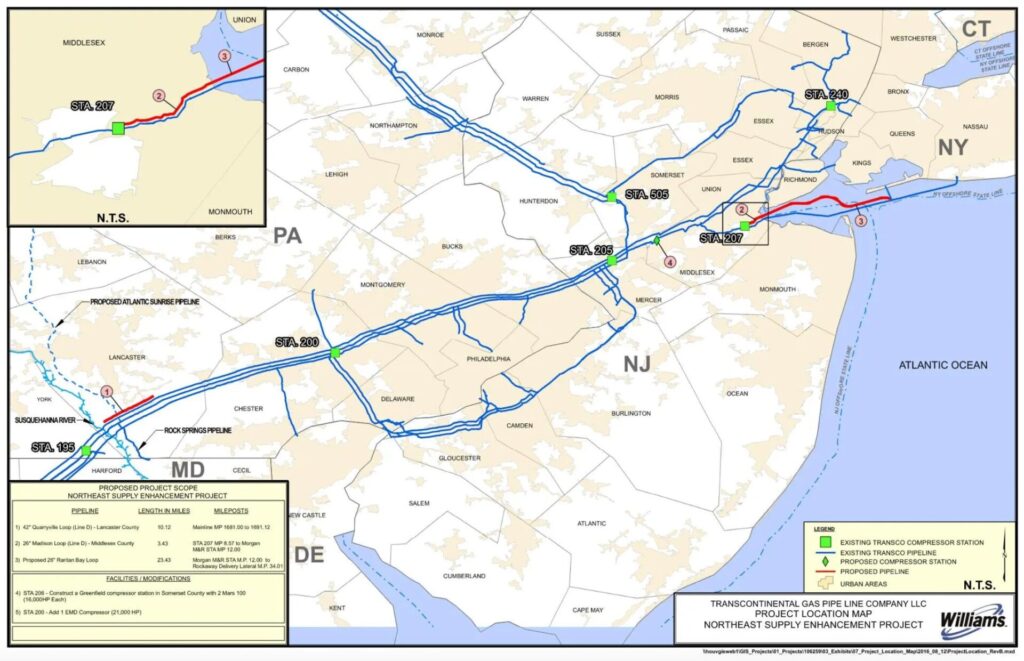
The Department of Environmental Conservation issued a state water quality permit for the Northeast Supply Enhancement pipeline…. The project would run 24 miles from New Jersey, across the Raritan Bay, to connect to the pipeline system in the Rockaways. The New Jersey Department of Environmental Protection also issued key permits.
On the Williams Cos. map below of the Northeast Supply Enhancement Pipeline, the portion approved by New York and New Jersey is shown in red.
The Hochul decision caused an uproar among many Democrats. “She did not just approve a fossil fuel project. She made a moral choice,” Lt. Gov. Antonio Delgado, who is opposing Hochul in the Democratic primary next year. “New Yorkers deserve a governor who does not treat the climate crisis as a PR problem, but as a test of moral leadership.”
The New York and New Jersey actions follow FERC’s August reinstatement of the project’s main federal authorization under the Natural Gas Act. Previously, Williams Cos., the firm building the pipelines, let its original 2019 FERC certificate lapse after denials of the water permits by New York and New Jersey.
“Following a comprehensive evaluation of this application,” said the New York State Department of Environmental Conservation (NYSDEC) in a letter to Williams, the regulatory agency “has determined that the project can comply with applicable water quality standards upon appropriate conditions.”
Energy affordability, as we have noted, has been an issue plaguing elected officials across the country – especially in states run by Democrats. Said Hochul:
As Governor, a top priority is making sure the lights and heat stay on for all New Yorkers as we face potential energy shortages downstate as soon as next summer. We need to govern in reality. We are facing war against clean energy from Washington Republicans, including our New York delegation, which is why we have adopted an all-of-the-above approach that includes a continued commitment to renewables and nuclear power to ensure grid reliability and affordability.
The New York State Public Service Commission (PSC) had found on Sept. 18 that the project was needed for its reliability and economic benefits. In its decision, the PSC cited long-running pipeline constraints in the region and a narrowly avoided catastrophe during a winter storm in December 2022.
Chad Zamarin, the CEO of Williams, said his company was proud to move the Northeast Supply Enhancement, an extension of the firm’s Transco pipeline network, forward and “do our part in providing New Yorkers access to clean, reliable and affordable natural gas.” He added that there is “increasing recognition that energy affordability directly impacts everyday affordability.”
Hochul’s decision comes after the state’s independent system operator, NYISO, in its Short-Term Assessment of Reliability (STAR) in October, identified “multiple reliability shortfalls in the next five years” in the New York City-Long Island area.
We reported in our Newsletter No. 53 that STAR said that the New York City area will be deficient “through the entire five-year horizon without the completion and energization of future planned projects.”
The projects include the 816-MW Empire Wind offshore project, which was expected to be online by 2027. That timeline was complicated when the Trump administration halted the project in April, then allowed it to resume a month later. Since then, it has faced additional complications and delays.
Earlier this year, it was widely reported that President Trump had made a deal to allow Empire Wind to go forward if Hochul approved the gas pipeline project, but offshore wind remains uncertain. Interior Secretary Doug Burgum said in September: “There is no future for offshore wind.”
As for the STAR report, it also found reliability weaknesses on Long Island starting in 2027 and the Lower Hudson Valley region in 2030.
In addition, NYISO’s 2025-2034 Comprehensive Reliability Plan (CRP), issued biennially, “warns that the New York State electric system faces an era of profound reliability challenges driven by the convergence of three structural trends: the aging of the existing generation fleet; the rapid growth of large loads (e.g.: data centers and semiconductor manufacturing); and the increasing difficulty of developing new supply resources due to public policies, supply chain constraints and rising costs for equipment,” according to an NYISO press release.
The strain is, in part, the result of New York’s existing stringent clean-energy regulations under the Clean Energy Standard (CES). Four years after its adoption in 2016, the CES was expanded to meet the requirements of New York’s Climate Act, “which sets goals for achieving 70% renewably sourced electricity by 2030 and a zero-emission electric grid by 2040,” according to the New York State Energy Research Authority.
The CES has two enforcement mechanisms – the renewable energy standard (RES) and zero-emissions credit (ZEC) regulation – that require every load-serving entity to procure renewable energy certificates and ZECs.
Critics say that the strain on New York’s grid caused by the CES has been a major contributor to the current affordability and reliability problems. According to EIA, about 60% of New York’s electricity is generated by natural gas and another 20% by nuclear power. Hydro and other renewables make up the rest. A drastic change in that mix – away from gas – would be catastrophic for the state, whose elected officials now seem to understand better that the key issue is keeping electricity bills down and ensuring that the power is flowing.
$1.7 Billion Hydrogen Hub Projects in Pennsylvania May Be Axed by the Trump Administration. A Bipartisan Effort Is Trying to Save Them.
Two Hydrogen Hubs in Pennsylvania, funded by President Biden and Congress, are in jeopardy, yet bipartisan support has emerged to save the $1.7 billion projects.
The two hubs survived a round of $7.5 billion cuts by the Department of Energy last month that hit blue states. But, reported Axios, “a new list emerged a few days later targeting both Pennsylvania projects.”
Pennsylvania is the only state with two hydrogen projects – the Mid-Atlantic Clean Hydrogen Hub (MACH2) in eastern Pennsylvania, Delaware and New Jersey; as well as the Appalachian Regional Clean Hydrogen Hub (ARCH2) project in western Pennsylvania, West Virginia, Kentucky and Ohio.
Hydrogen has significant promise as a clean energy source and a means of carrying storing and transporting energy from other sources, but it is not in widespread use. Hydrogen hubs aim to increase that use by creating networks of hydrogen producers, prospective consumers, and connective infrastructure located in close proximity.
The Mid-Atlantic Hub (MACH2), centered in Philadelphia, proposes producing hydrogen through renewable and nuclear energy. The Appalachian Hub, ARCH 2, which is based in West Virginia with extensive Pennsylvania reach, will use natural gas to produce hydrogen.
ARCH2 will take advantage of the region’s abundant natural gas. The hub seeks to create 21,000 direct jobs (18,000 in construction and 3,000 permanent), according to the Clean Air Task Force.
Prominent Pennsylvania politicians of both parties are coming to the aid of ARCH2 and MACH2. “That’s gonna harm Pennsylvania,” Democratic Gov. Josh Shapirotold reporters last month, quoted by Axios Pittsburgh. “It’s gonna kill thousands of union trade jobs. It’s gonna make us less competitive. It’s going to mean we’re producing less energy. I have no idea why the president of the United States would want to do that.”
At the same time, U.S. Sen. Dave McCormick, a Pennsylvania Republican, told Axios, “I am advocating for keeping the funding because I think it’s good for America’s energy future, and I think it’s good for Pennsylvania.” McCormick said that he was told that DOE Secretary Chris Wright was evaluating the funding, but no decision had been made – a condition that prevails today, six weeks later.
Meanwhile, the chief operating officer of MACH2, Manny Citron, told public broadcasting station WHYY that the uncertainty surrounding funding has made private partners move slower and act more cautious when working with the hubs.
Beyond the two hydrogen hub projects, the [DOE] list proposes to slash hundreds of millions of dollars in planned investments across Pennsylvania – including solar energy projects, a major truck battery plant in the Lehigh Valley, carbon capture pilot projects at U.S. Steel’s Mon Valley Works, industrial electrification projects, several workforce development initiatives and more.
Against this backdrop, the reliability of the Pennsylvania grid is becoming more doubtful as demand for electricity has risen and data centers use more power. PJM Interconnection, the state’s grid operator, in September proposed options such as allowing a large user to build its own power source or to shut off electricity to data centers during periods of high demand. Users would get credit for agreeing to disconnect in an emergency.