
- As New Jersey and Virginia get set to vote for governor, rising electric bills have moved into priority position.
- With electricity demand increasing and supply constrained by environmental policies, New York City faces serious reliability problems starting next year, says a new study.
- President Trump names his third FERC chair since January as the Senate confirms two Republicans to fill out the commission.
- Trying to cope with high electricity costs accelerated by emissions goals, California Gov. Newsom bucks a unanimous legislature in vetoing a bill aimed at demand for power.
- EPA lightens rules in order to encourage more coal-generated electricity.
- Trump Administration takes the occasion of the shutdown to kill funding of energy projects, including those seeking to improve transmission.
- Despite governance issues at PREPA and municipalities, Puerto Rico lands $365 million from the U.S. Department of Energy to harden its grid.
Rising Electric Bills Are No Longer a ‘Sleeper Issue’ for Governors’ Races and Beyond
On Nov. 4, New Jersey and Virginia will choose new governors, and energy affordability is a major issue in both races.
Nationally, consumer electricity costs have risen 5.1% year-on-year through September, according to the Bureau of Labor Statistics (BLS). In the Northeast, the increase is even greater: 9.3%. Those figures compare to a 3% inflation rate overall.
The Washington Post’s Evan Halper reported on Oct. 15:
Cheap, reliable electricity is no longer a given, with an energy crunch taking hold far and wide, and forecasts showing no price relief in sight…. Voters are demanding solutions, bringing to the forefront issues that long simmered in the political background, including the massive expansion of energy-hungry data centers, obscure surcharges on electric bills and mandates for clean energy generation.
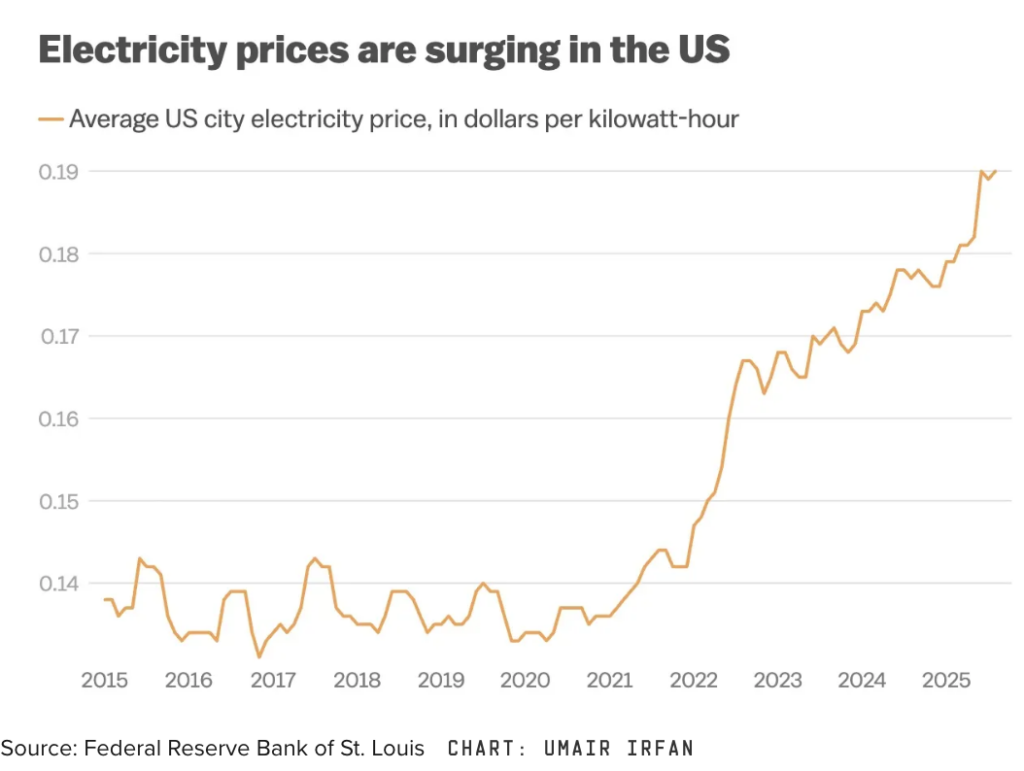
In New Jersey, the situation is among the worst in the nation. The latest data from the U.S. Energy Information Administration (EIA) shows that the average price of electricity to residential customers has jumped from 20.71 cents per kilowatt hour to 25.31 cents in 12 months, an increase of 22.2%.
“Surging electricity prices have risen to the forefront of the New Jersey governor’s race — and could be a key issue in the 2026 midterms,” reported The Hill on Oct. 16.
In the first New Jersey gubernatorial debate, both candidates brought the issue up in their opening statements. “We have an affordability crisis because of property taxes and electricity bills,” Republican nominee Jack Ciattarelli said. “I am laser focused on driving down your costs, making New Jersey more affordable. I’m going to start by declaring a state of emergency on energy costs,” the Democratic nominee, Rep. Mikie Sherrill, said.
Sherrill focused blame on PJM Interconnection, the grid operator for New Jersey and 12 other states plus the District of Columbia. In a video, she said that “268 gigawatts of power is just waiting to be added to the grid…and PJM has taken far too long to add it, taking up to six years to permit and add these new projects to our grid.”
But the Wall Street Journal, in an editorial on Sept. 28, had a different take, pointing out that New Jersey’s current Democratic Governor “withheld permits to block a 115-mile pipeline that aimed to move cheap natural gas fracked in Pennsylvania to his state. As a result, New Jersey’s natural gas plants this year have paid 35% more for fuel than the nationwide average. The constrained gas supply has limited the construction of new power plants.”
In addition, as we have reported in previous newsletters, plant retirements and rising demand for electricity lifted payments by utilities during PJM’s capacity auctions to ensure plants can provide power on demand. The Journal noted that, “[p]ayments by utilities in those auctions, which ultimately are paid by electricity consumers, jumped to $16.1 billion this year from $2.2 billion in 2023.”
In Virginia, the proliferation of data centers, particularly around Washington, D.C. and Richmond, has been a major culprit in boosting residential electricity rates, which are up 11.3%, according to the latest BLS figures. The state is the world’s capital for data centers, which are taking an even greater role due to the need for computing power to develop artificial intelligence (AI). Bloomberg reported that wholesale electricity costs are “as much as 267% more” than it was “five years ago in areas near data centers.”
At an Axios roundtable in Richmond in September, state and local officials, business executives and other experts “said AI’s growing power thirst — and hikes in electricity bills, along with the potential for rolling blackouts — are at the top of voters’ minds.” Glenn Davis, a former state legislator and director of Virginia’s Department of Energy, said, “[t]his is the first time I’ve really seen energy as part of the conversation during election season.”
Dominion Energy, which serves 2.5 million customers in the state has proposed raising rates by another $20 per month – or about 14% — over the next two years.
Abigail Spanberger, a three-term Democratic U.S. House member running to succeed term-limited Republican Gov. Glenn Youngkin, has proposed increasing local electricity generation and speeding up timelines for bringing new projects online. A position paper on her website advocates policies to:
Expand and incentivize the development and deployment of solar energy projects in commonsense locations such as abandoned mine sites, former industrial sites, rooftops, and parking lots, and locations where the reduction in energy costs would have an impact on the local community, such as schools and public buildings. Encourage the continued development of advanced energy technologies, such as small modular nuclear reactors, fusion, geothermal, and hydrogen.
Her Republican opponent, Lt. Gov. Winsome Earle-Sears, has stated, “I’m for an all-of-the-above energy plan: clean coal, oil, nuclear, natural gas—and yes, renewables too. Whatever keeps the lights on and the bills low.”
At the same time bills are rising and candidates want to expand capacity, Virginians are opposing data centers and facilities to power them.
In July, for example, Amazon Web Services pulled an application for a 7.2-million-square-foot data center in Louisa County, northwest of Richmond, after strong objections from neighbors concerned about the disruption caused by construction and about possible water contamination.
Dominion Energy faced complaints in Chesterfield County, south of Richmond, for its plan to build a 944-megawatt “peaker” complex on the site of a retired coal plant. The complex would take the strain off the power grid during spikes in hot and cold weather. At a State Corporation Commission hearing last month, one resident called the plan “a catastrophe.” One concern was that it would harm the health of nearby residents.
Research has found that the increase in utility bills is largely tied to rising investments in transmission (getting power from the plant to the substation) and distribution (moving it from the substation to the end user), as well as the continued pressure from some state energy and environmental policy mandates, which have forced early retirements of fossil-fuel plants (five large coal plants and one nuclear reactor in the state have shut down since 2017) and raised compliance costs.
A recent report from the Energy Tariff Experts and the Electric Power Supply Association (EPSA) examined the key drivers behind rising residential electricity bills across the PJM, including Maryland, New Jersey, Ohio, and Pennsylvania. The report found that the generation component (that is, the cost of producing electricity at the plant) is a distinct minority of the total of residential customer bills. So far this year, that generation cost has not increased materially and is consistent with historical averages.
It is rising transmission charges, particularly at PSE&G, New Jersey’s largest utility, that are the culprit, the study found.
Meanwhile, to meet demand growth, electric utilities earlier this year announced they would make more than $1.1 trillion in capital expenditures from the start of 2025 to the end of 2029. That is only a little less than they spent in the preceding ten years.
The electric utility sector’s capital expenditures “are higher than any other sector in the U.S. economy, outpacing transportation, retail, and other capital-intensive industries,” Drew Maloney, president of the Edison Electric Institute, said in a statement. “As demand for electricity continues to grow, we remain committed to making the investments needed to strengthen America’s energy security while ensuring that our customers receive reliable, affordable energy.”
Clearly, unleashing affordable, reliable energy on an improved grid – rather than attacks on struggling grid operators – is the solution to easing ratepayers’ pain and fueling local economies.
A few weeks ago, NBC News called rising utility bills “the sleeper issue that could play a huge role in Virginia and New Jersey – and the midterms.” It’s a sleeper no more.
New York City Faces Power Reliability Challenges Starting Next Year, Warns New ISO Report
New York City’s electric grid faces the risk of power shortages between now and July 2030,according to the Short-Term Assessment of Reliability (STAR) issued earlier this month by the state’s independent system operator, NY-ISO.
The New York City area will be deficient “through the entire five-year horizon without the completion and energization of future planned projects,” the STAR report concluded.
“Those projects,” reported Utility Dive on Oct. 14, “include the 816-MW Empire Wind offshore project, which was expected to be online by 2027. That timeline was complicated when the Trump administration halted the project in April before allowing it to resume a month later. Since then, it has faced additional complications and delays.”
The STAR report also found reliability weaknesses on Long Island starting in 2027 and the Lower Hudson Valley region in 2030.
In addition, NYISO’s 2025-2034 Comprehensive Reliability Plan (CRP), issued biennially, “warns that the New York State electric system faces an era of profound reliability challenges driven by the convergence of three structural trends: the aging of the existing generation fleet; the rapid growth of large loads (e.g.: data centers and semiconductor manufacturing); and the increasing difficulty of developing new supply resources due to public policies, supply chain constraints and rising costs for equipment,” according to an NYISO press release. The CRP was issued Oct. 16 in draft form and is expected to be final in November.
“Taken together, these two reports show the grid is at a significant inflection point,” said Zach Smith, senior vice president of System and Resource Planning for NYISO. “Depending on future demand growth and generator retirements, the system may need several thousand megawatts of new dispatchable generation within the next ten years.”
Gavin Donohue, president of the Independent Power Producers of New York, further stated “The NYISO’s findings should be alarming to residents and serve as another wake-up call for the state. Electric demand is continuing to drastically rise, and the state needs to look at all possible resources.”
The situation is having real-life consequences for New Yorkers. In June, New York City Comptroller Brad Lander reported that as utility costs have risen, 30% of New Yorkers are “energy insecure,” meaning they are unable to meet their household’s basic energy needs.
Over the past five years, 3.5 million New Yorkers, or 42% of the population, have fallen behind on utility payments, and 1.9 million (23%) have experienced utility shutoffs because they could not pay their bills. “Citywide, 11% of New Yorkers do not have air conditioners at home,” said Lander’s report, as approximately 580 people in the city die each year because of extreme heat.
The new STAR report pointed to “a deficiency in transmission security,” that is, “the ability of the power system to withstand disturbances, such as electric short circuits or unanticipated loss of a generator or a transmission line, while continuing to supply and deliver electricity to consumers during peak demand when the system is stressed.”
The problem is compounded because some generators in New York City are unavailable because of the New York State Department of Environmental Conservation’s “Peaker Rule,” which limits nitrogen oxide emissions. The rule is one of the many extreme environmental regulations that limit New York’s capacity and access to affordable, reliable energy.
The CRP noted that the rule, issued in 2019, has “resulted in 1,027 MW of affected fossil-fired generators being deactivated or limited as of May 1, 2023 and an additional 590 MW becoming unavailable by May of 2025.”
Aging fossil-fuel plants are also being decommissioned because of the state’s Climate Leadership and Community Protection Act, which mandates a zero-emission grid by 2040.
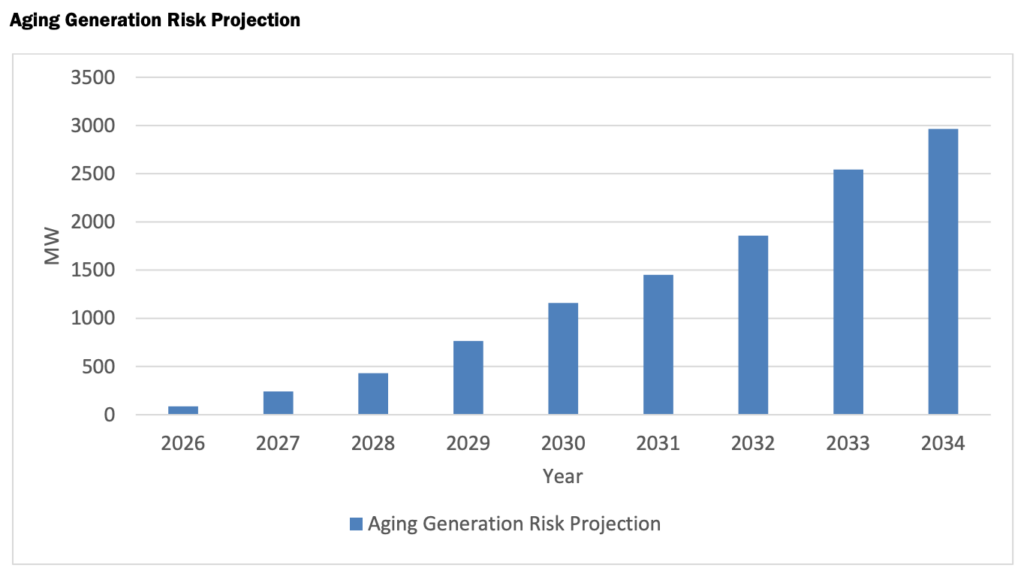
The graphic below, from the CRP, shows that “3,000 MW of New York’s existing conventional fossil-fuel generation was identified as likely to be unavailable by 2034, approximately 60% of which is in New York City.”
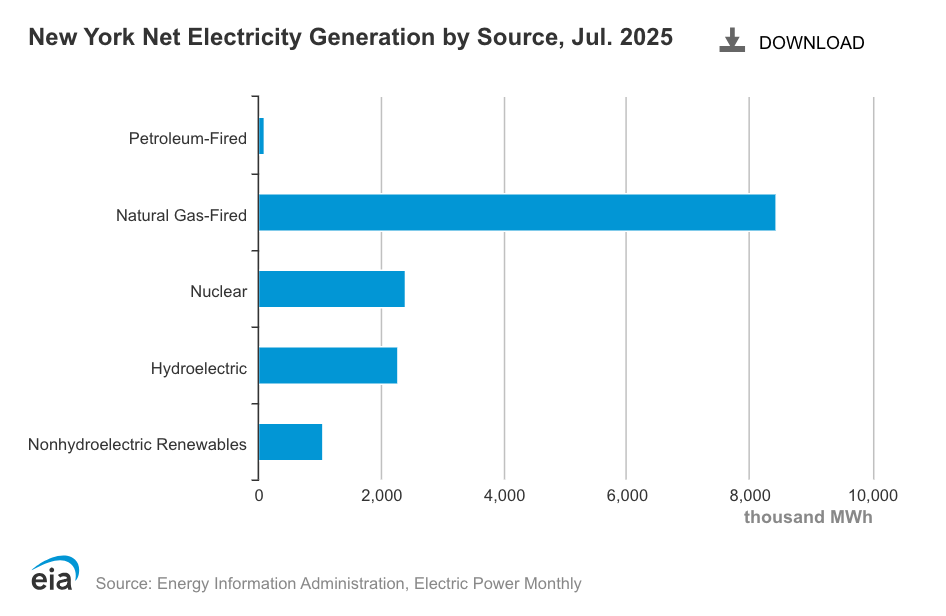
The state generates about two-thirds of its electricity from natural gas, with nearly all the rest coming from coming from nuclear and hydroelectric power. This month, the Albany Business Review reported that most New Yorkers see natural gas as both a reliable (84%) and affordable (76%) energy source.
“If the right market signals are in place, the private sector will invest in the necessary resources to address these shortfalls,” said Donohue, speaking for independent power producers. “All potential solutions must be on the table. Increasing dispatchable generation must be prioritized so that the state does not go dark.”
U.S. Senate Confirms Two Republican FERC Nominees, and Trump Names One of Them as Chairman
On a party-line vote of 51-47, the Senate on Oct. 7 confirmed President Trump’s two Republican nominees to fill two vacant seats on the Federal Energy Regulatory Commission (FERC), returning the agency to full capacity. Then, on Oct. 24, the President named one of them, Laura Swett, to be chairman, the fourth in the past 10 months. Republicans now have a 3-2 FERC majority.
As we reported in Newsletter No. 52, Swett previously worked in FERC’s enforcement office and as an advisor to former Chairman Kevin McIntyre. She litigated FERC law for the past 15 years, most recently at Vinson & Elkins. She also served as a lead attorney in FERC’s Office of Enforcement.
The other confirmed commissioner, David LaCerte, is a Louisiana lawyer who was an official in the U.S. Office of Personnel Management and previously acting managing director at the U.S. Chemical Safety and Hazard Investigation Board. He worked at the Baker Botts law firm on Clean Air Act-related litigation. Swett’s term expires in June 2030, LaCerte’s in June 2026.
As chairman, Swett replaces David Rosner, a Democrat who advised now-retired Sen. Joe Manchin (I-WV). Trump named Rosner to the chair six weeks ago. He continues as a member of the commission. Rosner himself replaced Mark Christie, whom Trump named chairman in January after assuming the presidency. Christie, a Republican, has since left the commission.
According to an S&P Global report, “Observers expect the commission to take a firmer position on data center colocation to support a robust nationwide deployment of artificial intelligence.” As we reported in Newsletter No. 45, Christie raised serious concerns about consumers facing higher utility bills as power is added for data centers.
In addition, the commission is expected to see an upswing in applications from gas pipeline developers seeking to take advantage of rising demand and a friendlier permitting environment under the Trump Administration.
The most critical challenge facing FERC is ensuring the U.S. has enough power to meet the growing demand for electricity, driven in large part by data center development. “I actually have lost sleep a few nights worrying about how our country will meet the demand that it faces,” said Swett at her confirmation hearing in September.
Said LaCerte during his confirmation: “Artificial intelligence, data centers and reindustrialization present a compounding of these issues, which will require diligent planning, forecasting and regulatory oversight from both the states as well as FERC.”
Industry representatives were encouraged by the confirmation of two commissioners who set a priority on an adequate power supply that promotes economic growth and keeps the national grid reliable. Todd Snitchler, president and CEO of the Electric Power Supply Association (see above), stated:
Competitive power suppliers are already investing tens of billions of dollars each year to build, upgrade, and maintain natural gas, nuclear, storage, and renewable resources. But long-term investment requires confidence in the rules of the road. That’s why steady federal oversight is critical. Reducing uncertainty and ensuring that competitive auctions are run regularly, fairly, and transparently will help unlock the private capital needed to strengthen our grid, support economic growth, and meet rising demand from manufacturing, electrification, and AI.
In a statement on its website, the Interstate Natural Gas Association of America (INGAA) also welcomed the confirmations: “INGAA has long said that FERC works best when it has a full complement of five commissioners to provide the regulatory certainty necessary for investment in America’s energy infrastructure. Economy-wide energy demand is quickly rising, providing an opportunity for vast economic growth if we can meet the moment by building the needed energy infrastructure, including natural gas pipelines, to meet that demand.”
Christina Hayes, executive director of Americans for a Clean Energy Grid, congratulated Swett and LaCerte in a press release on Oct. 8. She noted that the two recognized in their confirmation hearings that “building out our nation’s transmission infrastructure is critical to meeting the energy demand challenges presented by artificial intelligence, data centers, and advanced manufacturing […] We look forward to working with both commissioners to advance common-sense solutions to promote transmission’s role in the American energy dominance agenda.”
Republicans now have a 3-2 majority on the commission, which is positioned to facilitate permitting and move quickly to enhance the Administration’s goal of energy dominance. But major obstacles remain in building more supply, including a national grid that is more than a century old that was not built for an advanced economy with multiple sources to generate electricity.
More Turmoil in California Over Energy Policy as Gov. Newsom Prepares a Possible Run for President
Earlier this month, California Gov. Gavin Newsom vetoed a bill meant to provide demand-side electricity savings even though it was supported by all 119 state legislators who voted on it. The move appeared surprising to observers, but it may reflect positioning for a possible run for president in 2028.
The bill, AB 44, directed the California Energy Commission (CEC) to adopt a set of “upfront technical requirements and load modification protocols” to provide the option for a utility to reduce or modify its demand forecast, said a Utility Dive piece. In other words, the legislation encouraged the adoption of methods for consumers and businesses to decrease their demand for electricity at a time of rising rates.
Environmentalists expressed displeasure at Newsom’s veto. “California has failed to deliver significant cost savings for ratepayers,” said Edson Perez, California lead at Advanced Energy United. “With Assembly Bill 44 being vetoed, the state has missed a huge opportunity to advance common-sense policy that would have lowered costs, strengthened the grid, and unlocked the full potential of advanced energy.”
Said Kurt Johnson, community energy resilience director at the Climate Center, a nonprofit group, “These vetoes effectively stall progress on key distributed energy and affordability strategies.”
A report by PV Magazine explained: “The veto comes as California lawmakers are pursuing ways to use distributed energy resources, such as rooftop solar, energy storage and smart home devices, to reduce strain on the grid.” Another method of reducing demand that is gaining popularity is the “virtual power plant,” by which thousands of home batteries of the sort used for emergency generation and powering electric vehicles, are knitted together to serve broader audiences.
The Brattle Group, an energy consultancy, found in a 2024 analysis that VPPs could provide more than 15% of the state’s peak grid demand by 2035. Others, however, say the promise of VPPs is overblown.
California found itself in its current predicament because of decades of environmental and energy policies that contributed to residents having to pay the second-highest electricity costs in the nation.
Newsom gave a technical reason on Oct. 1 in vetoing the bill:
While I support expanding electric load flexibility, this bill does not align with the California Public Utility Commission’s Resource Adequacy framework. As a result, the requirements of this bill would not improve electric grid reliability planning and could create uncertainty around energy resource planning and procurement processes.
Moreover, energy affordability is being pushed into the forefront of state politics. Last month, Newsom signed a sweeping energy affordability legislative package that has been largely seen as an about-face from some of Newsom’s previous aggressive, environmentalist policies and statements. The bill included boosting oil drilling in Kern County by approving a long-delayed environmental impact report for new wells there. The veto of the demand bill is being considered by observers in the same light.
As we reported in Newsletter No. 52, when Newsom, a possible Democratic nominee for president in 2028, signed the earlier legislation, he said it will make it “easier to build the abundant clean energy we need to keep bills lower.” Critics disagree, saying the package of bills, which included an extension of cap-and-trade policies, will endanger the state’s electric grid and raise utility bills.
Newsom appears to be trying to balance his strong environmentalist ideology with a more practical approach to provide affordable, stable energy as the 2028 election nears.
EPA Actions Encourage Coal-Fired Power Generation to Meet ‘National Energy Crisis’
The Environmental Protection Agency (EPA) announced two major actions on Sept. 29 affecting coal-fired power plants. The first proposed rule pushes wastewater compliance into the future under the Clean Water Act. The second set a rulemaking under the Clean Air Act to restructure the Regional Haze Rule program.
The EPA’s actions were a response to the nation’s increase in demand for power at a time when coal plants are being decommissioned, in part because of environmental regulations.
The agency said on its website: “A national energy crisis is impacting the U.S. electric power sector in the form of extraordinary increases in electricity demand driven in part by the artificial intelligence (AI) and datacenter revolution, as well as an industrial and manufacturing resurgence.” EPA added:
The existing compliance deadlines are simply unworkable in this dynamic reality, and the EPA is taking action to relieve pressure on electricity producers and the grid. The Agency is committed to giving utilities more time to evaluate and plan for rapidly evolving electricity demand to ensure economic prosperity for the nation now and in the future and ensuring that reliable, high-performing, domestic sources of energy can continue to be counted upon.
The wastewater extension centers on seven compliance deadlines — from December 2029 to December 2034 – that were written into last year’s Steam Electric Power Generating Effluent Limitation Guidelines.
The new measures were unveiled as EPA Administrator Lee Zeldin, Energy Secretary Christopher Wright, and Interior Secretary Doug Burgum published an opinion piece on the Fox News website on Sept. 30 hailing a renewed national push for coal. In it, they cast the wastewater and air-quality actions as part of President Trump’s “energy dominance” agenda, writing:
The EPA is proposing revisions to regulations on Steam Electric Power Generation that provide certainty coal plants desperately need. We’re giving them more time to comply while keeping your lights on by extending seven major deadlines and eliminating the pressure to prematurely close reliable, affordable baseload power generation.
They added, “We’re also announcing new approaches to streamline Regional Haze implementation. Current program implementation has imposed substantial costs on power plants, threatening affordable energy access for American families.”
According to the EPA, the compliance deadline extensions respond to petitions from the Edison Electric Institute, a trade group representing U.S. investor-owned utilities; the Utility Water Act Group, a coalition of major electric utilities and power producers; and America’s Power, a coal industry association. The petitions cited engineering and procurement bottlenecks, transmission constraints, and concerns about overlapping retrofit timelines.
The EPA’s concerns about reliability may appear to be stretching its statutory mission to “protect human health and the environment,” but the agency signed a Biden-era memorandum of understanding with the Department of Energy, also in December, that “provides a framework for both agencies to support reliable electric service.”
The EPA also pointed to December’s Long-Term Reliability Assessment from the North American Electric Reliability Corp. (NERC), which concluded that more than half the U.S. faces a potential shortage of electricity supplies in the coming years. Additionally, the EPA noted a series of emergency reliability interventions in 2025, including orders to keep Michigan and Pennsylvania coal- and oil-powered plants online (as we noted in our Newsletter No. 52) as well as a FERC-approved reliability-must-run contract in Maryland.
The day before the opinion piece appeared, Energy Secretary Wright announced $625 million in funding aimed at retrofitting and recommissioning coal plants.
“Beautiful, clean coal will be essential to powering America’s reindustrialization and winning the AI race,” Wright said in a statement. He added:
These funds will help keep our nation’s coal plants operating and will be vital to keeping electricity prices low and the lights on without interruption. Coal built the greatest industrial engine the world has ever known, and with President Trump’s leadership, it will help do so again.
Michelle Bloodworth, CEO of the coal group America’s Power, responded by saying, “Under previous administrations, federal regulations were written to target coal plants and force them to retire prematurely. These coal retirements have put the reliability of the U.S. electricity grid at risk.”
The Trump Administration took other actions this spring to help coal, yet other than keeping a few plants open that were scheduled to be retired, the moves are unlikely to change the economics of coal generation, says Rob Gramlich, CEO of Grid Strategies, a research firm. “Natural gas fracking killed coal power in the US and neither this nor any previous administration is banning fracking,” Gramlich said on social media.
Funding Cuts Affect Transmission Plans
The government shutdown has accelerated funding cuts that affect electricity generation and especially transmission. One of the most consequential involved key seams upgrades between two regional grid operators, MISO (Midcontinent Independent System Operator) and SPP (Southwest Power Pool). A “seam” is the interface between two wholesale electricity control areas, systems, or markets.
Earlier this month, a $464 million grant tied to the Joint Interconnection Queue (JTIQ) was terminated. It would have helped pay the $1.8 billion cost of “two regional grids spanning much of middle America — a project meant to move wind power across state lines and eliminate bottlenecks that are contributing to rising electricity prices,” according to E&E News, which added:
Seen through the lens of President Donald Trump’s priorities, the power lines would appear to be just the kind of federally backed conduits for wind power that he and his closest advisers abhor. Seen through another lens, the canceled DOE grant threatens a grid expansion that should fit squarely inside the White House’s “energy dominance” agenda, grid officials say — bolstering infrastructure to move more electrons from all sources onto U.S. power grids.
The JTIQ was meant to improve reliability and reduce prices. DOE’s 2023 National Transmission Needs Study, issued in 2023, flagged growing interregional transmission needs. The MISO–SPP seam is already at capacity, and JTIQ was designed to unlock 28 to 30 gigawatts (GW) of new generation and reduce costly congestion.
In July, well before the shutdown, DOE terminated its conditional commitment for a $4.9 billion loan guarantee for another transmission project, the Grain Belt Express, which the department described as a “high-voltage direct current (HVDC) transmission line intended to connect wind and solar capacity across Kansas and Missouri.”
Invenergy, which is building the project, indicates that more than half the states in the U.S. would be connected through the transmission. Among the prospective beneficiaries is Minnesota, and the state’s Department of Commerce protested, “Without these investments, Minnesota could face higher energy prices, slower infrastructure development, and increased burdens on low- and middle-income households — all while demand for clean, affordable energy continues to grow.”
On the other hand, DOE gave the green light to a $1.6 billion loan guarantee to a subsidiary of American Electric Power “to upgrade nearly 5,000 miles of transmission lines across five states, mostly in the Midwest, for largely fossil fuel-run energy,” the Associated Press reported on Oct. 16.
Continuing the theme of thwarting Biden-era renewables projects, DOE cancelled $700 million in grants on Oct. 20 to battery companies Ascend Elements, American Battery Technology Co. (ABTC), Anovion, ICL, and LuxWall.
The projects “had missed milestones, and it was determined they did not adequately advance the nation’s energy needs, were not economically viable, and would not provide a positive return on investment of taxpayer dollars,” DOE spokesperson Ben Dietderich said in a statement.
“He did not specify the milestones,” reported E&E News, which added, “The cancellations are some of the largest to date of advanced battery manufacturing projects, affecting plans to build landmark plants in red states like Kentucky and Missouri.”
Battery power is in enormous demand. ABTC says it will appeal and proceed with its project, which is setting up a facility to manufacture battery cathode grade lithium hydroxide. “Under the grant,” reported Reuters, “DOE’s Manufacturing Energy Supply Chain office would contribute $57.7 million, while the company would put in an equal amount towards the facility…. Despite the setback, the company said it has raised over $52 million from public markets this year and will continue the project without changes to its timeline or scope.”
In April, ABTC “received a letter of interest from U.S. Export-Import bank for $900 million in financing to support construction of its Nevada-based lithium mine and refinery.” Meanwhile, Ascend says it will replace remaining federal dollars with private and municipal financing.
Hundreds of other clean-energy grants are on the chopping block, according to widespread reports. These include “the five remaining federally funded hydrogen hubs and two direct air capture projects, according to a list obtained by E&E News that is circulating among lobbyists and Capitol Hill staff. The compendium marks more than 600 grants totaling more than $20 billion as “terminate.”
E&E on Oct. 7 quoted an energy lobbyist as saying, “I understand this is the full list that was sent to Office Management and Budget a few weeks ago. Last week, they basically just pulled out most, if not all, the blue state projects, and that’s what they announced as cuts.”
The initial 233 targets, with grants of $7.6 billion, including the Grain Belt Express, were axed Oct. 1. DOE announced in a press release: “Following a thorough, individualized financial review, DOE determined that these projects did not adequately advance the nation’s energy needs, were not economically viable, and would not provide a positive return on investment of taxpayer dollars.”
Latitude Media reported on Oct. 2 that, “according to a fact sheet circulated by House Appropriations Committee Democrats this week, the impacted projects are in districts represented by 108 individual Democrats, and 28 Republicans.”
Cancelling transmission projects comes with risk. An independent congestion analysis by Grid Strategies a year ago, for instance, found:
Insufficient transmission grid capacity blocks the delivery of lowest-cost resources to consumers. The cost to consumers is measured through grid congestion. In the so-called “organized markets” where transmission congestion is transparently reported, total congestion costs in 2023 amounted to $8 billion. Scaled based on electricity demand, that number implies $11.5 billion in congestion costs nationwide in 2023. These costs are ultimately paid by consumers.
U.S. Energy Department Sending $365 Million to Puerto Rico; Is That Wise?
We reported in our Newsletter No. 52 about the dire situation in Puerto Rico, where, “eight years since the double blast of Hurricanes Irma and Maria and the federal funding that cascaded afterwards, Puerto Rico’s energy grid – and its energy future – remain precarious.”
The Energy Information Administration reports that even without “major events” like hurricanes, customers in Puerto Rico have lost between 26 and 30 hours of power in each of the past four years, compared with about two hours in the mainland United States.
Now, with the backdrop of cuts in the U.S., DOE announced Oct. 1 that it will “reallocate up to $365 million to address Puerto Rico’s grid crisis and deliver affordable, reliable energy for the 3.2 million Americans who call Puerto Rico home.”
There is no doubt Puerto Rico has serious grid deficiencies, but observers say the island’s governance situation should give pause to any steward of federal funds. DOE in its press release said that “the funding will support commonsense repairs and emergency measures that strengthen grid stability and harden critical infrastructure.”
The funding, however, will go to PREPA, which has been beset with management problems. As we reported in our Newsletter No. 52, “A deal to end the eight-year saga of the bankruptcy of the Puerto Rico Electric Power Authority (PREPA) is nowhere in sight, as the Bond Buyer recently reported.”
Wrote Ben Zycher, an American Enterprise Institute economist, on Sept. 18, “Have the people of Puerto Rico not suffered enough from the decade-plus of PREPA machinations?”
Meanwhile, in a letter to Homeland Security Secretary Kristi Noem last month, the National Taxpayers Union warned that some Puerto Rican municipalities are trying to levy retroactive taxes on federally funded reconstruction. “Every dollar diverted to pay a municipal tax bill is a dollar not spent on repairing substations, modernizing the grid, or hardening infrastructure against the next storm,” said the letter.
Zycher notes that the municipalities have filed suit trying to extract millions from PREPA for work funded by Noem’s department after Hurricanes Irma and Maria. Will they try the same with the new tranche of funding?
Mainland taxpayers will not be happy if they see hundreds of millions of dollars heading to Puerto Rican city halls instead to rebuilding generation, hardening transmission, and lowering rates. In the end, a hurricane-exposed grid will become even more vulnerable.
DOE talks of killing mainland projects on ROI grounds. Critics say it should reduce risks for its Puerto Rico spending with strict guardrails, preemption where appropriate, and real-time audits so that every dollar reduces outage minutes and customer bills. It makes sense to treat Puerto Rico at least the same as the mainland.