
- Utilities are slowing their requests for rate increases. What’s the explanation?
- In a big change, NERC wants to regulate electricity users, not just providers, as large loads cause disruptions.
- Permitting reform moves closer to reality with a vote set for Nov. 9 in the Senate.
- Here are highlights of the permitting bill.
- A study by Columbia estimates how much permitting reform will speed the development of different kinds of energy infrastructure.
- Even before the permitting bill passes, FERC moves to streamline natural gas projects.
- Competitive energy providers test their readiness for attacks.
A Surprising Decline in Requests for Rate Increases: What Does It Mean?
PowerLines, a non-profit concerned with the cost and operations of the U.S. utility regulatory system, reported early this month that electric and gas utilities have requested $23.1 billion in rate increases for the first nine months of 2026.
While that figure may sound large, it is less than the $34 billion requested in the first nine months of 2025. Why, during a period of rising demand for electricity, has there been a decline in the dollar volume of rate requests?
Part of the answer is the election. In an Oct. 6 S&P Global piece, Allison Good and Darren Sweeney, write that “utilities are adjusting to a nationwide backlash to data center development as candidates campaign on affordability messaging.” The reporters stated:
Keeping pace with the changing political landscape is proving challenging for the industry, even as utility management teams say they are working to improve stakeholder engagement and protect customers from the costs of generation, transmission and distribution additions to serve large loads.
The article quoted Drew Maloney, CEO of the Edison Electric Institute, the utility trade group, as saying in reference to the intersection of data centers and affordability: “I’ve been doing politics for a long time, and this issue has probably shifted more quickly than almost any issue I think I’ve ever seen.”
According to S&P Global Market Intelligence data, of the 36 states electing governors on Nov. 3, “California has the largest total dollar value of gas and electric rate increase requests pending with state regulators, at $2.67 billion, followed by Michigan, Ohio, Arizona and New York, Utilities regulators are appointed by the governor and confirmed by the Senate in all of those states but Arizona, where members of the state Corporation Commission are elected statewide.”
In Newsletter No. 61, we reported that Gov. Mike Braun, a Republican who was elected for the first time in 2024, removed the chairman of the Indiana Utility Regulatory Commission (IURC) from office on June 22 after the agency agreed to a rate increase sought by AES Indiana.
Gov. Braun had appointed the chairman, Andy Zay, a former state senator, just six months earlier. The rate increase — $71 million — was “about 37% of what the utility initially requested and lower than a settlement agreement proposed in October,” the Indiana Capital Chronicle reported. Said Gov. Braun of the increase:
My top priority is affordability, which is why I am deeply disappointed by the IURC’s approval of another AES rate increase. Hoosiers have spent years tightening their belts and making tough financial decisions. It’s time for utility companies to do the same.
Further evidence of the adverse climate for rate increases: PECO Energy in April withdrew a $510 million request filed with the Pennsylvania Public Utility Commission (PUC) over affordability concerns.
“In the wake of the filing…and reflecting upon concerns expressed by customers, policymakers, regional leaders, and community partners, PECO has determined to seek leave to withdraw [its proposal] and maintain electric distribution rates at current levels,” the Philadelphia-based company told the PUC.
PECO on March 30 had asked for a $429 million, or 12.5%, annual revenue hike for its electric operations and an $81 million, or 11.4%, increase for its gas business.
“While our filing with the PUC would have provided needed improvements in safe and reliable energy delivery, we recognize that Pennsylvanians are struggling with basic necessities like gas, food, and energy and have decided to withdraw our proposal,” David Vahos, PECO president and CEO, said in a press release.
Meanwhile, utilities are finding ways to get more peak power out of their existing infrastructure rather than making massive capital investments.
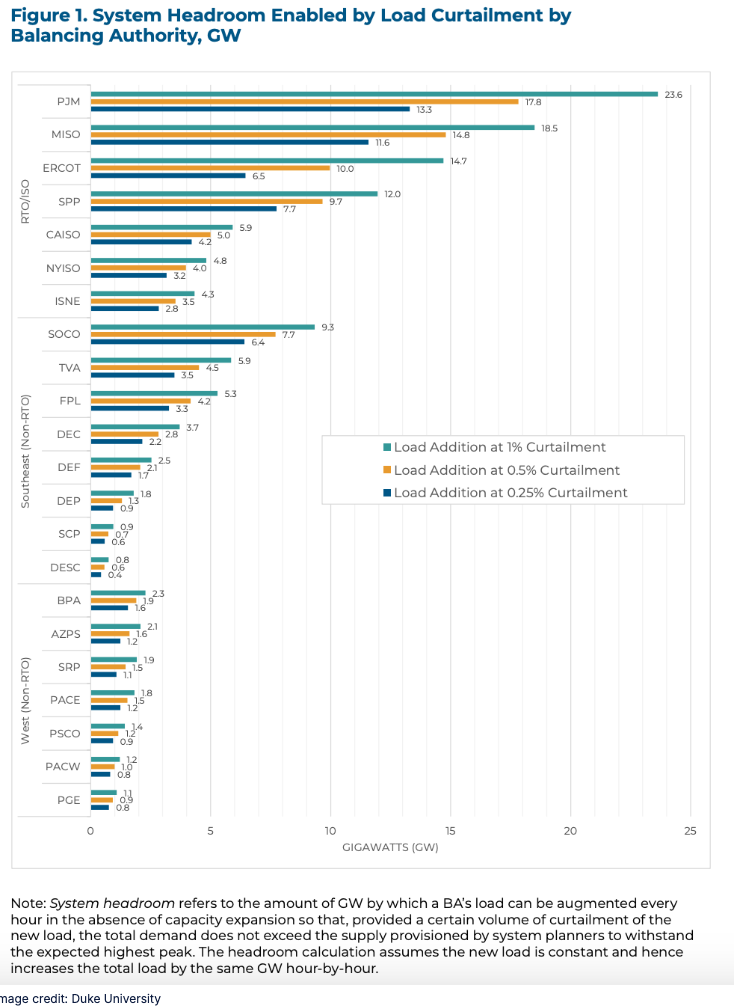
In a much-discussed research paper last year, Tyler Norris and colleagues at Duke’s Nicholas Institute for Energy, Environment and Sustainability showed that the increase in large loads can be accommodated “with minimal capacity expansion or impact on demand-supply balance,…provided the new load can be temporarily curtailed as needed.”
For example, “76 GW [gigawatts] of new load – equivalent to 10% of peak demand – could be integrated with an average annual load curtailment rate of 0.25%,” said the study. (Curtailment is a planned or controlled reduction of the use of electricity to balance supply and demand during peak use periods.)
The report says that the nation can add 100 GW of additional load through flexibility solutions, as this graphic from the report, which breaks down flexibility by regional grid operator (RTO or ISO) shows.
Portland (Ore.) General Electric (PGE) has been working with GridCARE, a California-based power acceleration company, which uses physics-based artificial intelligence to unlock potential capacity.
Since May 2025, the partnership has discovered more than 400 megawatts (MW) of potential capacity on PGE’s system that could be available by 2029, including 80 MW available this year. Says Cariana Morales, GridCARE’s chief of staff:
What’s happening today is that when a utility says, “Hey, we don’t have power until 2037,” they’re basically saying that at peak capacity, the grid is overloaded. But the grid’s only at peak capacity for a few hours of the year. The rest of the year, there’s all this headroom that’s available…. The other 98 to 99 percent of the year, the grid is only running at 30-percent capacity.
GridCARE says it using about two dozen “flexibility strategies” to help data centers and grid operators navigate peak demand periods, ClearingUp reports. “Such strategies involve the use of backup generation and batteries.”
There are other means of making the grid more efficient. For example, Duquesne Light Co. in Pennsylvania has used what is called Dynamic Line Rating (DLR) technology, deployed by the company LineVision, to increase “the capacity of existing transmission lines by as much as 40%,” according to a press release.
DLR, a type of grid-enhancing technology (GET), is a way of setting how much electricity a transmission line can carry based on actual, current weather rather than a fixed worst-case assumption. DLR allows a line to handle more electricity in cooler weather when the chances of overheating and having transmission wires expand and droop, causing a fire hazard, are lower.
Current FERC rules require utilities to consider hardware and software that get more capacity out of existing lines.
in demand from data centers may be overblown. Certainly, more power is needed, but the AI developers themselves have constraints – from investors worried about a bubble, from supply-chain But, says a Bipartisan Policy Center (BPC) analysis of the Sept. 30 permitting reform bill (see below), “because utilities earn a return on the capital they invest, they have little financial reason to choose cheaper options over new construction, and adoption has been slow.”
Regulators have been prodding utilities to adopt GETs for years now, but with little effect. The bill in front of Congress goes further, requiring utilities to deploy advanced transmission technologies, including the best-available conductors, when building or upgrading if benefits exceed costs. The bill also clears the way for upgrades within existing rights of way, such as GETs and the use of advanced conductors that can enable more power to be carried over existing lines.
To date, however, utilities – for the reason BPC cites (more capital investment boosts their profits) – have been slow to adopt these efficiencies.
There may be yet another reason for the apparent slowdown in the growth of rate increases: projections of a rapid rise limitations, and from politicians and their constituents who don’t want the centers in their backyards.
Still, in a separate report, S&P Global projected “approximately $1.3 trillion of aggregate capital expenditures for US energy utilities between 2026 and 2030 as companies seek to modernize infrastructure and add generation capacity in response to heightened energy demand from large-load customers, particularly data centers that support AI, digital services and cloud infrastructure.”
A closer look at the forecast, however, shows that utility capital expenditures will rise 6% from 2025 to 2026 and only 0.3% from 2026 to 2027.
NERC Is Moving to Deal With Computational Loads, in Part by Regulating Players on Electricity’s Demand Side
The board of trustees of the North American Electric Reliability Corp. (NERC) voted Oct. 26 to adopt reliability standards for AI data centers, crypto mining, and other large computational loads.
At the same time, NERC is asking for approval from the Federal Energy Regulatory Commission (FERC) to add two new functional entities to the NERC registry criteria — Computational Load Owner and Computational Load Operator. These requests, if granted, would be a significant break with the past.
In August, Keentel Engineering, an electric power specialist, explained on its website the consequences of NERC’s action, noting that the organization had for 20 years regulated only the supply side. Keentel continued:
Generators, transmission owners, balancing authorities, reliability coordinators — the entities that make and move electricity — carried mandatory, federally enforceable obligations. The entities that consume electricity did not. Load was something the grid planned around, not something the grid regulated.
But that is changing. NERC has decided that it now has to set rules for the demand side. Keentel warns that institutions such as data centers and crypto miners, if they meet criteria, could become “a NERC registered entity: mandatory requirements, compliance audits, and civil penalty exposure at $1,584,648 per violation per day.”
On its website, the American Public Power Association explained that the NERC move was the result not just of the proliferation of large loads interconnecting to the bulk power system (BPS) but of “emerging concerns over the electrical behavior of large data centers and other computational load,” The association’s article on Oct. 25 added: “Specifically, large-scale customer-initiated load reductions during normal grid faults could lead to voltage and frequency excursions, posing risks to the operation of the BPS.”
NERC stated that existing registered entities on the supply side cannot “perform all the actions needed to address the risks.” The organization added:
It became clear that computational load did not behave like other large load, and with the projected increase connecting to the grid, NERC needed to quickly understand how to mitigate any impacts from the aggregate risks posed by large amounts of load with unique electrical behaviors.
Jim Robb, the CEO of NERC, explained on an episode of the Public Power Now podcast posted in late July that data centers present three major issues.
There’s the resource adequacy question, “which is where are we going to get the power and the fuel to support this new load?…. It obviously has implications in our long-term reliability assessment.”
Robb said resource adequacy is “really something that the data center developers, the power generation developers, the utilities, and the regulators” need to figure out –how to get power supply to the load.”
The second issue is “the terms and conditions under which these loads interconnect – basically,…what is going to be needed to get the load connected and who’s going to pay for what part of it. That’s really kind of up to FERC and the state regulators to sort out,” he said.
“And then there’s this third issue where we’re highly focused, which is the operating performance of the data center. How do we get that to not compromise and maybe even contribute to the reliability of the grid itself?”
The proposed rules will govern grid behavior, not rates, siting, or how much power a data center may use. NERC argues it already has the legal authority: “Congress and the [Federal Energy Regulatory] Commission long ago contemplated that such large customers may someday need to be regulated under section 215 of the Federal Power Act.”
NERC called the vote by its board on Oct. 26 on standards for computational loads a “major milestone in accelerated efforts to address the reliability risks” caused by rapidly growing demand. The next step is for NERC to file the actual standards with FERC for final approval. Utility Dive reported:
The proposed standards build on insights and research related to a Level 3 alert NERC issued in May after several incidents where data centers unexpectedly dropped load or oscillated demand rapidly, threatening the stability of regional grids.
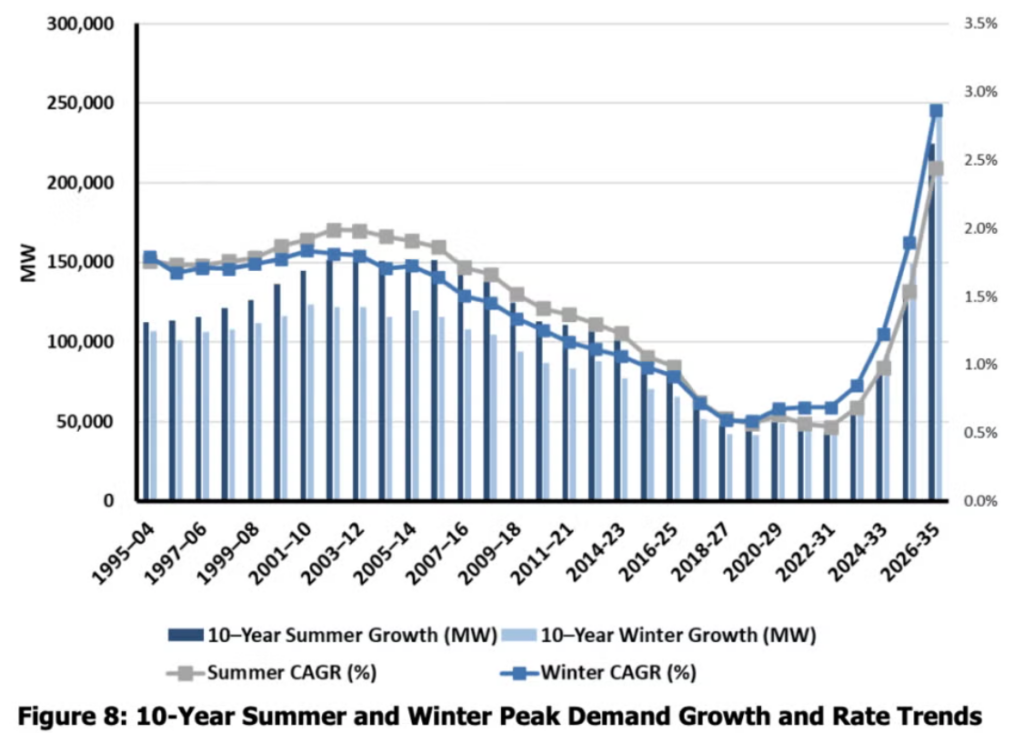
Peak demand during the summer across the bulk power system will grow by 224 GW over the next 10 years, a 24% increase over peak demand in 2025, estimated NERC in January.
“These loads are reshaping the demand profile and exposing reliability gaps in both operational and planning time horizons,” NERC said on its standards development project site. The standards will apply to computational loads of 50 megawatts (MW) and above, connected at voltage levels greater than or equal to 100 kilovolts.
The non-profit watchdog said in an Oct. 27 statement that the board action “is the first phase of NERC’s broader large loads action plans to address the reliability challenges associated with large loads, with additional standards development efforts underway to address computational load performance, planning and reliability studies, and event reporting.”
Permitting Reform, With Major Changes in Grid Transmission Policy, Moves Closer to Reality
Permitting reform appears to be moving to passage at long last in the Senate. At least, we now know what’s in the bill that’s become the template, though it may still be changed at the margins. The legislation runs 417 pages.
The bill, whose text was disclosed on Sept. 30, is dubbed the Bipartisan American Affordability and Jobs Act, or BAAJA, and, if enacted, it will speed up deployments of all kinds of energy infrastructure, ease the building of transmission lines, restrict cancellations of projects for reasons of energy ideology, and much more.
The Senate bill is largely the work of four legislators: Sens. Shelley Moore Capito (R-WV), chair of the Environment and Public Works Committee, and the panel’s ranking member, Martin Heinrich (D-NM), and Mike Lee (R-UT), chairman of the Energy and Natural Resources Committee (ENR), and its ranking member, Sheldon Whitehouse (D-RI). According to Heatmap, they “framed the deal as a way to lower energy costs, stabilize the energy system, and expand the economy.”
Permitting reform has a long history. It was Sen. Joe Manchin, Democrat and then Independent of West Virginia, who pushed dramatic changes as chairman of ENR but couldn’t get them over the finish line. His bill, co-sponsored by Sen. John Barasso (R-WY), cleared the committee in 2024 with a strong bipartisan vote but died in the lame-duck session.
The current legislation is even broader, and one section of particular importance will make it much easier to build long-distance transmission lines and connect the country’s aging power grid.
Robinson Meyer of Heatmap notes that “the Department of Energy has estimated that the country must boost its long-distance transmission capacity by more than half by 2035 just to meet growing energy demand.” But currently, he writes:
Instead of applying to a single federal agency that can approve their proposed line, developers must go hat in hand to every state and local government that their project passes through. States and local governments can then kill a project not even by rejecting its permit, but by sitting on it indefinitely.
Under the bill, FERC will be able to step in and approve the line if it considers the project to be in the national interest, meeting such criteria as “whether a project cuts bills or improves reliability.” Also, the bill sets out a new national formula for how utilities and customers divide the costs of a new line.
Making it easier to build new power lines “could help calm surging power prices and…weaken the monopoly power of electricity utilities,” wrote Meyer. For example, the bill bans federal “right of first refusal” rules, which give incumbent utilities the first chance to build new regional lines in their territory. The current policy is inconsistent with FERC’s embrace of competitive principles.
Utility Dive quoted Rob Gramlich, founder of the research firm Grid Strategies, as saying:
If Congress wanted to expand and de-congest the nation’s transmission grid, these permitting bill policies are the changes that can get that done. The transmission title as well as the impact of the other sections on transmission development are very well-crafted.
According to Tango Analytics,“Transmission [long-distance] and distribution [delivery to the customer] costs share a growing percentage of the total utility expenses – accounting for over 50% of the bill in some territories,” Over the past 20 years, costs of transmission and distribution have doubled,, reports Thunder Said Energy, a consulting firm.
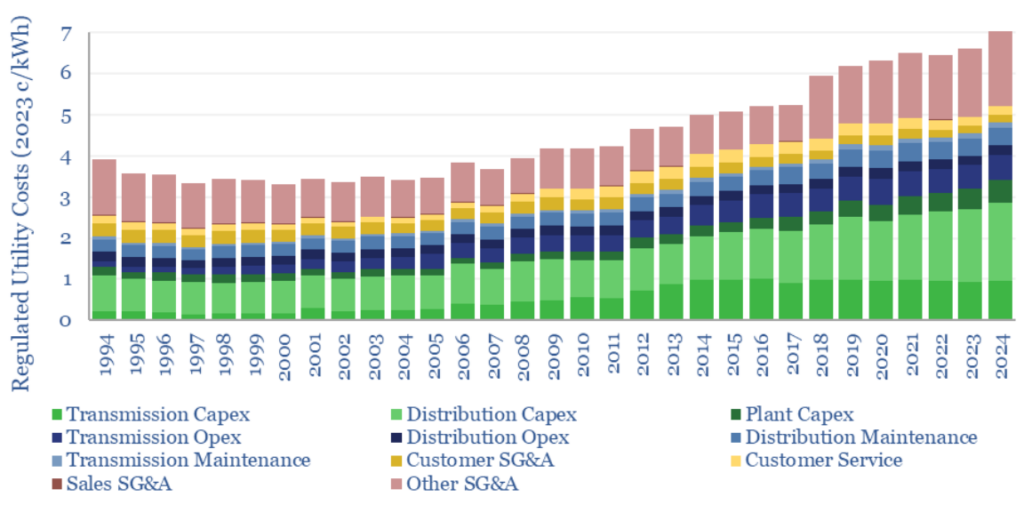
While new lines have to be built (70% of wires are at least 25 years old), the fastest and most cost-effective way to increase the power that flows to homes, businesses and factories is improving the efficiency of lines that already exist – through new hardware, software, and smart practices (as we noted above).
Todd Snitchler, the CEO of EPSA, the Electric Power Supply Association, congratulated Members of Congress and staffers for reaching an agreement on the bill, citing their “their hard work and dogged determination.” He added:
Congress continues to recognize that the energy industry is at a rare inflection point. Demand for electricity is rising, and the energy infrastructure, including power plants, transmission lines, and natural gas pipelines, required to supply that demand needs a more efficient and predictable path for investment.
Among the other organizations backing permitting reform are the National Association of Manufacturers, the U.S. Chamber of Commerce, American Gas Association, American Clean Power Association, and the American Chemistry Council.
Will the bill pass? Some Democrats complain about removing legal obstacles to projects that may be environmentally harmful. “Most Democrats will want to see how things go on Nov. 3 and then do a reality check,” Rep. Jared Huffman, a California Democrat, told Bloomberg’s Ari Natter. “If we’re on our way to a majority in one or both Houses, it makes no sense to fold our hand when we could wait a few months and have a much better deal early next year.”
But insiders say that scenario is unlikely because, even if just a simple majority is needed, President Trump will undoubtedly veto a bill with a strong imprint from Democrats. If the current bill fails in the lame-duck session, it may be the last chance for a long time for permitting reform.
Jennifer Granholm, who was Secretary of Energy under President Biden, urged Democrats to “seize the chance to pass the bill, Axios reported on Oct. 28. “I think we should pass it,” she said. “I know it’s not perfect. Who’s to say we’re going to get a better deal? We still need a presidential signature in the next two years.”
What’s in the Permitting Bill?
In addition to the transmission changes, here are some of the highlights:
Changes to NEPA. In its review of the Senate permitting bill, the Bipartisan Policy Center (BPC) notes that the National Environmental Policy Act of 1969 (NEPA) “requires federal agencies to consider the environmental effects of major federal actions—permits, leases, federal funding, and federally built projects—before deciding whether to proceed.”
Those NEPA reviews are time-consuming and costly, and they can lead to an infrastructure project being undone years after it is finished. BAAJA rewrites the statute’s procedural provisions along three lines: “scope of review (what agencies must analyze), which projects get reviewed at all, and how long the process takes,” BPC summarizes. In short, NEPA will be a lower hurdle to get over for energy infrastructure projects.
Timelines. The legislation would require the lead agency to issue a decision within 45 days of a published environmental impact statement (EIS) “and require outstanding federal authorizations to be decided within 90 days by agencies that participated in the review and 120 days by those that did not,” says the BPC review.
“The result is that finishing a review now starts a clock on the permits, rather than leaving a project to wait once the analysis is done” – which has caused substantial delays. BAAJA takes other steps to ensure that agencies move quickly and don’t miss deadlines.
Judicial Review. Currently, NEPA litigation has to proceed under the Administrative Procedure Act (APA), and, says BPC, “even though they win most NEPA-related lawsuits,” developers face long delays” under APA procedures. BPC adds:
“Because large energy projects are financed years before they are built, the uncertainty associated with the current judicial review regime raises the cost of capital for any project requiring a federal approval—conventional and renewable alike—and consumers ultimately pay for it.”
BAAJA limits standing for parties filing suit, compresses litigation risk into months rather than years, narrows “what a court can do when it finds a violation, and sends challenges directly to the courts of appeals.” Also, under BAAJA, “a NEPA violation alone would no longer stop a project.”
Some analysts say the NEPA lawsuit restrictions are complicated and confusing. Justin Pidot of the University of Arizona School of Law wrote on Oct. 16: “The dramatic implication I see is this: Despite the elaborate structure for judicial review the bill creates, it would effectively eliminate judicial review of most NEPA claims.” He advocates “clearer text that won’t sow confusion among litigants, agencies and courts.”
Data Centers and Utility Bills. The legislation “rewrites federal electricity law to ensure that artificial intelligence data centers cannot drive up power rates for American households,” reports Meyer of Heatmap.
Project Certainty. In what was one of the most contentious issues, the negotiators, with support from the White House, agreed to restrict cancellations of politically disfavored projects.
The BPC notes that “the Biden administration revoked the Keystone XL cross-border permit in January 2021 and the project was canceled that June; the Trump administration suspended work on five offshore wind projects in 2025, one of them roughly 87% built.” In the event of such permit cancellations, damages are generally not available under current law.
Among other changes to promote permitting certainty, BAAJA would allow a “sponsor in any of 46 enumerated project types intended to cover all possible energy project types — from onshore wind and solar to coal, nuclear, pipelines, mining, and LNG — [to] sue over a permit improperly denied or delayed more than 60 days past a deadline ‘due to a pattern of disparate treatment,’” that is, animosity toward a particular generation source.
Many Democrats are not enthusiastic about this provision. They want the Trump Administration to stop canceling renewables projects, but they recognize that if they take the White House and Congress in 2029, they will have a difficult time cancelling coal enhancement and other projects that the Trump Administration has funded.
The bill would also speed up generation interconnection queues — a source of long delays in some regions. It would also strip a Clean Water Act provision that had allowed some Democratic governors to block the expansion of natural gas pipelines. In addition, BAAJA hastens decisions involving the Endangered Species Act that could delay a project and narrows the limits that agencies can place on hydropower.
Bloomberg reports that environmental groups are pushing back against the legislation. They have raised concerns that fall broadly into three areas: “changes to the Endangered Species Act, rollbacks to Clean Water Act protections and, more fundamentally, whether longstanding safeguards for nature would be lost without securing enough renewable energy in return.”
Some of these concerns are shared, added Bloomberg, by “groups that don’t outright oppose the deal.”
The Natural Resources Defense Council (NRDC) issued an analysis that states:
The legislation would provide a dramatic near-term boost to the nation’s grid by increasing both the amount of power that existing transmission lines can carry and the supply of electricity available to meet growing demand. It establishes procedures that could cut the time to build a major new transmission line to five to six years from 10 years—or sometimes significantly longer—today.
But the NRDC has many objections, led by the “project certainty” provisions. The organization wants agencies to “retain the ability to address significant and unanticipated environmental or public health harms.” It also wants courts to “retain the authority to fix unlawful permits and pause construction” NEPA and other laws. Under the current Congress, those changes are almost certain to be non-starters.
Still, BPC comes to this conclusion: “The bill is a true compromise, one in which both Democrats and Republicans can claim big wins, and one in which the end result will be reduced costs for Americans, increased quality of life, improved energy security and reliability, better environmental outcomes, and reduced emissions.”
How Much Will Permitting Reform Actually Reduces Delays?
The Center on Global Energy Policy at Columbia University released a report on Oct. 21 that showed only small reductions in the time between the initiation and completion of infrastructure construction projects under the proposed permitting legislation compared with normal current circumstances – but far greater reductions when regulators delay analysis or lawsuits are filed.
The report is based on an interactive tool that “estimates how the proposed bill could impact the permitting and construction timelines of different types of energy projects.” Jack Andreasen Cavanaugh, a senior researcher at Columbia, explained:
Based on historical data on how energy projects have advanced through the permitting process, [the tool] uses energy infrastructure archetypes and individual past projects to assess how quickly a given project may move through the permitting process under BAAJA compared with the status quo.
The time saved for projects under BAAJA is surprisingly minor if agencies meet deadlines under current law and lawsuits don’t hold up work, but the savings are significant in the case of the delays and challenges that characterize today’s system.
For example, the Columbia research finds that, under current law, it takes an average of 78 months from the filing of a federal application to the completion of a transmission project of 345 kilovolts or more on federal and private land. BAAJA reduces the time to 75.5 months – a savings of only two and a half months. But because of the lengthy prevailing period during which opponents can sue, the reduction in time for projects that are challenged extends to 96 months – a huge difference.
Similarly, BAAJA will cut the time for a gas pipeline from 48 months to 44 months under unchallenged circumstances if regulators meet deadlines, but the time is cut by 21 months when compared to a current situation with legal challenges and other delays. You can see all the data here.
FERC Wants to Streamline Natural Gas Projects
Not waiting for a permitting bill to pass, FERC on Oct. 15 issued a Draft Policy Statement advocating eased reviews of natural gas and liquefied natural gas (LNG) projects under the Natural Gas Act (NGA), consistent with the commission’s obligations under NEPA.
FERC Chairman Laura Swett said that the purpose of the proposals is, in part, to ensure that the U.S. can supply natural-gas-powered plants with the fuel they need to operate.
“Building generation involves gas,” Swett said during the agency’s monthly meeting. “The only current restriction on getting American gas is our ability to get the gas to market and the infrastructure bottlenecks.”
Under the draft statement, FERC would “(i) no longer generally require NGA project applicants to submit air dispersion modeling or rely on such modeling to assess whether the air quality effects of facility operations are ‘significant’ for purposes of FERC’s analysis under NEPA, and (ii) treat a project’s compliance with all applicable Clean Air Act (CAA) permitting and regulatory requirements as evidence that its air quality effects are less than ‘significant’ for purposes of NEPA,” according to a review by the law firm McGuire Woods.
“The proposals would accelerate infrastructure development by streamlining authorizations and reducing duplicative environmental reviews,” reported the Oil & Gas Journal on Oct. 19.
“The Commission will shift to a more streamlined approach, ultimately designed to bring our NEPA analysis ‘back in line with the statutory text and common sense,’ and likewise avoid functional duplication of [Clean Air Act] review and permitting responsibilities entrusted to the [Environmental Protection Agency] and the state air permitting agencies,” FERC said in its draft policy statement.
While Commissioner Judy Chang, a Democratic appointee, opposed the elimination of the dispersion modeling provision, all the FERC commissioners approved the proposal for a blanket authorization program for “eligible LNG plant activities modeled on the commission’s blanket certificate program for interstate natural gas pipelines, which has operated for about 40 years,” said the Oil & Gas Journal.
LNG developers could “gain authorization for major construction projects, including new liquefaction trains, storage tanks, and marine berths, following a 90-day notice-and-protest period.” The Oil & Gas Journal added:
Eligible projects could extend beyond an existing plant’s footprint but permanently occupy no more than 25 acres of previously disturbed or developed land or waterways in industrially zoned or unzoned areas. Developers also would be required to use the same or upgraded versions of equipment previously evaluated and authorized at the terminal.
LNG exports have boomed in recent years and got a further boost in 2026 from the war in Iran. In 10 years, monthly shipments from U.S. ports have gone from 16 billion cubic feet (cf) of natural gas to 519 billion cf. The increase from July 2025 to July 2026 was 19%, according to the Energy Information Administration.
Comments on the proposed FERC natural gas policy are due Nov. 16.
Security Exercise by Competitive Power Providers Tests Response to Attacks on the Grid
Even before the Iran war, increasingly sophisticated cyber and physical threats have been posing risks to the electric infrastructure of the nation. NERC’s E-ISAC (Energy Information and Analysis Center) recorded more than 3,500 physical security breaches in 2025 compared with 2,800 in 2023. About 100 of the breaches last year disrupted electricity.
On Oct. 29, EPSA (see above) convened competitive power suppliers for GenEx, “a targeted security exercise testing the industry’s ability to respond to incidents that could disrupt electricity generation and grid reliability.” EPSA explained in a press release:
The exercise brought together operational personnel and security experts from EPSA member companies to confront realistic scenarios involving cyberattacks, damage to critical infrastructure, communications outages, extreme weather, and misinformation. Participants tested emergency response protocols, information sharing, and coordinated decision-making under conditions designed to challenge power generation operations.
Todd Snitchler, EPSA’s CEO, stated that “reliable electricity is a national security priority…. Competitive power suppliers view that responsibility as job one.” He also noted that threats to the grid are “real and evolving,” so his members “are taking proactive steps to test their capabilities, identify vulnerabilities, and prepare for disruptions before they occur.”
IBM’s 2026 Cost of a Data Breach Report found that last year there was a 56% increase “in AI-driven attacks, led by AI deepfake impersonations and AI-enabled malware, which drove the highest volume of those incidents.” One in four malicious breaches involved AI-enabled attacks.
GenEx, said the EPSA press release, “complements broader industry preparedness effort,”, including NERC’s “GridEx exercise, with a targeted focus on generator-specific risks, operational continuity, and coordination during complex emergencies.”
Michael Ball, NERC’s senior vice president and CEO of the E-ISAC, underscored the importance of partnership with organizations like EPSA and proactive industry efforts in grid security: “As the threat landscape for energy infrastructure continues to evolve, exercises are a powerful tool.” strengthen coordination, and turn lessons learned into action.”
Ball added, “At the E-ISAC, we want to support that work year-round, including through the new GridEx Library, which gives members access to past GridEx materials they can adapt to strengthen their own exercise programs.”