
- EPA announces it is repealing contentious rules that limit power plant emissions.
- The repeal is part of the Trump Administration’s strategy of encouraging more use of coal in generating electricity. But a court stands in the way of its effort to delay plant closures.
- The House passes a bill to increase the accuracy of electric load forecasts amid rising demand.
- The White House appears to have made concessions, and permitting reform may now be possible.
- A Massachusetts analyst blames renewable-energy mandates for lofty electric bills.
- The U.S. got through extreme winter weather without serious disruptions, but a FERC/NERC review points to backup policies that need addressing.
- An opinion piece in the Washington Times claims that utilities in the PJM area of operation are blocked from building and owning new power plants. That’s wrong, says a letter to the paper – but the utilities’ investors have to compete and bear risk.
EPA Is Repealing the Controversial Power Plant Emissions Rules
At a G20 energy ministerial meeting in Houston on Sept. 14, Lee Zeldin, the administrator of the Environmental Protection Agency (EPA) announced a repeal of limits on carbon emissions from coal- and gas-fired power plants. Reuters reported:
The agency also proposed rescinding all remaining greenhouse gas emission requirements for power plants to prevent future climate regulations targeting the power sector, saying the EPA does not have authority under the Clean Air Act to regulate the sector’s GHG emissions.
In our Newsletter No. 25 and subsequent editions, we reported extensively on the power plant rules, which have long been contentious.
For example, at Congressional hearings in May and June 2023, strong opposition was raised by, among others, West Virginia Sen. Joe Manchin. Manchin, who at the time was a Democrat, then later switched to Independent and retired in January 2025, said he recognized that “our electric grid is undergoing a transition, both in generation sources and in the types of demand the grid is called on to serve.” However, he said, “the speed of this transition must be balanced against the reliability and affordability of electricity.”
The rule, which the EPA finalized during the Biden administration, required existing coal and new natural gas-fired power plants to reduce their carbon dioxide pollution, starting in the 2030s or else shut down. Power plants are the second largest source of carbon dioxide emissions in the U.S., behind transportation.
The rule was particularly controversial, said Politico at the time, because EPA told operators of gas and coal plants that they would have to “capture their greenhouse gas emissions before they hit the atmosphere — a long-debated technology that no power plant in the U.S. uses now.”
Attempts to limit emissions by power plants stretch back more than a decade. In 2014, the Obama Administration proposed a “Clean Power Plan” aimed at cutting CO2 emissions by 32%, from 2005 levels, by 2030. “That plan faced legal challenges and never went into effect,” recounted NPR. “Still the country met that goal well before 2030, as coal-fired power plants were replaced by natural gas plants that emit less carbon dioxide and renewable energy projects began producing more electricity.”
In 2019, Trump introduced his own Affordable Clean Energy rule in an effort to keep coal plants open. Biden then entered office with a goal of eliminating all emissions from the power sector by 2035.
In 2022, the U.S. Supreme Court limited the EPA’s options with its landmark opinion in West Virginia v. the Environmental Protection Agency. Justices said that without a specific law passed by Congress, the agency could not force the entire power industry to move away from fossil fuels.
EPA’s answer was to create regulations governing individual power plants.
The final rules were announced in the spring of 2024 to a storm of protest from many in Congress and the power industry, as we reported in our Newsletter No. 35.
According to E&E News, the Administration rushed to complete the rules before May so that they will not “become vulnerable to reversal by a Republican-controlled White House and Congress under the Congressional Review Act.”
The regulation called for reductions of 90% by 2039, “one year earlier than the agency had initially proposed,” reported the New York Times. “The compressed timeline was welcomed by climate activists but condemned by coal executives who said the new standards would be impossible to meet” because capture and sequestration technology has not advanced enough to be practical.
By leading to the closure of plants that cannot comply, the new rules risked exacerbating an impending reliability crisis cited by those energy executives, as well as many regulators and researchers.
Jim Matheson, chief executive officer of the National Rural Electric Cooperative Association, which supplies electricity to many of the nation’s rural and suburban communities, reacted by saying, “This barrage of new E.P.A. rules ignores our nation’s ongoing electric reliability challenges and is the wrong approach at a critical time for our nation’s energy future.”
Now the Trump administration is moving to eliminate the rules altogether.
Trump Administration Is Trying to Facilitate More Coal Generation
In announcing his repeal decision on Sept. 14, Administrator Zeldin emphasized that it would facilitate more coal generation. He said in a statement that the Trump Administration was taking the actions “in accordance with the law and based on the best reading of the Clean Air Act (CAA). EPA’s final rule is expected to unleash the full potential of America’s vast energy resources, including coal and natural gas.”
He added:
For over 15 years, the Obama and Biden administrations implemented a war on coal to destroy reliable and affordable energy. The Trump Administration has come in to protect American energy and to make sure you can afford to keep the lights on. Americans will see a decrease in electricity prices, but this is just the beginning. We are working to go even further so that American energy can be fully unleashed. Realizing the full potential of American energy means more jobs, lower prices, and a more prosperous America.
Reuters quoted Under Secretary of Energy Kyle Haustveit as telling reporters that the new rules would lift up coal-fired electricity, which had been declining steadily in the U.S. due to the availability of cheaper natural gas and renewable energy. “President Trump ended the war on beautiful, clean coal,” he said. “Coal is reliable, affordable, secure.”
In his statement on the EPA website, Zeldin said, “Coal production for power sector use is expected to increase by more than 10 times.” That would appear to be unlikely. On Sept. 9, the U.S. Energy Information Administration (EIA) projected that for 2026, coal’s share of electricity generation would be 16% (less than both nuclear and wind plus solar) and then drop to 14% in 2027.
Whether lifting greenhouse gas emissions rules will even increase coal generation is an open question. As a source of electric power, coal began declining in 2007, more than a decade before the Biden Administration imposed its new regulations. Coal has largely been replaced by natural gas. (See the graphic below from the EPA.) Coal’s slide was due to “market conditions, such as falling natural gas and renewable energy prices,” according to Philip Rossetti of the American Action Forum, a right-of-center think tank.
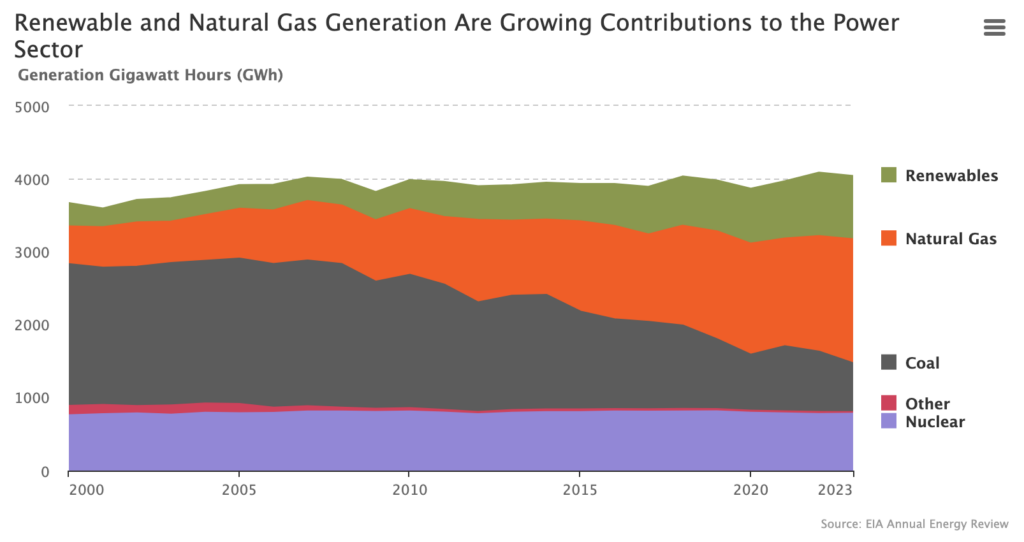
According to the EIA, the use of coal as a power resource fell 38% during the first Trump term and 19% during President Biden’s four years in office. In just 10 years starting in 2014, coal generation has fallen from 1.6 billion megawatt hours (MWh) to 652 million MWh.
During its current term, the Trump Administration has required coal plants (and in one case a natural gas plant) that were scheduled to shut down to keep operating. Canary Media reported on Sept. 14 that the orders have affected seven plants – two in Indiana and one each in Colorado, Florida, Pennsylvania, Washington state, and Michigan.
The Canary report notes, “More than 20 coal-burning units are supposed to close between now and the end of Trump’s term. Federal data show the next batch is slated to retire this December, at Colorado’s Comanche plant and at Minnesota’s Sherburne County station,” whose owner, Xcel, is building on one of the nation’s largest solar farms nearby to replace coal.
On Sept. 11, however, a federal appeals court vacated the U.S. Department of Energy’s emergency order that required the owners of the J.H. Campbell coal-fired power plant in Michigan to delay its planned retirement. Said the U.S. Appeals Court for the District of Columbia Circuit in its ruling:
The federal government has, until now, issued stopgap generation orders in response only to transitory emergencies caused by war, extreme weather events, market manipulation, or unplanned, short-term unavailability of specific generation units. It is the states — informed by federal, regional, and load-serving entities’ assessments of available supply and reliability needs — that bear the responsibility to plan for and avert reliability risks on an ongoing basis.
“Through June 30, the net cost of complying with the DOE emergency orders was $259 million, after applying MISO revenues of $239 million, Consumers said in a July 28 filing with the Securities and Exchange Commission,” said Utility Dive.
Other states may follow with similar suits, and the Department of Energy will likely appeal the Michigan case to the U.S. Supreme Court.
The Associated Press reported that the Department of Energy was undeterred by the court decision, and Secretary Chris Wright “announced another emergency order to keep online a coal plant in Centralia, Washington. That plant, operated by TransAlta, had been scheduled to shut down at the end of 2025.”
But the decision on Sept. 14 was favorable to natural gas as well. As this newsletter reported three years ago, when the power plant rules were announced, Jim Robb, president of the North American Reliability Corporation (NERC), worried that new policies could force dispatchable natural gas off the electricity system.
“It’s highly troubling,” Robb said, “because we are retiring these plants before their attributes are being replaced. . . The important thing [dispatchable sources] provide for the grid is the ability to maintain voltage, and to maintain frequency, and resist disturbances. Other resources can’t do that nearly as well as a large spinning mass generation.”
According to the latest EIA forecast, natural gas will provide 40% of U.S. electricity both this year and next. Quoted in the EPA press release, Secretary Wright pointed out:
During periods of peak electricity demand, coal and natural gas continue to play a critical role in keeping the lights on. Today’s announcement will help ensure reliable electricity generation regardless of whether the wind is blowing or the sun is shining by allowing coal and natural gas plants to keep generating power when Americans need it most.
He added, “Unlike past administrations that prioritized the interests of climate alarmists, President Trump promised to put the American people first and he is delivering.”
House Passes Bill to Improve Electric Load Forecasting
The U.S. House of Representatives on Sept. 15 passed the Load Forecasting Enhancement Act (H.R. 9332), which seeks to protect ratepayers by strengthening grid planning as demand for electricity continues to rise.
The legislation, introduced by Rep. Troy Balderson (R-OH), chair of the House Energy Action Team, and Rep. Rob Menendez (D-NJ) as co-sponsor, was immediately sent to the Senate Committee on Energy and Natural Resources for consideration.
If the bill is enacted, the Federal Energy Regulatory Commission (FERC) would be required to establish regional boards to study and recommend best practices for electric load forecasting – that is, the process of predicting the demand for electricity at a particular time.
The bill also modifies provisions under the Public Utility Regulatory Policies Act to require state public utility commissions to consider adopting those recommendations. It adjusts the Energy Policy and Conservation Act to make federal assistance for state energy conservation plans contingent on the plan.
In a press release, Rep. Balderson noted that the U.S. “is experiencing unprecedented growth in electricity demand, driven by expanding manufacturing, electrification, and emerging technologies.”
Meanwhile, NERC, in its Long-Term Reliability Assessment, warns that much of the U.S. faces a growing risk of energy shortfalls over the next five years, “with PJM, the regional transmission organization serving Ohio, classified as ‘high risk.’” Balderson added:
To protect Americans from higher electric bills and make sure our grid can keep up with rising demand, we need to plan ahead. The bipartisan Load Forecasting Enhancement Act gives states and utilities the tools they need to better understand future electricity demand and prepare for it.
In a statement, Todd Snitchler, CEO of EPSA, the Electric Power Supply Association, noted, “With ratepayer protection front and center, getting the forecast right is essential to protecting consumers and building the power supply America actually needs. Better forecasting can help separate true demand from speculative or duplicative requests, give investors clearer signals about where new resources are needed, and reduce the risk of building costly infrastructure around demand that never materializes.”
Snitchler pointed out that “competitive power markets provide another important safeguard for consumers [because] competitive generators put private capital at risk, meaning investors—not captive customers—bear the risk if those investments don’t pay off. That market discipline helps guard against unnecessary overbuilding while directing investment toward the resources the grid actually needs.”
As an example of current forecasting difficulty, Snitchler noted that “Goldman Sachs Research projects U.S. data center power demand could more than double from 31 gigawatts [GW] in 2025 to 66 gigawatts in 2027, while estimating that only about 50–60% – roughly half – of data center capacity scheduled over the next one to two years will actually come online on time amid delays and cancellations.”
Snitchler pointed to an investor-owned utility in Ohio that initially faced more than 30 GW of prospective data-center demand, but after customers were required to make increasingly firm financial commitments, roughly 13 GW proceeded to engineering studies, and just 5.6 GW of that group ultimately signed binding service agreements, an illustration of how dramatically projected demand can change as projects move from expressions of interest to financially committed load.
Canary Media also reported on the Ohio situation. On Sept. 9, Kathleen Kowalski wrote that projections by utilities and the grid operator “drive plans for expanded infrastructure.” But, said John Seryak, CEO of the energy consulting firm RunnerStone, “If those data centers don’t show up…you’re going to pay the costs,” a reference to the utility’s customers.
Large-scale projects are overseen by FERC, but lower-level “supplemental” transmission is up to the states. Those projects “can add up to billions of dollars, though,” writes Kowalski. “And in Ohio, no one is independently examining their prudence or cost-effectiveness,” the reporter quoted Maureen Willis, agency director for the Office of the Ohio Consumers’ Counsel as saying said.
Kowalski added, “A new rule limiting the time to question company witnesses about customer charges will make it even harder to challenge costs.”
A day after the forecasting bill was approved, the House passed, by a 417-3 vote, the Ratepayer Protection Act, designed to prevent data centers and other large computational loads from shifting their grid and power generation costs onto existing customers. Utility Dive explained:
The bill requires states to “consider” adopting a set of standards for loads larger than 100 MW — something that is already underway in most states. The House bill is “somewhat behind the regulatory curve” and would “largely reinforce” that transition, ClearView Energy Partners said in a client note.
Is Permitting Reform Really Getting Closer?
If this newsletter seems to be obsessing over permitting reform, it is only because it is so important. A deal may at last be near, but a vote probably won’t occur until after the mid-term elections on Nov. 3.
Both Democrats and Republicans want to find a way to make the process of getting regulatory and judicial approvals for energy infrastructure projects faster and more predictable. They differ, however, on some important details, and efforts to find a compromise over the past few years have been unsuccessful.
The Senate holds the key, and on Sept. 23, Bloomberg reported:
A White House official said Wednesday evening that the Trump administration and Republicans in Congress had proposed a bipartisan offer in good faith, but threatened that it would be revoked if the Democrats didn’t accept it as is.”
The day before, Senate Majority Leader John Thune (R-SD) told Politico that striking a deal could be enough of a reason to keep the Senate in session. “If we can get a deal there,” he said, “that’s something that most of our members believe is really consequential legislation and worthwhile.” But optimism about a quick vote was premature, and Democrats say that the Senate won’t vote until November or December.
Politico noted that a deal “got new life after Trump signaled he’d ease his administration’s blockade on wind projects to help grease negotiations with Democrats.” In a separate piece, Politico reported:
Trump told aides he would agree to direct the Defense Department to start clearing its queue of long-delayed onshore wind projects to strike a deal, two people familiar with the talks and granted anonymity told POLITICO. He told advisers, including Interior Secretary Doug Burgum and Energy Secretary Chris Wright, in a briefing on the negotiations Monday [Sept. 21] that he would be OK with easing off his attacks on his least favorite energy source in order to close the deal.
As we reported in Newsletter No. 63, “Republicans want to balance ease of fossil fuel development with transmission and renewables development, but Democrats aren’t so sure – especially with the Trump Administration using its power to cancel, delay or decline to permit wind and solar projects.”
A Utility Dive report noted that, at a hearing earlier this year, Sen. Angus King, (I-ME), who caucuses with the Democratic Party, told Interior Secretary Doug Burgum that in the current political climate, “it would be ‘foolish’ to pass permitting reform that allowed fossil projects to move with more alacrity through the system, and theoretically would allow renewable projects, only to end on your desk or on somebody else’s desk or with some kind of action by another agency.”
Democrats, said a July E&E News article , “continue to press for significant measures to…restrain the president’s power to cancel approved energy project permits.” The article added, “It’s unclear whether the White House — and its allies on Capitol Hill — would accept any permitting deal that would restrain the president’s powers.”
Other Hill sources, however, now say that the White House has agreed that wind, solar, oil, gas and coal projects will receive “permitting certainty” and that provisions will be retroactive, with permit holders receiving remedies if permit denials were due to government discrimination against a certain energy resource class (e.g., wind and solar).
The journal National Affairs this month published an article by Jeff Rosen that laid out the history, the need for reform, and the three main sources of delays:
- First, the pre-filing compliance stage, when “its champions need to identify the laws — sometimes as many as 60 separate statutes — with relevant requirements, as well as any agencies whose approval they must obtain. They then have to meet these requirements — some of which call for various studies and engineering work — before they can be granted permission to begin construction. These planning and compliance activities alone can take considerable time.”
- Second, there is the federal review and approval process. “This stage comprises multiple steps and can involve many statutes. The National Environmental Policy Act (NEPA) — which requires major projects to have Environmental Impact Statements (EIS) assessing the project’s potential environmental effects and exploring alternative options — is the chief law at issue here, but many others frequently are relevant, too.”
- Third, there is the period after the decision is made — in the record of decision (ROD) or the finding of no significant impact (FONSI) — that leads to agency approval and kicks off the possibility of outside litigation. “McKinsey reports that roughly a third of projects that require an EIS under the NEPA are litigated and take on average 4.2 years to resolve, even though project sponsors eventually win 80% of the lawsuits. This third stage, in the absence of reform legislation, includes a six-year statute of limitations under the Administrative Procedure Act, so the window for potential litigation can be quite long.”
The Permitting Institute reports that permit delays increase sponsor costs by an average of 20%-30%, writes Rosen. Delays also deprive the public of project benefits at an estimated cost of over $100 billion per year. “Thanks in part to these added expenses, there are plenty of examples of projects that were abandoned at each stage.”
Measures passed in the 1970s set the stage, but the permit-delay problem started to surface in the 1990s. Efforts to fix it during the Biden Administration fell short. Now, with demand for electricity and natural gas rising, the need for permitting relief has become more urgent – and Democrats who want to see more use of renewables are advocates as well.
Rosen, a fellow at the American Enterprise Institute and former U.S. acting attorney general, concludes:
When all is said and done, the underlying problem remains. The permitting process may not seem glamorous or easy to understand, but it plays a significant role in determining what gets built, what gets mined, what gets grown, how power is supplied and delivered, and many other crucial components of our economy that affect our quality of life. Our future prosperity depends on getting this right. Americans want to build again, and our government should better clear the path for doing so.
A wide variety of stakeholders back reform. Groups range from the American Clean Power, which represents the wind, solar and storage industries, to the Interstate National Gas Association of America, the American Petroleum Institute, and the National Governors Association, which says on its website:
America’s energy problem is not resources, it is speed. Governors from both parties have united behind a package of commonsense permitting reforms to build the infrastructure the country needs faster, cheaper and with more certainty.
The text of a compromise still has not been released – probably because Thune does not want to give time for opponents to take shots at parts they don’t like. Democrats say negotiations continue.
Renewable-Energy Mandates Are Blamed for Rising Electricity Bills
In a MarketWatch opinion piece on Sept. 10, Kenneth Rapoza argued that renewable-energy mandates – not demand from data centers — are the key reason that electricity prices have risen so much.
Rapoza, an analyst for the Coalition for a Prosperous America, lives in Massachusetts, which he calls “ground zero” for high utility bills. EIA data for June show that the state ranked behind only California in the mainland U.S., at a price of 29.61 cents per kilowatt hour (kWh) in June for electricity. The U.S. average was 18.34 cents.
“Massachusetts requires roughly 69% of electricity supply to come from qualifying renewable or clean-energy sources like Canadian hydro,” wrote Rapoza. “Next year, the requirement rises to 75%. Even low-cost natural-gas generation cannot eliminate the separate cost of satisfying the state’s clean-energy and renewable-credit obligations.” He adds:
Electricity costs were rising well before artificial-intelligence data centers became the preferred explanation for higher demand. Massachusetts has no hyperscale AI data centers, yet electricity rates rose last month by roughly 10.9% to 16.5%, depending on the utility. Last year, they rose about 11%.
Rapoza notes that “solar supplied 60% of all new U.S. generating capacity added during the latest quarter; solar plus storage accounted for 91%. Natural-gas turbines can face multiyear delivery backlogs, delaying new gas-fired power plants.” But, he writes, “The problem is not solar. The problem is the mandate.”
He notes that “Texas once had renewable mandates but eliminated them. Florida also has no renewable mandate and continues adding solar rapidly. EIA data for June 2026 show about 13.34 gigawatts of utility-scale solar and 3.34 GW of small-scale solar in Florida, up roughly 12.5% from a year earlier. Their experience supports the proposition that renewables can expand without a binding quota.”
Consider electricity prices. In Texas, they were 15.94 cents per kWh in June, well below the U.S. average and up only 4% compared with 12 months earlier. In Florida, electricity was just 15.10 cents per kWh in June – down 2%.
“The architecture behind many blue-state mandates is the renewable portfolio standard, or RPS,” writes Rapoza. “States require utilities and retail suppliers to obtain a specified share of electricity from qualifying renewable sources. Utilities generally prove compliance through renewable energy certificates, or RECs. One REC typically represents the renewable attributes of 1 megawatt-hour of renewable generation.” He adds:
Think of it as a compliance credit. If a utility sells 100 MWh [megawatt hours] of electricity, but only 50 MWh qualifies as renewable while the state requires 60 MWh, it can buy 10 RECs from another renewable generator to close the gap. The mechanism is similar in spirit to a carbon-credit system.
The problem is that, when governments require utilities to buy more renewable energy than can be supplied cheaply by the market, the mandates hike the price of electricity.
“PJM Interconnection, the country’s largest grid operator, reported that renewable-energy and other compliance costs rose from $676.7 million in 2014 to $2.879 billion in 2023,” writes Rapoza. “Lawrence Berkeley National Laboratory in California estimated that compliance added about 15.2% to Washington, D.C.’s electric costs. Massachusetts saw another 11%.”
D.C. Mayor Muriel Bowser said that the city’s RPS policy had added at least $20 per month to electricity bills, with that increase potentially doubling to $40 over the next three years.
Rapoza’s home state of Massachusetts shows why this debate could become a risk for renewable-energy companies. A Suffolk University poll of Boston residents found 83% were somewhat or very concerned about electricity costs. Asked what was primarily responsible, 32.6% blamed energy supplier costs and 30.2% blamed state policies.
FERC/NERC Review of Power During Extreme Winter Weather Finds Few Interruptions, But Key Backup Issues Unaddressed
In a joint review of the Winter 2026 Arctic Cold Period, FERC and NERC concluded that “While the electric and natural gas industries experienced significant operational constraints, electric entities did not report any manual load shed and natural gas entities did not report widespread interruption of firm customer service.”
The review noted that total U.S. natural gas demand peaked at 172 billion cubic feet per day on Jan. 24 —”one of the highest levels ever observed”—while total U.S. electric demand reached 663 GW on Jan. 27, during Winter Storm Fern.
Generator outages peaked at 68,169 megawatts (MW) on Jan. 26 across the Eastern and Texas Interconnections. (See the graphic below.) Meanwhile, “the natural gas system experienced only moderate production declines and some limited short-duration force majuere events, both of which had insignificant effects on end users.
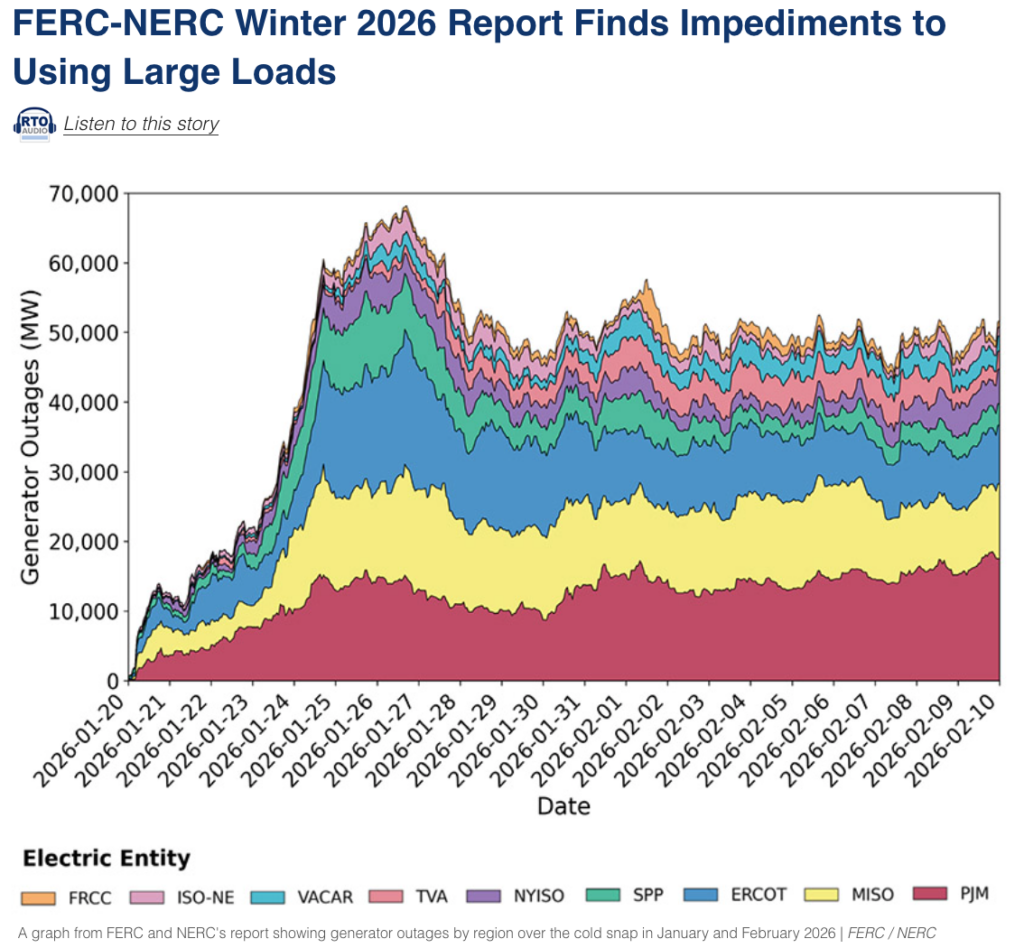
Still, this is no time for relaxing, the report made clear. As RTO Insider reported, “Large loads continue to have major impacts on the grid, but using their backup generation to preserve reliability needs more work, as evidenced by an attempt from DOE to do so during extreme cold weather.”
The report credited Secretary Wright with using 15 Section 202 (c) emergency orders and five extension orders “directing electric entities to dispatch units to maintain reliability that allowed generators to exceed permitted environmental emissions limitations.”
But, the report added, critical questions about the use of that backup generation remained unanswered:
Specifically, ERCOT [the Texas grid operator] stated that during Winter Storm Fern, operators in its footprint did not have a pre-existing formal communication channel available or information about the capability of backup generation at large loads.
Similarly, PJM [operator in the Middle Atlantic and part of the Midwest] noted that it lacked certainty on location, amount, duration, switching capability, communication, telemetry and whether the exceedance of environmental limitations from an emergency order it had received applied to customer-owned backup generation at large loads under a separate emergency order it had also received.
MISO, the Midcontinent Independent System Operator, said that “large loads in its footprint could not be a flexible resource unless the facility is designed, interconnected, metered, modeled, protected and operated with that in mind,” reported RTO Insider.
NERC CEO Jim Robb agreed that the industry has learned lessons from harsh winters past and benefited from new reliability standards.
“But the work is not finished,” Robb said in a statement. “Both the electric and gas systems were stretched over multiple days, and multiple reliability challenges brought the system close to the edge. We cannot let this be the new norm of operating the grid. We need to continue addressing the vulnerabilities that prolonged periods of severe weather can reveal.”
The FERC-NERC report presented a table (page 7) showing generation during the hour of peak demand for Winter Storm Fern in 2026 and previous events, including Winter Storm Uri, which devastated Texas and other states in 2021.
During Uri, total demand was 553 GW, compared with 663 GW during Fern. Exactly half of the extra generation came from natural gas, which increased from 211 GW to 266 GW. Renewables were also critical, with solar and wind rising from 26 GW to 84 GW. Coal generation fell from 161 GW during Uri to 128 GW during Fern.
The report highlighted weatherization and maintenance measures as playing a significant role in avoiding serious outages: “Electric entities have embraced winterization efforts as a critical safeguard for continued system reliability.”
In particular, the report cited NYISO, the New York grid operator, whose inspections in the fall of 2025 ensured resources were winterized prior to and during the Winter 2026 Arctic Cold Period. In addition, said the report:
In contrast to the experience with Winter Storm Elliott in 2022, PJM started planning for Winter Storm Fern a week before it was expected, using advanced natural gas unit commitments to ensure generators could run through the first weekend (January 24-25, 2026) of the storm.
Also, the Southwest Power Pool (SPP) “employed a multi-day commitment process that allowed generators to receive notice sufficiently in advance to procure fuel for natural gas-fired units to be ready for Winter Storm Fern.
Can Utilities Build and Own New Power Plants in PJM Region? Yes, But They Have to Compete, and Investors Bear the Risk
In an opinion piece in the Washington Times on Aug. 10, former Rep. Joe Barton (R-TX) asserted that electricity prices are high in the area covered by PJM Interconnection, the largest grid operator in the U.S., because “utilities in many PJM states are largely not allowed to build or own power plants, even if that could lower costs and improve reliability.”
Therefore, Barton argues, “supply growth has not kept up with rising demand…. Market rules have stopped utilities from building new power plants in places such as Pennsylvania, where older plants have closed.”
Todd Snitchler, CEO of EPSA, responded two days later with a letter to the editor countering Barton’s claim. Snitchler wrote that “any assertion that utilities cannot build or own generation in PJM is incorrect. Using such falsehoods to call on policymakers to change energy policy affecting millions of customers will only place more risk on families already struggling with higher bills.” He added:
Investor-owned utilities can already build generation in PJM, the grid operator for much of the mid-Atlantic, so long as they’re willing to build that generation competitively. PSEG, a New Jersey utility, said in its most recent earnings call that its competitive power generation arm is exploring opportunities in PJM. In Pennsylvania, PPL’s president and CEO, told investors that PJM has already accepted 5 gigawatts of generation projects that PPL submitted as part of a joint venture.
Snitchler continued, “These projects would be impossible if utilities could not build or own generation. What utilities are not allowed to do in any PJM state is build generation under a monopoly model where they receive guaranteed returns on their investments.”
It’s an important distinction. “When generation is built competitively, investors are the ones that bear the risk if that power plant gets delayed, exceeds construction budgets or ends up not being cost-effective. Generation built under the monopoly utility model, however, passes those risks onto captive customers.”
Snitchler cites an example with which readers of this newsletter: the Vogtle nuclear plant in Georgia, where ratepayers were on the hook after the project “cost twice as much as anticipated and took twice as long to build.” Snitchler added:
The risks of a monopoly utility system are exactly why consumer advocates across PJM have vehemently denounced efforts to abandon competition in favor of monopoly control. Similarly, Brian Lipman, director of New Jersey’s Division of Rate Counsel, has said that “competition is good for ratepayers” and “utility-owned generation will likely shift the risk of producing generation away from generation developers and onto ratepayers.“