
- A frustrated federal regulator orders PJM, America’s largest grid operator, to adopt new, transparent rules to speed power to data centers and other large loads.
- Chevron and other petroleum producers argue before the Supreme Court on Jan. 12 that their case involving Louisiana wetlands deserves to be in federal court. The Trump Administration takes Chevron’s side, with the state’s Republican Governor opposed.
- Rising demand and retiring plants mean reliability challenges for New York state, says a new report.
- Large swaths of the country are again at elevated risk this winter, says electric-reliability regulator NERC. Says an official: “Natural gas is an essential fuel.”
- A blue-ribbon private-sector panel, reporting to the Department of Energy, urges better coordination between natural gas and electricity sectors.
- Washington state gets half its power from hydro, but rising demand still endangers its electricity supply.
FERC Orders PJM to Set Rules to Speed Power to AI Data Centers While Constraining Costs for Consumers and Businesses
“Unless something changes, PJM consumers will pay an extra $100 billion through 2033 as new data centers continue to exceed available power supply,” wrote Tom Rutigliano and Claire Lang-Ree of the Natural Resources Defense Council in an opinion piece for Utility Dive on Dec. 2. “By 2028, families in the region will be paying around $70 a month extra on their electricity bills.”
In addition, “Future reliability is also at risk. The power grid in the region is full: Starting in summer 2026, PJM will have just enough power to keep the grid reliable.”
On Nov. 25, the PJM market monitor took the unusual step of issuing a complaint that urged the Federal Energy Regulatory Commission (FERC) to tell PJM that it can’t add large data centers to its system until it is certain they can be reliably served.
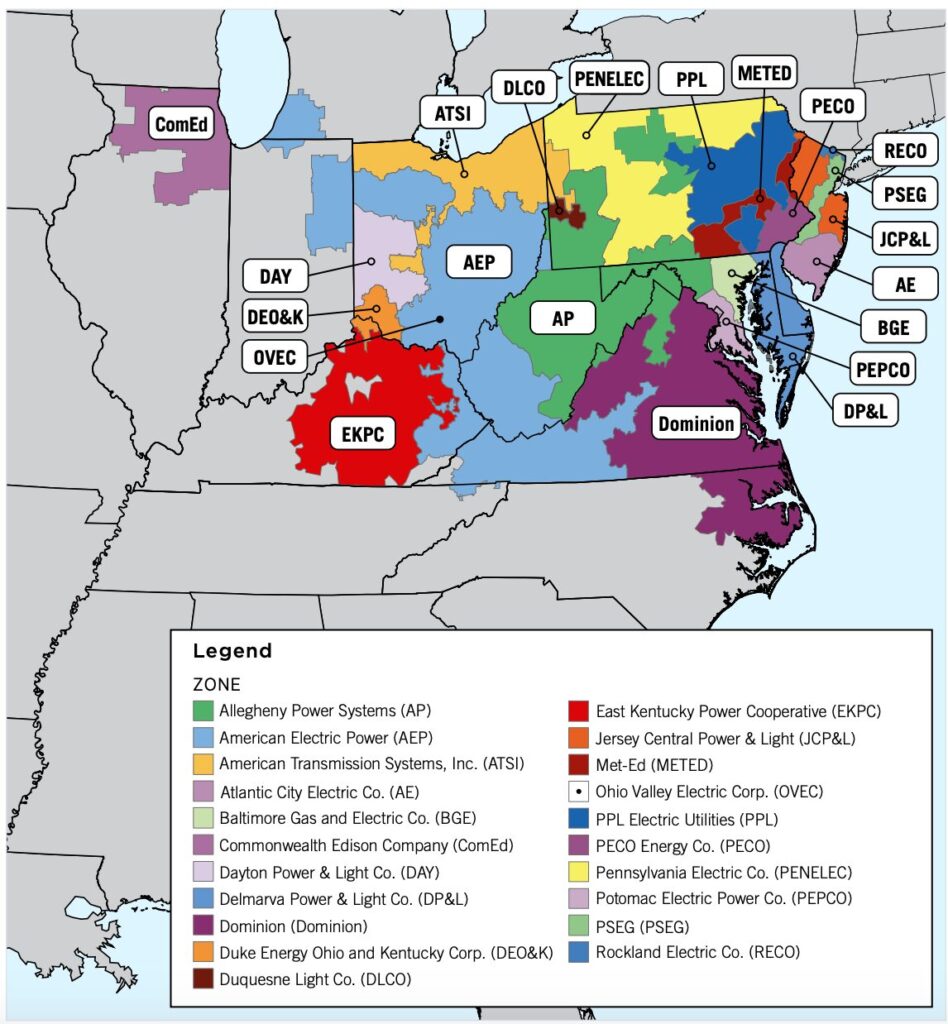
PJM Interconnection is the largest grid operator in the United States, covering all or parts of 13 states and the District of Columbia. The organization, acknowledging that data center expansion is pushing the grid into unprecedented territory, has held stakeholder meetings across its region to highlight its deepening concern and look at possible solutions, but it has failed to come up with a workable answer on its own.
Then, on Dec. 18, FERC acted, issuing an order that PJM “establish transparent rules to facilitate service of AI-driven data centers and other large loads co-located with generating facilities.”
With tough language, the commission said that PJM’s current tariff “is unjust and unreasonable due to a lack of clarity and consistency in the rates, terms, and conditions for generators who wish to serve co-located load and for the transmission customers who would take transmission service on behalf of these co-located loads.”
Specifically, said an analysis of the ruling by the law firm Baker Botts, FERC directed “PJM to offer new types of transmission service based on a large load’s net withdrawals from the system, as opposed to requiring co-located loads to be served by traditional front-of-the-meter network transmission service. These new transmission service options…will reduce the scope of required transmission upgrades thereby allowing co-location arrangements to more quickly interconnect to the grid.”
The commission also directed PJM “to adopt a new interim service that would allow co-location arrangements to access the PJM grid (subject to curtailment) while the transmission upgrades needed to accommodate network service are under construction.”
Utility Dive quoted officials with Capstone, a research firm, as stating:
We view this order as a strong signal of FERC’s position on the data center vs. affordability narrative, with the commission, rather than impeding AI development, likely to focus on avenues for relief for rising electricity costs, such as changes to capacity accreditation, fast-tracking new, high-capacity resources, and transferring costs from load to renewable generators.
In other words, FERC is telling PJM: You have to provide the power to keep AI moving ahead, but you also have to find ways to keep a lid on utility bills, which rose 6.9% year on year in the U.S. through November. The way to do that is to put responsibility on new customers whose large load requirements will burden the system.
These large loads are at the core of the problem faced by PJM and other grid operators. As an example, Constellation Energy and Microsoft announced a deal in September for the technology company to buy the entire 835–megawatt (MW) output of the Three Mile Island Unit 1 nuclear facility in Pennsylvania, an independent facility not affected by the 1979 accident that shut down Unit 2. Five years ago, Unit 1 was decommissioned for economic reasons.
A year ago, FERC rejected an amended interconnection service agreement that would have facilitated expanded power sales to a collocated Amazon data center from the 2,475 MW a Pennsylvania nuclear power plant majority-owned by Talen Energy. Three months later, FERC launched a review of issues related to collocating large loads at power plants in PJM’s footprint.
The FERC ruling on Dec. 18 drew positive responses from independent power producers. For example, Todd Snitchler, CEO of the Electric Power Supply Association (EPSA), issued a press release stating, “Today’s order from FERC addressing large loads and colocation is a welcome step toward addressing this important issue impacting the electric grid. We welcome FERC’s action to find innovative solutions to new challenges to the system.” Snitchler added:
The optionality that the commission laid out at the open meeting is helpful in recognizing the variety of co-location approaches that may be utilized to meet the moment. Clearly, this is the first step in a process that will require quick action and durable consensus from many stakeholders and highlights the urgency in getting solutions onto the system, and for that we applaud FERC’s approach.
Snitchler pointed out that “in April 2025, EPSA urged FERC to direct PJM to revise its tariff to provide clear, workable rules for co-located load arrangements and to move swiftly to resolve that uncertainty based on the extensive record in these PJM proceedings.” Now, FERC, under new leadership, has done just that.
In its comments, EPSA called on FERC to require PJM to work with “stakeholders on expedited tariff revisions that remove barriers to co-location while maintaining reliability and adhering to cost-causation principles.”
PJM has been under pressure to come up with a solution to rising demand, and its December capacity auction, which occurred just before FERC issued its ruling, was only the latest event spurring change.
Prices for back-up power “reached $333.44 a megawatt-day,” reported Reuters, which quoted Stu Bresler, who becomes PJM’s chief operating officer next month, as saying that there is “no doubt that data centers’ demand for electricity continues to far outstrip new supply, and the solution will require concerted action involving PJM, its stakeholders, state and federal partners, and the data center industry itself.”
Reuters noted that “the expansion of Big Tech’s data centers has driven up so-called capacity prices in PJM by about 1,000% over a roughly two-year period.” Even at record-high prices, the auction failed to meet the reliability target.
The struggle to meet rising demand also involves state policies that critics say have stifled supply. We reported in our Newsletter No. 54 that a group of “Republican legislators from across the Mid-Atlantic region gathered in Harrisburg, Pennsylvania in October to discuss how to keep a lid on rising utility bills and improve grid reliability in the face of…stultifying regulations and policies that aim to reduce greenhouse gas emissions but present obstacles to boosting needed power.”
We also noted that “policymakers in some Mid-Atlantic states have taken measures that critics say are counter-productive to solving the electricity crisis – but, in the face of rising utility bills, they are changing their positions.”
We pointed to the actions of Pennsylvania Gov. Josh Shapiro, a Democrat, whose administration agreed to withdraw from the Regional Greenhouse Gas Initiative (RGGI), a cap-and-trade program for power plant emissions that Shapiro’s predecessor joined by executive order in 2019. Shapiro’s decision was part of a general budget agreement. Republicans said the change would “unleash the promise of Pennsylvania” through the development of its natural gas resources.
“We had neither certainty or stability, and I truly believe that because of our regulatory climate here in Pennsylvania, we were continuing to lose energy development and the family sustaining jobs that go with it to our neighboring states,” State House Republican Leader Jesse Topper said.
In its decision, FERC summed up the issue:
As technology leaps forward, clear and fair regulations must keep pace to support advancement, help prevent price volatility, and promote competition, ultimately benefiting consumers by keeping electricity costs manageable.
Without acting swiftly, PJM faces a decade of constrained growth, higher prices, and rising reliability risks. The U.S. cannot meet demand driven by AI and manufacturing modernization unless the nation adopts a process that brings the grid and the regulatory and permitting process into the 21st Century.
As Wetlands Oil Production Case Goes to the Supreme Court, Louisiana’s Republican Governor Opposes Trump Administration
The Supreme Court will hear oral arguments on Jan. 12 in an important energy and environment case we have been following in this newsletter. Chevron, et al. v. Plaquemines Parish, La., et al. “centers on the fossil fuel industry’s effort to move a swath of lawsuits against it from state to federal court, where energy companies believe they are more likely to prevail,” reported E&E News on Dec. 15.
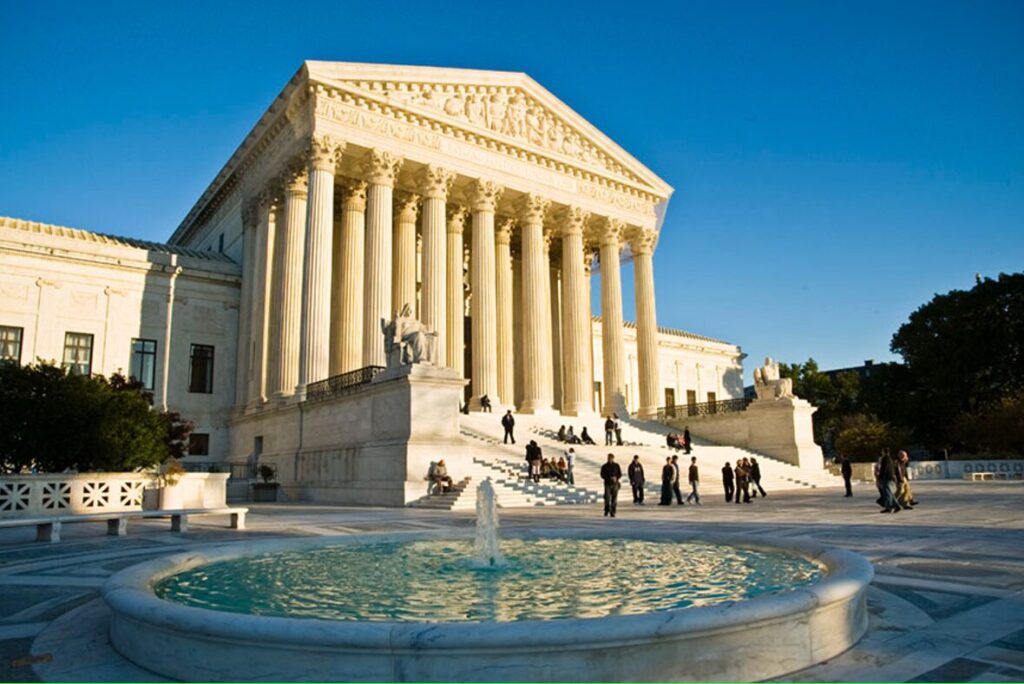
The Trump Administration is backing Chevron and has been granted 10 minutes to make its case along with 20 minutes for the oil and gas companies. The federal government has argued the companies’ request to transfer the cases under the federal officer removal statute is appropriate and the federal government ‘has a substantial interest in the proper interpretation of that statute,’” said E&E.
Dr. Wayne Winegarden of the Pacific Research Institute – which sponsors this newsletter – called attention to this lawfare in a Forbes column on April 1. He noted, “Holding private companies liable for actions that were approved by the state and federal governments is a terrible policy. The long history of both the federal and state governments supporting the oil development activities is also material.”
A Dec. 12 opinion piece in the New Orleans Times Picayune by James K. Glassman, a former senior fellow at the American Enterprise Institute, criticized Louisiana Gov. Jeff Landry, a Republican, for supporting Plaquemines and other parishes (akin to counties). “The lawsuits,” wrote Glassman, “run directly counter to Donald Trump’s energy goals” and will discourage future investment in critical fossil fuels in the state.
In a brief filed in November, the state of Louisiana, with Plaquemines and Cameron parishes, argued that Chevron and other companies “have no grounds to move lawsuits against them to federal court because local communities have raised claims against them under a state coastal protection law,” reported Politico’s EnergyWire.
The energy companies, on the other hand, say that the case deserves to be removed from state court because they engaged in production in Louisiana at the behest of the federal government.
The 43 lawsuits originally filed by Louisiana jurisdictions contend that the energy business is responsible for land loss and erosion in the state’s wetlands over more than 80 years. In April, the first of the cases reached a jury verdict in Plaquemines Parish with a judgment against Chevron of $745 million. The decision, reported the Associated Press, “could set a precedent leaving other oil and gas firms on the hook for billions of dollars in damages.”
Glassman wrote:
Chevron didn’t deny that land eroded but said that nothing it did was illegal. The regulation in question went into effect in 1980 and did not apply to oil and gas activity before then, Chevron argued. The energy companies say the U.S. government directed them to produce petroleum at practically any cost to help win World War II.
Wrote Glassman: “Gov. Landry and his friends in parish governments and local law firms are creating a hostile climate that will discourage the state’s remaining private-sector growth engine from making new investments.”
NY State ‘Faces an Era of Profound Reliability Challenges’ From Rising Demand and Retiring Plants
In its Comprehensive Reliability Plan (CRP) covering the 10 years from 2025 to 2034 and issued on Nov. 21, the New York Independent System Operator (NYISO) found that “the state’s electric system faces an era of profound reliability challenges as resource retirement accelerate, economic development drives demand growth, and project delays undermine confidence in future supply.” NYISO added:
The grid is at an inflection point, driven by the convergence of three structural trends: the aging of the existing generation fleet, the rapid growth of large loads, and the increasing difficulty of developing new dispatchable resources.
These trends are not isolated, they are compounding. As older conventional plants deactivate, the system loses firm capacity and operational flexibility. At the same time, new demand from data centers, industrial facilities, and electrification is accelerating, placing additional stress on the grid. Meanwhile, the development of new reliable resources is not keeping pace due to permitting challenges, supply chain constraints, and policy uncertainty.
The NYISO plan paints a clear picture of the strain facing New York’s electric grid. “The surge in large semiconductor manufacturing plants and data center projects is reshaping the demand outlook,” said the DRP. It noted that at the end of 2024, the NYISO interconnection queue included roughly 4,000 MW of large load projects. By September 2025, that figure had risen to 10,000 MW, with upstate New York especially affected.
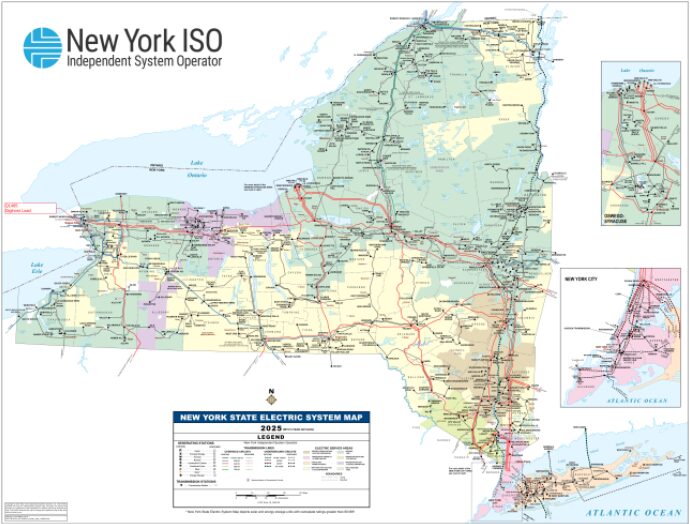
At the same time, New York’s thermal fleet continues to age. “Roughly 25% of the state’s total generating capacity is fossil-fuel-based generation that has been in operation for more than 50 years, well beyond the age at which similar units have been deactivated across the country,” said the CRP. New dispatchable resources, particularly natural-gas-fired generation, are not being added fast enough.
Said NYISO senior vice president Zach Smith: “The system requires additional dispatchable generation to serve forecasted increases in consumer demand. We also need to refine and evolve our planning processes to better reflect this period of great change on the grid and a broader range of plausible future outcomes.”
As Daily Energy Insider pointed out on Nov. 25, Because of the “emerging reliability challenges, traditional planning methods built around a single forecast are no longer sufficient. To maintain system reliability and protect public safety, the CRP recommends actions and investments needed to strengthen planning processes across a spectrum of system conditions.”
The good news, as our Newsletter No. 54 reported, is that New York and New Jersey recently approved a new natural gas pipeline that will bring more fuel into New York City just as new warning lights were flashing about the reliability and affordability of electricity in the state.
The Williams Cos. project will “run 24 miles from New Jersey, across the Raritan Bay, to connect to the pipeline system in the Rockaways.”
New York’s reliability warnings reinforce a key reality: replacing retiring thermal assets with renewables jeopardizes reliability. To maintain public safety and economic competitiveness, the state cannot avoid new, flexible natural-gas generation — and the permitting reform that makes it possible to site and build those facilities before the reliability gap becomes unmanageable.
Prolonged Cold Snaps Will Put Much of America at Elevated Risk for Insufficient Energy Supplies, NERC Concludes
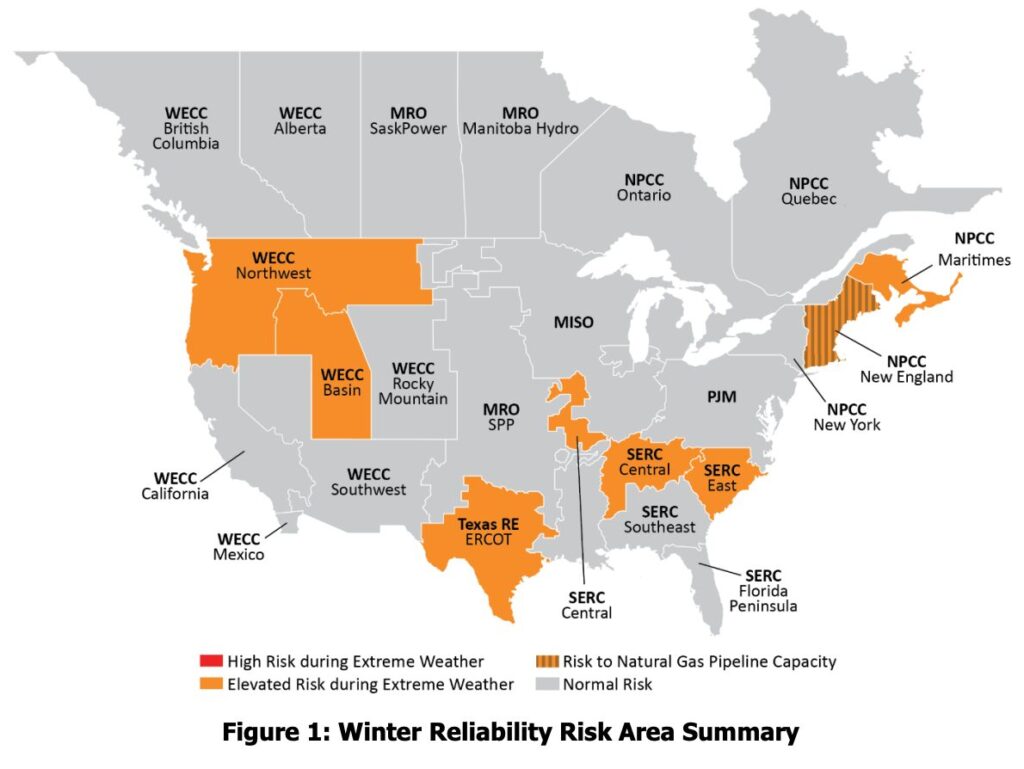
The Winter Reliability Assessment (WRA) issued recently by NERC found that “much of North America is again at an elevated risk of having insufficient energy supplies to meet demand in extreme operating conditions.”
The North American Electric Reliability Corp., a non-profit whose mission is to “assure the effective and efficient reduction of risks to the reliability and security of the grid,” concluded in the WRA, released on Nov. 18:
Although resources are adequate for normal winter peak demand, any prolonged, wide-area cold snaps will be challenging. This is largely due to rising electricity demand, which has grown by 20 GW since last winter, significantly outpacing winter on-peak capacity. This, coupled with the changing resource mix, is affecting the winter outlook.
Extreme winter conditions, as in 2021, “can topple forecasts by as much as 25%,” said John Moura, NERC’s director of Reliability Assessments and Performance Analysis. “This latest assessment highlights progress on cold weather readiness but underscores that more work remains to ensure energy and fuel supplies can be reliably delivered even during the harshest conditions.”
The map below shows areas with elevated risk in orange.
Gas-fired generators remain vulnerable to cold weather stresses, but at the same time, gas remains the essential marginal winter fuel, as NERC’s Mark Olson noted:
Natural gas is an essential fuel for electricity generation in winter. Winter fuel supplies for thermal generators must be readily available during the periods of high demand for both electricity and natural gas that accompany extreme cold weather. Although we are seeing evidence of improved performance, grid operators in areas that rely on single-fuel gas-fired generators are exposed to unanticipated generator loss during cold snaps when gas supply interruptions are more prevalent.
What can we do about the NERC winter warnings? The assessment calls for improved fuel assurance, load forecasting, cold-weather readiness, and regulatory flexibility during emergencies.
“Reliability Coordinators (RC), Balancing Authorities (BA), and Transmission Operators (TOP) in the elevated risk areas should review seasonal operating plans and protocols for communicating and resolving potential supply shortfalls in anticipation of potentially high generator outages and extreme demand levels.,” NERC advised.
The organization also called for RCs and BAs to “implement generator fuel surveys to monitor the adequacy of fuel supplies. They should prepare their operating plans to manage potential supply shortfalls and take proactive steps for generator readiness, fuel availability, load curtailment, and sustained operations in extreme conditions.”
In states and Canadian provinces, NERC also recommended:
Regulators can assist grid owners and operators in advance of and during extreme cold weather by maintaining awareness of BA, natural gas pipeline, and gas local distribution company operational public announcements and notices, amplifying public appeals for electricity and natural gas conservation, and supporting requested environmental and transportation waivers.
Todd Snitchler, the CEO of EPSA, pointed out that competitive energy suppliers are trying to build new natural gas, nuclear, storage, and renewable resources—but are constrained by regulatory and permitting bottlenecks. “To bring these projects online quickly, we need permitting reform, predictable market rules, and policies that support private investment.”
NERC’s warnings make clear that the fundamental threat to reliability is not so much a lack of engineering readiness. Instead, the danger is a lack of new dispatchable capacity, particularly natural gas — combined with fuel infrastructure constraints that only permitting reform can solve. Without unlocking pipeline and generation development, winter risks will escalate as electrification and data center loads continue outpacing supply additions.
Better Coordination Between Natural Gas and Electricity Is Needed, Advises a Blue-Ribbon Petroleum Council
Earlier this month, the National Petroleum Council (NPC), the U.S. Department of Energy’s advisory group, released a groundbreaking report titled, Reliable Energy: Delivering on the Promise of Gas-Electric Coordination, evaluating how rising natural gas and electricity demand, combined with shifting usage patterns, is straining natural gas pipelines in key regions of the United States. The council made recommendations to federal regulators, as well, and called for action on permitting reform.
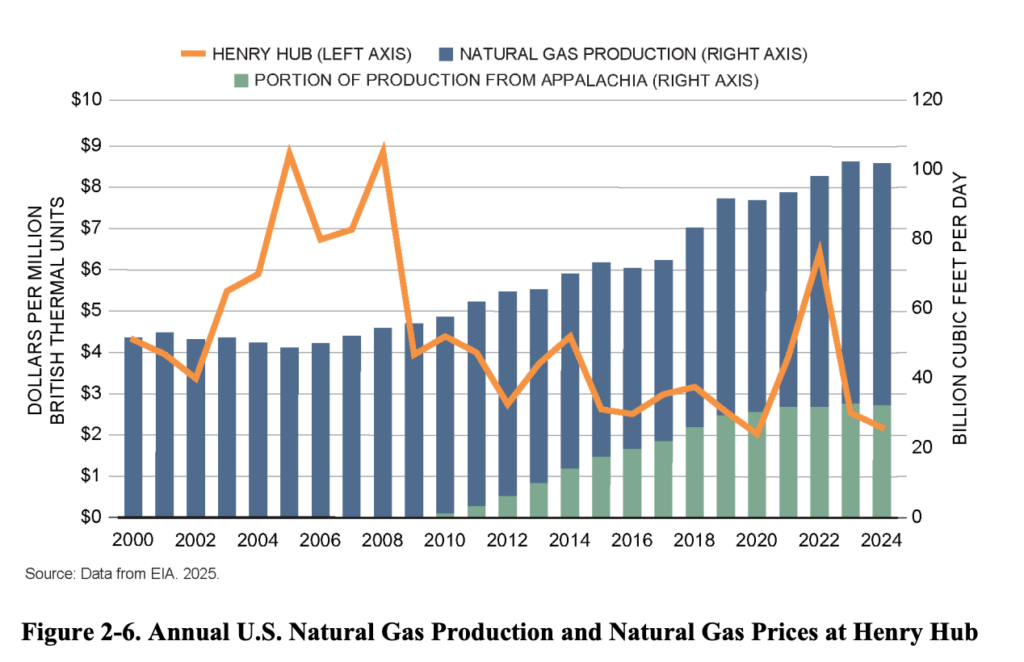
The graphic below shows how natural gas use in producing electricity has nearly doubled from 2010 to 2024.
The NPC, established in 1946, is a large committee composed of leaders from the petroleum industry, utilities and academia, as well as other stakeholders. It completed its report at the request of U.S. Secretary of Energy Chris Wright as part of a broader examination of “Future Energy Systems.” The goal was to advance President Trump’s agenda to unleash American energy, accelerate infrastructure build-out, and ensure affordable, reliable and secure energy for American families.
The report found that “the natural gas and electric systems both face reliability risks
today. Neither industry—nor their customers—can afford to wait. Strengthening the system before the next crisis, not after it, is the mark of prudent risk management.”
The report made 10 recommendations:
- Embrace Comprehensive Long-Term Planning
- Reform Permitting
- Construct New Fit-for-Purpose Infrastructure
- Enhance and Expand Existing Infrastructure
- Reform Market Compensation Models
- Implement an Accountability Framework
- Expand Pipeline Service Offerings
- Clearly Identify Roles and Responsibilities
- Utilize Existing Entities to Improve Leading Practices
- Reform Performance Metrics
Among the highlights was to urge Congress, federal agencies, and industries to reform permitting and build new, suitable energy infrastructure, while also improving and expanding existing infrastructure.
The group also called for improving market and regulatory frameworks through a Natural Gas Readiness Forum — along with long-term planning by FERC, regional transmission organizations (RTOs) and independent system operators (ISOs) and new pricing structures to handle changing gas flow patterns.
Also, the NPC recommended insuring gas-fired power generators are compensated for reliability, establishing a “best efforts” accountability framework for independent power producers, and improving RTO/ISO performance metrics.
“For years, the Biden Administration advanced policies that made it harder to produce American energy,” said Wright in a Dec. 3 press release. “The National Petroleum Council’s findings confirm what President Trump has said from day one: America needs more energy infrastructure, less red tape, and serious permitting reform. These recommendations will help make energy more affordable for every American household.”
DOE’s Assistant Secretary for Hydrocarbons and Geothermal Energy, Kyle Haustveit, stated:
The studies represent a significant collaborative effort to tackle some of the most complex challenges in our energy infrastructure. The National Petroleum Council recommendations will be instrumental in guiding the Department’s strategies for enhancing grid reliability and streamlining the development of essential energy projects.
The Natural Gas Council (NGC) and the Reliability Alliance together voiced support for the recommendations: “These reports, as well as the recently released National Association of Regulatory Utility Commissioners (NARUC) Gas-Electric Alignment for Reliability (GEAR) final report, make clear [that] we need market reforms to facilitate investment in fit-for-purpose infrastructure, and permitting reform to keep up with growing demand while keeping the lights on and homes warm.”
The work ahead Is not simple. As the report says, “Achieving true gas-electric coordination will require more than operational adjustments. It demands structural alignment of incentives, planning processes, and accountability frameworks…. Healthy alignment will depend on balancing market efficiency with reliability obligations and recognizing that neither sector can achieve resilience in isolation.”
Despite Abundant Hydropower, Washington State Faces Electricity Shortfalls Ahead
In Washington state, a legislator is sounding an alarm that has become increasingly urgent. Citing a recent report by the Energy and Environmental Economics (E3) consulting firm, State Sen. Matt Boehnke says he is concerned that the Northwest will face a 1,300 MW shortfall next year and an 8,700 MW shortfall by 2030. The latter figure is equivalent to the entire electric load of Oregon.
Boehnke, the senior Republican on the Environment, Energy, and Technology Committee, cites “factors such as the state’s push toward clean energy, new data centers and the shuttering of coal plants,” said a Dec. 4 article in The Olympian, a state newspaper. Boehnke told reporters he was particularly disturbed by the E3 analysis, presented at a joint meeting of the Washington State Department of Commerce and the Utilities and Transportation Commission in September.
The deficit that concerns Boehnke emerges as the Northwest continues retiring coal plants, restricting new natural-gas development, and experiencing rising winter peak demand. NERC’s recent assessment confirms the Northwest faces a 9.3% increase in winter peak demand this year, with elevated risk during extreme cold events.
Since 2019, Puget Sound Energy has added more than 2,600 megawatts of new solar, wind and battery storage capacity, said spokesperson Melanie Coon, quoted by The Olympian. She said more capacity is expected the years ahead to meet the state’s “ambitious clean energy laws.”
“The region will also need natural gas as a critical backstop for reliability when the wind isn’t blowing or the sun isn’t shining,” she added. “These are peaking plants — they are intended to run only for a short period to meet customer demand when it spikes, such as a cold winter day.”
Clean-energy mandates, however, restrict new firm capacity additions, even as the state is“going all in on AI,” reported The Olympian. “But the power-hungry data centers needed to fuel the technology have raised questions about resource strain and the cost to ratepayers.”
The state’s policy direction compounds the reliability challenge. Clean-energy mandates restrict new capacity additions from fossil-fuel generation. Major utilities have found that renewable resources cannot provide the certainty needed in winter, when hydropower output is low and weather conditions suppress wind and solar generation.
The office of Washington’s Democratic Governor, Bob Ferguson, told the newspaper that he is dedicated to ensuring energy reliability. A spokesperson said, “This is one of the most urgent issues facing our state. Our team is working with tribes, stakeholders and legislators to help support this mission in a way that works for Washington.”
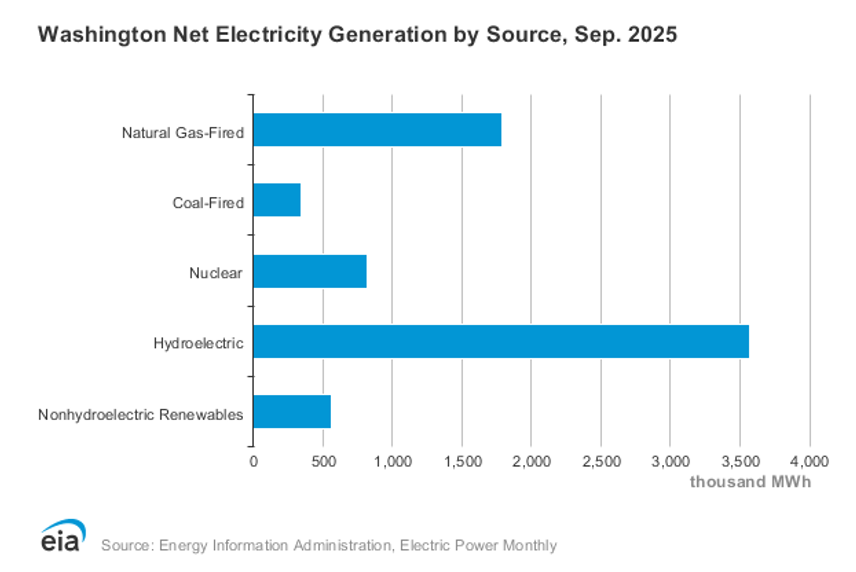
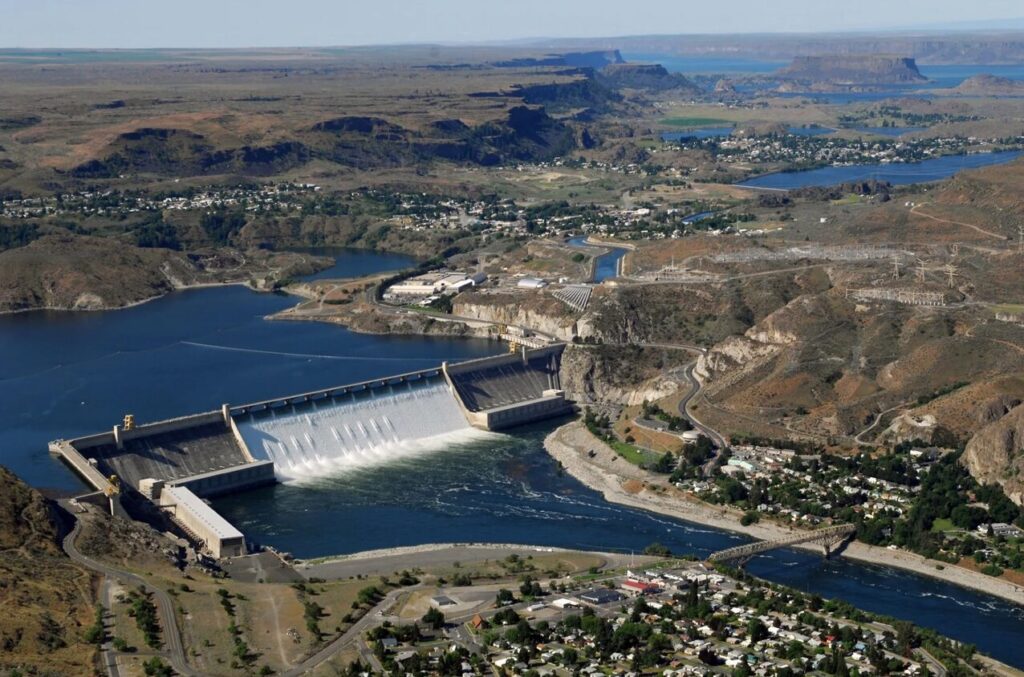
Washington generates more electricity from hydropower than any other state, according to the U.S. Energy Information Administration. Thanks to the Grand Coulee Dam, the largest power plant in the U.S., Washington “accounted for 25% of the nation’s total utility hydroelectric generation in 2024.”
Without reliable, affordable and dispatchable natural gas and the ability to get permits on a timely basis for new infrastructure, even a state like Washington, which gets half its electricity from hydro, will face reliability shortfalls. The Northwest’s path forward has to include new gas capacity and streamlined regulations, or the region risks chronic exposure to blackout conditions.